

Beef, brisket, flat half, separable lean and fat, trimmed to 1/8" fat, select, raw
Whole food · Beef Products
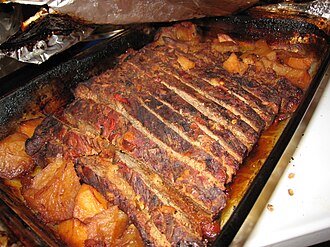
Photo: Wikipedia
Beef brisket flat half is a lean, well-marbled cut from the lower chest of the cow, prized for its deep beefy flavor and a texture that transforms from tough to meltingly tender with slow cooking. Nutritionally, it's a powerhouse of protein and healthy fats, with virtually no carbohydrates, making it a staple for low-carb and high-protein diets.
Calorie split: 26% protein · 0% carbs · 74% fat
↓ Full nutrition💚 Why it's loved
People adore brisket for its incredible flavor depth and versatility—it's the star of slow-smoked barbecue, hearty braises, and comforting stews. Its ability to absorb rubs, marinades, and sauces makes it a canvas for culinary creativity across many cultures.
⚠️ Watch-outs & how to enjoy it better
The high saturated fat content means it should be enjoyed in moderation, especially for those managing cholesterol or heart health. Its toughness requires long, slow cooking methods; rushing it with high heat will result in a chewy, disappointing meal. To counteract, trim excess external fat before cooking and pair it with fiber-rich sides like roasted vegetables or a vinegar-based slaw to balance the meal.
Key benefits
- Excellent source of high-quality protein for muscle maintenance and repair.
- Rich in bioavailable iron, crucial for oxygen transport and energy levels.
- Provides significant amounts of zinc, supporting immune function.
- Contains B vitamins, especially B12, essential for nerve health and red blood cell formation.
- A good source of conjugated linoleic acid (CLA), a type of beneficial fat.
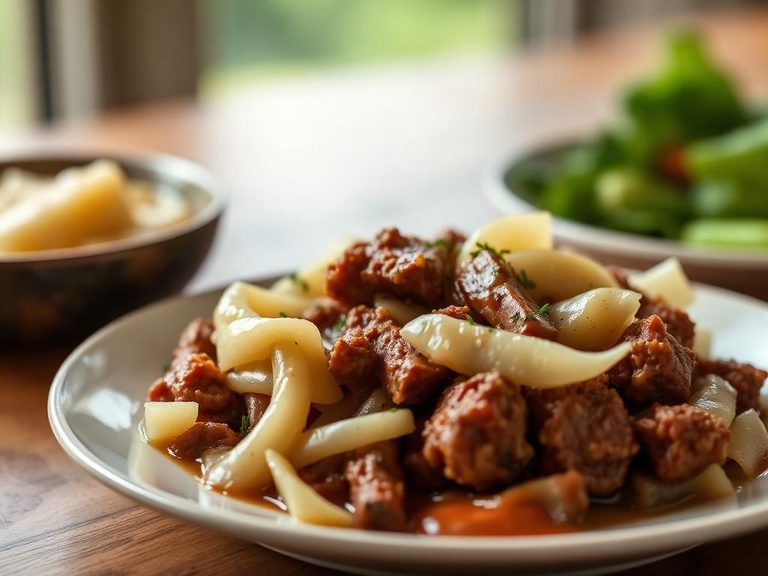
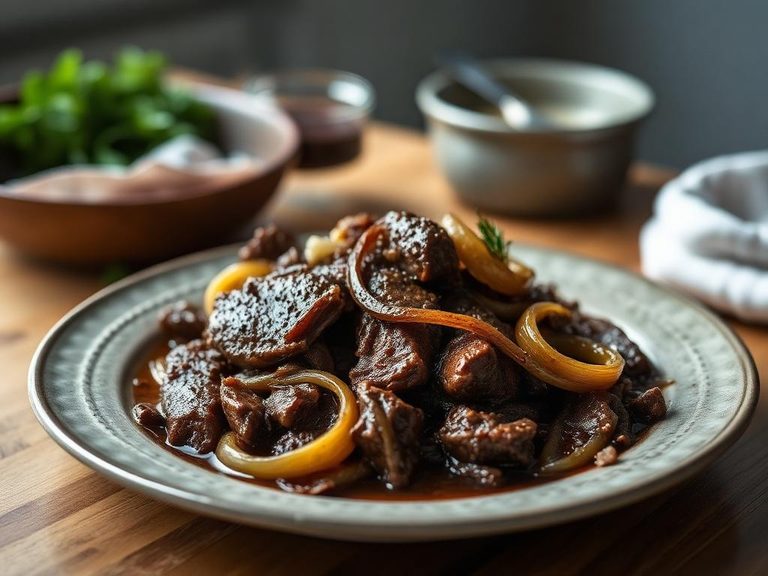
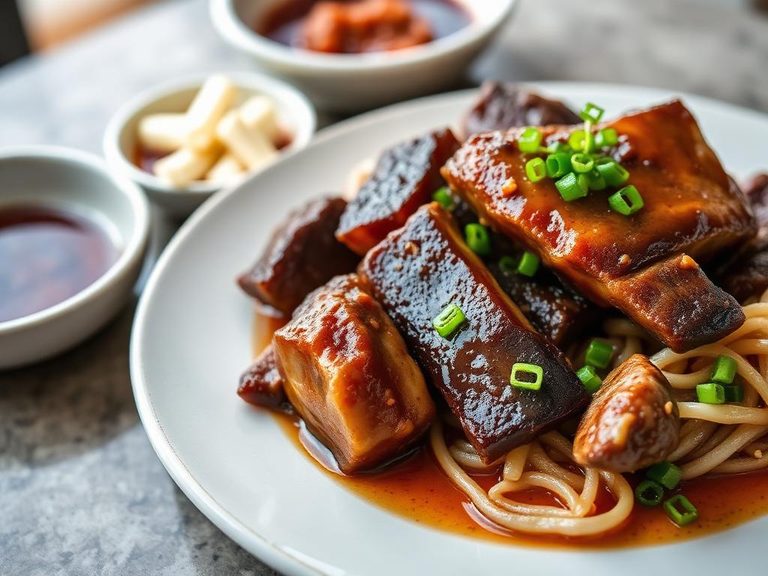
🍽️ Popular dishes


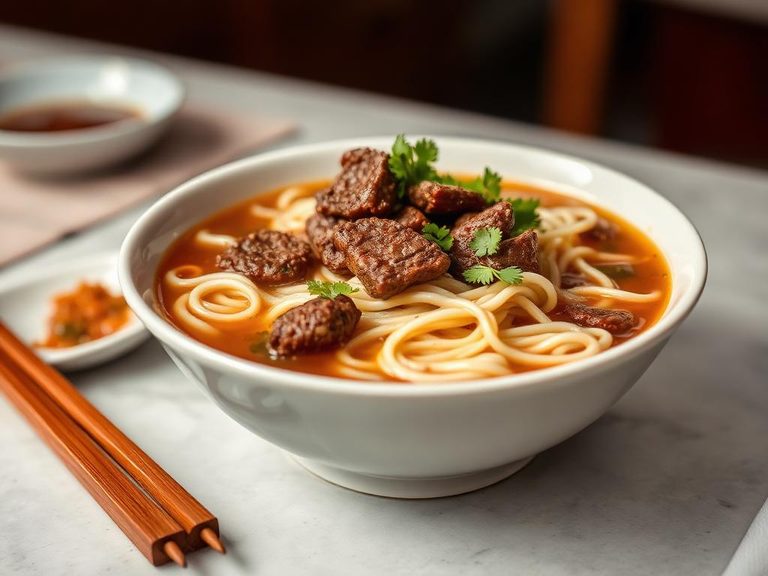
🌍 Where it's eaten
💡 Did you know?
The word 'brisket' comes from the Middle English 'brusket,' which itself comes from the Old Norse 'brjósk,' meaning cartilage, referring to the cut's location near the cartilage of the breastbone.
Full nutrition (USDA data · scales with serving)
| Water | 59.3 g |
| Energy | 276 kcal |
| Energy | 1156 kj |
| Protein | 17.8 g |
| Total lipid (fat) | 22.2 g |
| Ash | 0.80 g |
| Carbohydrate, by difference | 0.00 g |
| Fiber, total dietary | 0.00 g |
| Total Sugars | 0.00 g |
| Calcium, Ca | 17.0 mg |
| Iron, Fe | 1.5 mg |
| Magnesium, Mg | 18.0 mg |
| Phosphorus, P | 164 mg |
| Potassium, K | 271 mg |
| Sodium, Na | 58.0 mg |
| Zinc, Zn | 4.2 mg |
| Copper, Cu | 0.07 mg |
| Manganese, Mn | 0.01 mg |
| Selenium, Se | 19.4 ug |
| Vitamin C, total ascorbic acid | 0.00 mg |
| Thiamin | 0.07 mg |
| Riboflavin | 0.12 mg |
| Niacin | 4.0 mg |
| Pantothenic acid | 0.50 mg |
| Vitamin B-6 | 0.45 mg |
| Folate, total | 9.0 ug |
| Folic acid | 0.00 ug |
| Folate, food | 9.0 ug |
| Folate, DFE | 9.0 ug |
| Choline, total | 74.2 mg |
| Betaine | 10.9 mg |
| Vitamin B-12 | 1.4 ug |
| Vitamin B-12, added | 0.00 ug |
| Vitamin A, RAE | 0.00 ug |
| Retinol | 0.00 ug |
| Carotene, beta | 0.00 ug |
| Carotene, alpha | 0.00 ug |
| Cryptoxanthin, beta | 0.00 ug |
| Vitamin A, IU | 0.00 iu |
| Lycopene | 0.00 ug |
| Lutein + zeaxanthin | 0.00 ug |
| Vitamin E (alpha-tocopherol) | 0.43 mg |
| Vitamin E, added | 0.00 mg |
| Tocopherol, beta | 0.00 mg |
| Tocopherol, gamma | 0.00 mg |
| Tocopherol, delta | 0.00 mg |
| Vitamin K (phylloquinone) | 1.7 ug |
| Alcohol, ethyl | 0.00 g |
| Caffeine | 0.00 mg |
| Theobromine | 0.00 mg |
Fat & fatty acid profile (per 100g)
| Fatty acids, total saturated | 9.0 g |
| SFA 4:0 | 0.00 g |
| SFA 6:0 | 0.00 g |
| SFA 8:0 | 0.00 g |
| SFA 10:0 | 0.07 g |
| SFA 12:0 | 0.05 g |
| SFA 14:0 | 0.70 g |
| SFA 16:0 | 5.4 g |
| SFA 18:0 | 2.7 g |
| Fatty acids, total monounsaturated | 9.5 g |
| MUFA 16:1 | 1.1 g |
| MUFA 18:1 | 8.4 g |
| MUFA 20:1 | 0.03 g |
| MUFA 22:1 | 0.00 g |
| Fatty acids, total polyunsaturated | 0.84 g |
| PUFA 18:2 | 0.54 g |
| PUFA 18:3 | 0.27 g |
| PUFA 18:4 | 0.00 g |
| PUFA 20:4 | 0.04 g |
| PUFA 20:5 n-3 (EPA) | 0.00 g |
| PUFA 22:5 n-3 (DPA) | 0.00 g |
| PUFA 22:6 n-3 (DHA) | 0.00 g |
| Cholesterol | 94.0 mg |
Amino acid profile (per 100g)
| Tryptophan | 0.12 g |
| Threonine | 0.71 g |
| Isoleucine | 0.81 g |
| Leucine | 1.4 g |
| Lysine | 1.5 g |
| Methionine | 0.46 g |
| Cystine | 0.23 g |
| Phenylalanine | 0.70 g |
| Tyrosine | 0.57 g |
| Valine | 0.88 g |
| Arginine | 1.1 g |
| Histidine | 0.57 g |
| Alanine | 1.1 g |
| Aspartic acid | 1.6 g |
| Glutamic acid | 2.7 g |
| Glycine | 1.1 g |
| Proline | 0.85 g |
| Serine | 0.70 g |
| Hydroxyproline | 0.19 g |
FAQ
What's the difference between the flat and point cuts of brisket?
The flat half is leaner, more uniform in shape, and slices neatly, making it ideal for presentation. The point half (also called the 'deckle') is fattier, thicker, and more marbled, which makes it exceptionally flavorful and forgiving for slow cooking, often used for burnt ends.
Why is my brisket always tough?
Brisket is a hard-working muscle full of connective tissue (collagen). If cooked too quickly or at too low a temperature, the collagen won't break down into gelatin. The key is low-and-slow cooking (around 225-275°F / 107-135°C) until the internal temperature reaches about 203°F (95°C), where the tissue fully melts.
Is brisket a healthy choice?
It's a nutrient-dense food, high in protein, iron, and B vitamins. However, it's also high in saturated fat. For a healthier preparation, consider trimming all visible fat before cooking, using moist-heat methods like braising where excess fat can be skimmed, and controlling portion sizes.
Nutrient density (calculated · NRF9.3)
Nutrient Rich Foods index: beneficial nutrients (protein, fiber, vitamins, minerals) minus saturated fat, added sugar & sodium, per 100 kcal.
NRF9.3 index — Fulgoni, Keast & Drewnowski, 2009. Computed from USDA nutrients.
Weight-loss friendliness (composite index)
Energy density 2.76 kcal/g · 26% calories from protein · 0.0 g fiber · 0.0 g sugar per 100 g.
Composite of energy density (Rolls et al., 1999), protein & fiber satiety, minus sugar. A calculated heuristic — ranks satiety-per-calorie, not a clinical measure.
Dietary load (calculated from USDA values)
Potential renal acid load. Positive = acid-forming, negative = alkaline-forming.
Sodium-to-potassium ratio: 0.21 (lower is better — aim for ≤ 1)
Sodium:potassium per WHO potassium guidance. Computed from USDA nutrients.