

Yogurt, fruit, lowfat, with low calorie sweetener, fortified with vitamin D
Whole food · Dairy and Egg Products
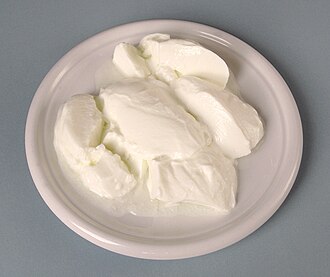
Photo: Wikipedia
This is a smooth, creamy, low-fat fruit yogurt, often strawberry or peach, sweetened with zero-calorie sweeteners like sucralose or stevia. It has a light, tangy base with a fruity sweetness and a pourable to slightly thick texture. Nutritionally, it's a low-calorie, high-protein snack fortified with vitamin D for bone health.
Calorie split: 18% protein · 70% carbs · 12% fat
↓ Full nutrition💚 Why it's loved
People love it for the satisfying combination of creamy texture and fruity flavor without the guilt of high sugar and fat. It's a versatile staple, enjoyed as a quick breakfast, a post-workout snack, or a healthy dessert base.
⚠️ Watch-outs & how to enjoy it better
The primary downside is the use of low-calorie sweeteners, which some people find leaves a lingering aftertaste or may cause digestive discomfort (like bloating) in sensitive individuals. To mitigate, pair it with a source of fiber and healthy fat (like a handful of nuts or seeds) to slow sugar absorption and improve fullness. Also, check the ingredient list for specific sweeteners you tolerate well.
Key benefits
- Excellent source of calcium and vitamin D for bone support
- High in protein (4.86g per 100g) for satiety and muscle maintenance
- Low in fat (1.41g per 100g) and calories (105 kcal per 100g)
- Contains live active cultures for gut health
- Provides a quick, convenient source of energy and nutrients
🍽️ Popular dishes


🌍 Where it's eaten
💡 Did you know?
The fortification with vitamin D is a modern nutritional strategy, as yogurt itself is not a natural source of this vitamin; it's added to help combat widespread vitamin D deficiency, especially in regions with limited sunlight.
Full nutrition (USDA data · scales with serving)
| Water | 74.1 g |
| Energy | 105 kcal |
| Energy | 440 kj |
| Protein | 4.9 g |
| Total lipid (fat) | 1.4 g |
| Ash | 1.0 g |
| Carbohydrate, by difference | 18.6 g |
| Fiber, total dietary | 0.00 g |
| Total Sugars | 2.9 g |
| Calcium, Ca | 152 mg |
| Iron, Fe | 0.07 mg |
| Magnesium, Mg | 16.0 mg |
| Phosphorus, P | 133 mg |
| Potassium, K | 194 mg |
| Sodium, Na | 58.0 mg |
| Zinc, Zn | 0.82 mg |
| Copper, Cu | 0.08 mg |
| Manganese, Mn | 0.07 mg |
| Selenium, Se | 3.1 ug |
| Vitamin C, total ascorbic acid | 0.70 mg |
| Thiamin | 0.04 mg |
| Riboflavin | 0.18 mg |
| Niacin | 0.10 mg |
| Pantothenic acid | 0.54 mg |
| Vitamin B-6 | 0.04 mg |
| Folate, total | 10.0 ug |
| Folic acid | 0.00 ug |
| Folate, food | 10.0 ug |
| Folate, DFE | 10.0 ug |
| Choline, total | 15.2 mg |
| Vitamin B-12 | 0.52 ug |
| Vitamin B-12, added | 0.00 ug |
| Vitamin A, RAE | 131 ug |
| Retinol | 131 ug |
| Carotene, beta | 4.0 ug |
| Carotene, alpha | 0.00 ug |
| Cryptoxanthin, beta | 0.00 ug |
| Vitamin A, IU | 443 iu |
| Lycopene | 0.00 ug |
| Lutein + zeaxanthin | 0.00 ug |
| Vitamin E (alpha-tocopherol) | 0.06 mg |
| Vitamin E, added | 0.00 mg |
| Vitamin D (D2 + D3), International Units | 52.0 iu |
| Vitamin D (D2 + D3) | 1.3 ug |
| Vitamin D3 (cholecalciferol) | 1.3 ug |
| Vitamin K (phylloquinone) | 1.2 ug |
| Alcohol, ethyl | 0.00 g |
| Caffeine | 0.00 mg |
| Theobromine | 0.00 mg |
Fat & fatty acid profile (per 100g)
| Fatty acids, total saturated | 0.91 g |
| SFA 4:0 | 0.04 g |
| SFA 6:0 | 0.03 g |
| SFA 8:0 | 0.02 g |
| SFA 10:0 | 0.04 g |
| SFA 12:0 | 0.05 g |
| SFA 14:0 | 0.15 g |
| SFA 16:0 | 0.38 g |
| SFA 18:0 | 0.14 g |
| Fatty acids, total monounsaturated | 0.39 g |
| MUFA 16:1 | 0.03 g |
| MUFA 18:1 | 0.32 g |
| MUFA 20:1 | 0.00 g |
| MUFA 22:1 | 0.00 g |
| Fatty acids, total polyunsaturated | 0.04 g |
| PUFA 18:2 | 0.03 g |
| PUFA 18:3 | 0.01 g |
| PUFA 18:4 | 0.00 g |
| PUFA 20:4 | 0.00 g |
| PUFA 20:5 n-3 (EPA) | 0.00 g |
| PUFA 22:5 n-3 (DPA) | 0.00 g |
| PUFA 22:6 n-3 (DHA) | 0.00 g |
| Cholesterol | 6.0 mg |
Amino acid profile (per 100g)
| Tryptophan | 0.03 g |
| Threonine | 0.20 g |
| Isoleucine | 0.27 g |
| Leucine | 0.49 g |
| Lysine | 0.44 g |
| Methionine | 0.14 g |
| Cystine | 0.04 g |
| Phenylalanine | 0.27 g |
| Tyrosine | 0.24 g |
| Valine | 0.40 g |
| Arginine | 0.15 g |
| Histidine | 0.12 g |
| Alanine | 0.21 g |
| Aspartic acid | 0.39 g |
| Glutamic acid | 0.95 g |
| Glycine | 0.12 g |
| Proline | 0.58 g |
| Serine | 0.30 g |
FAQ
Is this yogurt good for weight loss?
Yes, it can be. Its high protein and low calorie content help promote fullness, making it a good snack choice to manage hunger. However, overall diet and portion control are key.
Why is it fortified with vitamin D?
Many people, especially in northern latitudes, don't get enough sun exposure for their skin to produce sufficient vitamin D. Fortifying common foods like yogurt is an effective public health measure to support bone and immune health.
Are the low-calorie sweeteners safe?
Approved sweeteners like sucralose, aspartame, or stevia are considered safe for the general population within acceptable daily intake limits set by food safety authorities. Some people may experience mild digestive sensitivity.
Nutrient density (calculated · NRF9.3)
Nutrient Rich Foods index: beneficial nutrients (protein, fiber, vitamins, minerals) minus saturated fat, added sugar & sodium, per 100 kcal.
NRF9.3 index — Fulgoni, Keast & Drewnowski, 2009. Computed from USDA nutrients.
Weight-loss friendliness (composite index)
Energy density 1.05 kcal/g · 19% calories from protein · 0.0 g fiber · 2.9 g sugar per 100 g.
Composite of energy density (Rolls et al., 1999), protein & fiber satiety, minus sugar. A calculated heuristic — ranks satiety-per-calorie, not a clinical measure.
Dietary load (calculated from USDA values)
Potential renal acid load. Positive = acid-forming, negative = alkaline-forming.
Sodium-to-potassium ratio: 0.30 (lower is better — aim for ≤ 1)
Sodium:potassium per WHO potassium guidance. Computed from USDA nutrients.