

Turkey, whole, neck, meat only, raw
Whole food · Poultry Products

Photo: Wikipedia
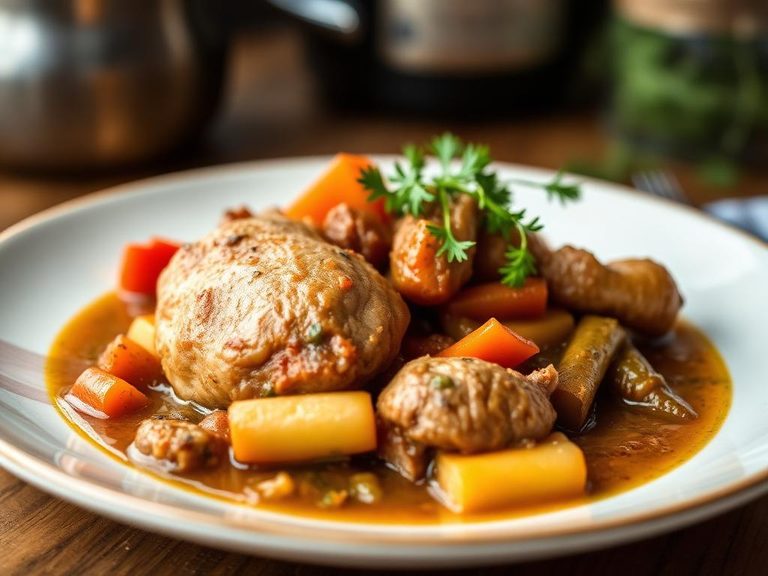
Turkey neck meat is a dark, richly flavored cut from the bird's neck, known for its tender, fall-off-the-bone texture when slow-cooked. It boasts an exceptionally high protein-to-fat ratio, making it a lean powerhouse for muscle maintenance.
Calorie split: 55% protein · 0% carbs · 45% fat
↓ Full nutrition💚 Why it's loved
People adore turkey necks for their deeply savory, umami-rich flavor that intensifies with slow cooking, and their incredible versatility in soups, stews, and braises where they impart profound depth.
⚠️ Watch-outs & how to enjoy it better
The primary caution is the presence of many small bones, which requires careful eating or thorough cooking until meat is tender. For those monitoring sodium, commercial preparations or broths can be high in salt; opt for homemade versions and season at the end.
Key benefits
- Excellent source of high-quality, complete protein
- Very low in carbohydrates and sugars
- Rich in minerals like selenium and phosphorus
- Provides B vitamins, especially niacin (B3)
- Lean cut with minimal saturated fat
🍽️ Popular dishes
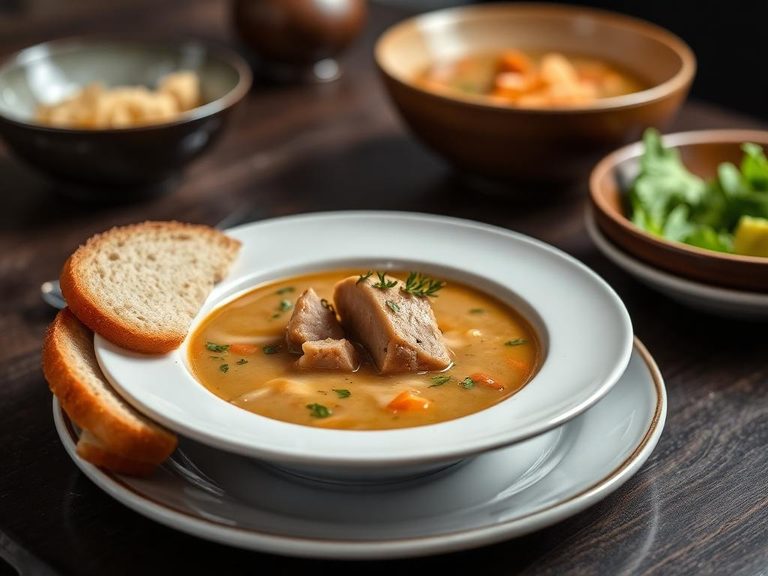
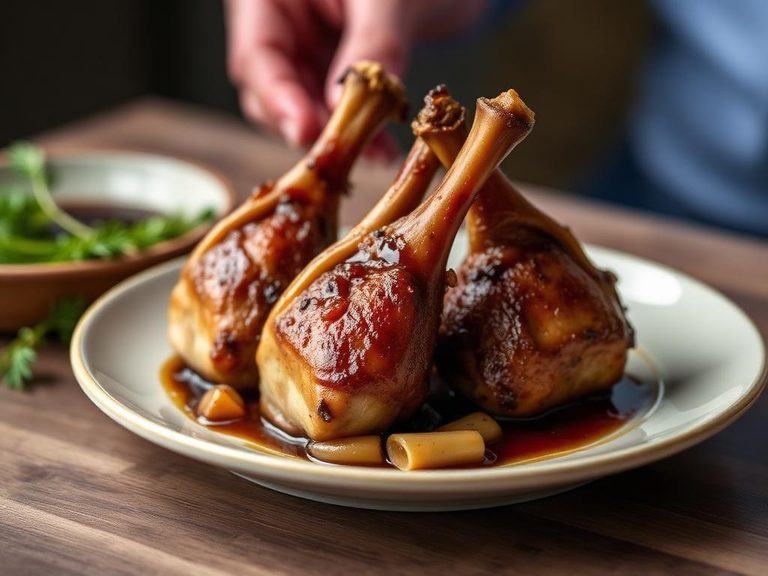
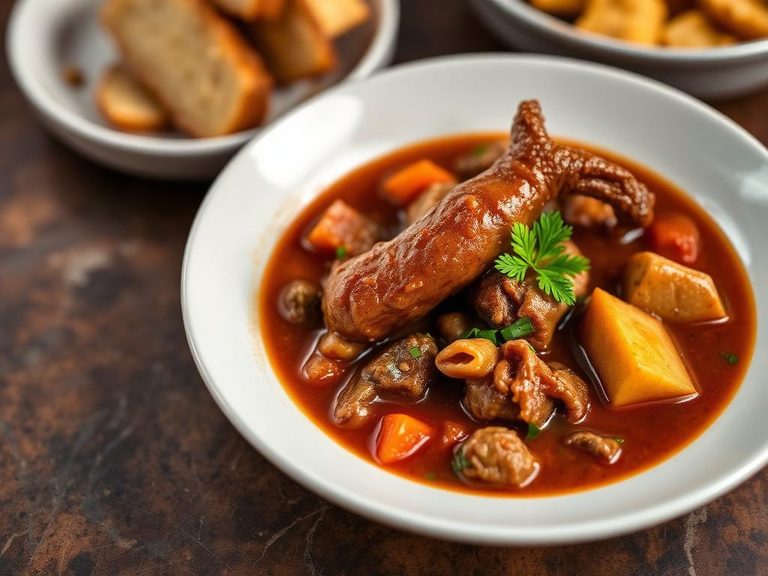
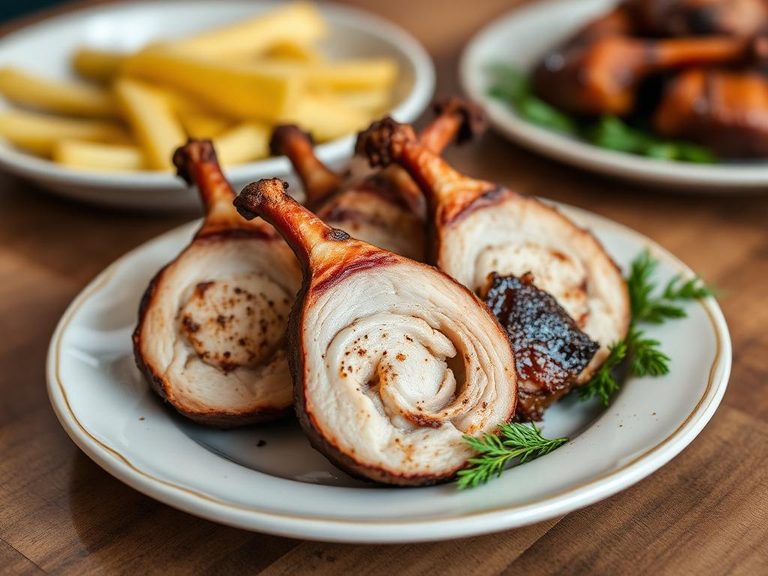
🌍 Where it's eaten
💡 Did you know?
The turkey neck is anatomically unique among poultry, containing a complex series of interlocking vertebrae that give it a distinctive, elongated shape perfect for slow, moist-heat cooking.
Full nutrition (USDA data · scales with serving)
| Water | 75.9 g |
| Energy | 125 kcal |
| Energy | 523 kj |
| Protein | 16.5 g |
| Total lipid (fat) | 6.0 g |
| Ash | 1.1 g |
| Carbohydrate, by difference | 0.00 g |
| Fiber, total dietary | 0.00 g |
| Total Sugars | 0.00 g |
| Calcium, Ca | 24.0 mg |
| Iron, Fe | 1.0 mg |
| Magnesium, Mg | 15.0 mg |
| Phosphorus, P | 160 mg |
| Potassium, K | 133 mg |
| Sodium, Na | 233 mg |
| Zinc, Zn | 3.4 mg |
| Copper, Cu | 0.14 mg |
| Manganese, Mn | 0.06 mg |
| Selenium, Se | 28.6 ug |
| Vitamin C, total ascorbic acid | 0.00 mg |
| Thiamin | 0.05 mg |
| Riboflavin | 0.21 mg |
| Niacin | 4.9 mg |
| Pantothenic acid | 0.80 mg |
| Vitamin B-6 | 0.36 mg |
| Folate, total | 5.0 ug |
| Folic acid | 0.00 ug |
| Folate, food | 5.0 ug |
| Folate, DFE | 5.0 ug |
| Choline, total | 54.0 mg |
| Vitamin B-12 | 1.8 ug |
| Vitamin B-12, added | 0.00 ug |
| Vitamin A, RAE | 13.0 ug |
| Retinol | 13.0 ug |
| Carotene, beta | 0.00 ug |
| Carotene, alpha | 0.00 ug |
| Cryptoxanthin, beta | 0.00 ug |
| Vitamin A, IU | 43.0 iu |
| Lycopene | 0.00 ug |
| Lutein + zeaxanthin | 0.00 ug |
| Vitamin E (alpha-tocopherol) | 0.12 mg |
| Vitamin E, added | 0.00 mg |
| Vitamin D (D2 + D3), International Units | 13.0 iu |
| Vitamin D (D2 + D3) | 0.30 ug |
| Vitamin D3 (cholecalciferol) | 0.30 ug |
| Vitamin K (phylloquinone) | 0.00 ug |
| Alcohol, ethyl | 0.00 g |
| Caffeine | 0.00 mg |
| Theobromine | 0.00 mg |
Fat & fatty acid profile (per 100g)
| Fatty acids, total saturated | 1.6 g |
| SFA 4:0 | 0.00 g |
| SFA 6:0 | 0.00 g |
| SFA 8:0 | 0.00 g |
| SFA 10:0 | 0.01 g |
| SFA 12:0 | 0.03 g |
| SFA 14:0 | 0.06 g |
| SFA 16:0 | 1.1 g |
| SFA 18:0 | 0.46 g |
| Fatty acids, total monounsaturated | 1.8 g |
| MUFA 16:1 | 0.17 g |
| MUFA 18:1 | 1.6 g |
| MUFA 20:1 | 0.02 g |
| MUFA 22:1 | 0.00 g |
| Fatty acids, total polyunsaturated | 1.5 g |
| PUFA 18:2 | 1.3 g |
| PUFA 18:3 | 0.07 g |
| PUFA 18:4 | 0.00 g |
| PUFA 20:4 | 0.09 g |
| PUFA 20:5 n-3 (EPA) | 0.00 g |
| PUFA 22:5 n-3 (DPA) | 0.01 g |
| PUFA 22:6 n-3 (DHA) | 0.01 g |
| Cholesterol | 115 mg |
Amino acid profile (per 100g)
| Tryptophan | 0.18 g |
| Threonine | 0.60 g |
| Isoleucine | 0.47 g |
| Leucine | 1.1 g |
| Lysine | 1.4 g |
| Methionine | 0.43 g |
| Cystine | 0.16 g |
| Phenylalanine | 0.53 g |
| Tyrosine | 0.49 g |
| Valine | 0.53 g |
| Arginine | 0.94 g |
| Histidine | 0.45 g |
| Alanine | 0.89 g |
| Aspartic acid | 1.3 g |
| Glutamic acid | 2.2 g |
| Glycine | 0.70 g |
| Proline | 0.89 g |
| Serine | 0.65 g |
FAQ
How do I eat around the bones?
After slow-cooking until very tender, the meat can be pulled or scraped from the bones. Alternatively, simmer the necks to make a rich broth, then strain and discard the bones.
Is turkey neck meat healthy?
Yes, it's a very lean, high-protein food. Its main nutritional consideration is potential sodium content if cooked in salty broths; homemade preparation allows for full control.
What's the best way to cook it?
Low-and-slow methods are ideal: braising, stewing, or simmering in soups for 1.5-3 hours. This breaks down connective tissue, resulting in tender, flavorful meat.
Nutrient density (calculated · NRF9.3)
Nutrient Rich Foods index: beneficial nutrients (protein, fiber, vitamins, minerals) minus saturated fat, added sugar & sodium, per 100 kcal.
NRF9.3 index — Fulgoni, Keast & Drewnowski, 2009. Computed from USDA nutrients.
Weight-loss friendliness (composite index)
Energy density 1.25 kcal/g · 53% calories from protein · 0.0 g fiber · 0.0 g sugar per 100 g.
Composite of energy density (Rolls et al., 1999), protein & fiber satiety, minus sugar. A calculated heuristic — ranks satiety-per-calorie, not a clinical measure.
Dietary load (calculated from USDA values)
Potential renal acid load. Positive = acid-forming, negative = alkaline-forming.
Sodium-to-potassium ratio: 1.75 (lower is better — aim for ≤ 1)
Sodium:potassium per WHO potassium guidance. Computed from USDA nutrients.