

Snacks, potato chips, fat-free, made with olestra
Whole food · Snacks

Photo: Wikipedia
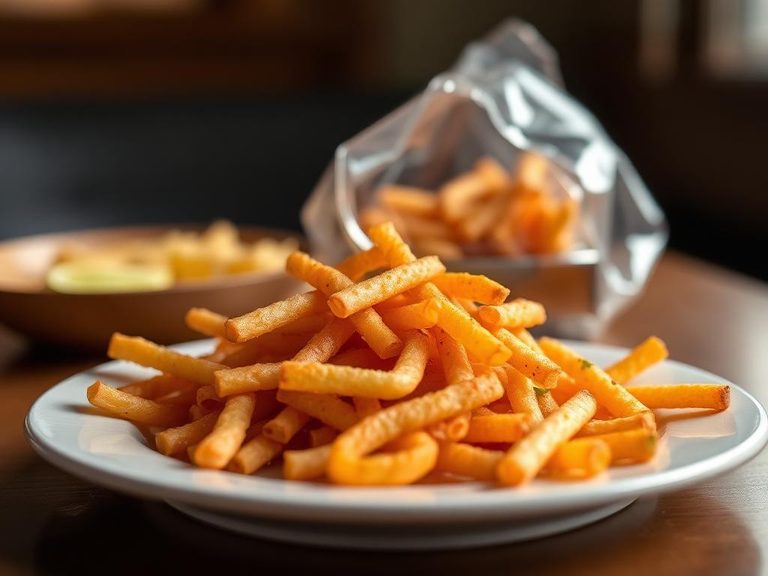
These are ultra-light, airy potato chips engineered to deliver a satisfying crunch with virtually no fat. They have a classic, salty, potato-forward flavor but with a slightly drier, more brittle texture than traditional chips due to the absence of frying oil. Nutritionally, they are a high-carb, high-fiber snack that provides significant calories from starch.
Calorie split: 10% protein · 87% carbs · 2% fat
↓ Full nutrition💚 Why it's loved
People love them for delivering the nostalgic, salty, crunchy experience of a classic potato chip while fitting into a very low-fat dietary framework. They are a go-to for portion-controlled snacking when a specific craving hits.
⚠️ Watch-outs & how to enjoy it better
The primary concern is the potential for gastrointestinal discomfort (cramping, loose stools) in some individuals due to the olestra ingredient, which is not fully absorbed. They are also a high-glycemic, low-protein snack that can lead to rapid blood sugar spikes. To counteract this, pair a small portion with a protein source like Greek yogurt or a handful of nuts, and drink plenty of water to aid digestion.
Key benefits
- Fat-free snack option
- Significant dietary fiber content (6.8g/100g)
- Provides quick energy from carbohydrates
- Low in sugar
- Can satisfy a salty crunch craving without dietary fat
🍽️ Popular dishes
🌍 Where it's eaten
💡 Did you know?
Olestra, the fat substitute used, is made from sucrose and vegetable oil but is too large for the body to digest, allowing it to pass through without adding calories or fat.
Full nutrition (USDA data · scales with serving)
| Water | 2.0 g |
| Energy | 274 kcal |
| Energy | 1147 kj |
| Protein | 7.7 g |
| Total lipid (fat) | 0.70 g |
| Ash | 4.6 g |
| Carbohydrate, by difference | 65.0 g |
| Fiber, total dietary | 6.8 g |
| Total Sugars | 0.00 g |
| Starch | 58.2 g |
| Calcium, Ca | 35.0 mg |
| Iron, Fe | 2.4 mg |
| Magnesium, Mg | 69.0 mg |
| Phosphorus, P | 174 mg |
| Potassium, K | 1160 mg |
| Sodium, Na | 554 mg |
| Zinc, Zn | 3.5 mg |
| Copper, Cu | 0.44 mg |
| Manganese, Mn | 0.77 mg |
| Selenium, Se | 0.90 ug |
| Vitamin C, total ascorbic acid | 28.3 mg |
| Thiamin | 0.33 mg |
| Riboflavin | 0.05 mg |
| Niacin | 4.4 mg |
| Pantothenic acid | 0.98 mg |
| Vitamin B-6 | 0.16 mg |
| Folate, total | 83.0 ug |
| Folic acid | 0.00 ug |
| Folate, food | 83.0 ug |
| Folate, DFE | 83.0 ug |
| Choline, total | 38.8 mg |
| Betaine | 1.0 mg |
| Vitamin B-12 | 0.00 ug |
| Vitamin B-12, added | 0.00 ug |
| Vitamin A, RAE | 0.00 ug |
| Retinol | 0.00 ug |
| Carotene, beta | 0.00 ug |
| Carotene, alpha | 0.00 ug |
| Cryptoxanthin, beta | 0.00 ug |
| Vitamin A, IU | 0.00 iu |
| Lycopene | 0.00 ug |
| Lutein + zeaxanthin | 0.00 ug |
| Vitamin E (alpha-tocopherol) | 0.00 mg |
| Vitamin E, added | 0.00 mg |
| Vitamin D (D2 + D3), International Units | 0.00 iu |
| Vitamin D (D2 + D3) | 0.00 ug |
| Vitamin K (phylloquinone) | 0.00 ug |
| Vitamin K (Dihydrophylloquinone) | 0.00 ug |
| Alcohol, ethyl | 0.00 g |
| Caffeine | 0.00 mg |
| Theobromine | 0.00 mg |
Fat & fatty acid profile (per 100g)
| Fatty acids, total saturated | 0.24 g |
| SFA 4:0 | 0.00 g |
| SFA 6:0 | 0.00 g |
| SFA 8:0 | 0.00 g |
| SFA 10:0 | 0.00 g |
| SFA 12:0 | 0.01 g |
| SFA 14:0 | 0.01 g |
| SFA 16:0 | 0.17 g |
| SFA 18:0 | 0.04 g |
| SFA 20:0 | 0.00 g |
| SFA 22:0 | 0.01 g |
| Fatty acids, total monounsaturated | 0.18 g |
| MUFA 14:1 | 0.00 g |
| MUFA 16:1 | 0.01 g |
| MUFA 18:1 | 0.17 g |
| MUFA 20:1 | 0.00 g |
| MUFA 22:1 | 0.00 g |
| Fatty acids, total polyunsaturated | 0.30 g |
| PUFA 18:2 | 0.28 g |
| PUFA 18:3 | 0.03 g |
| PUFA 18:4 | 0.00 g |
| PUFA 20:4 | 0.00 g |
| PUFA 20:5 n-3 (EPA) | 0.00 g |
| PUFA 22:5 n-3 (DPA) | 0.00 g |
| PUFA 22:6 n-3 (DHA) | 0.00 g |
| Cholesterol | 0.00 mg |
Amino acid profile (per 100g)
Estimated from Snacks, corn-based, extruded, chips, plain — USDA does not publish this profile for Snacks.
| Tryptophan | 0.05 g |
| Threonine | 0.25 g |
| Isoleucine | 0.23 g |
| Leucine | 0.80 g |
| Lysine | 0.18 g |
| Methionine | 0.14 g |
| Cystine | 0.12 g |
| Phenylalanine | 0.32 g |
| Tyrosine | 0.27 g |
| Valine | 0.33 g |
| Arginine | 0.33 g |
| Histidine | 0.20 g |
| Alanine | 0.49 g |
| Aspartic acid | 0.46 g |
| Glutamic acid | 1.2 g |
| Glycine | 0.27 g |
| Proline | 0.57 g |
| Serine | 0.31 g |
FAQ
What exactly is olestra?
Olestra is a fat substitute made by chemically bonding sugar molecules to fatty acids from vegetable oils. This creates a molecule too large for the digestive system to break down and absorb, so it provides the mouthfeel of fat without the calories.
Why are they so high in carbs and fiber?
The base is still potato, which is a starchy carbohydrate. The fiber content is notably high because the manufacturing process concentrates the potato's natural fiber, and olestra itself can contribute to the total fiber count on the label.
Are they suitable for a low-carb or keto diet?
No. With 65g of carbohydrates per 100g, these chips are extremely high in carbs and are incompatible with low-carb or ketogenic diets.
Nutrient density (calculated · NRF9.3)
Nutrient Rich Foods index: beneficial nutrients (protein, fiber, vitamins, minerals) minus saturated fat, added sugar & sodium, per 100 kcal.
NRF9.3 index — Fulgoni, Keast & Drewnowski, 2009. Computed from USDA nutrients.
Weight-loss friendliness (composite index)
Energy density 2.74 kcal/g · 11% calories from protein · 6.8 g fiber · 0.0 g sugar per 100 g.
Composite of energy density (Rolls et al., 1999), protein & fiber satiety, minus sugar. A calculated heuristic — ranks satiety-per-calorie, not a clinical measure.
Dietary load (calculated from USDA values)
Potential renal acid load. Positive = acid-forming, negative = alkaline-forming.
Sodium-to-potassium ratio: 0.48 (lower is better — aim for ≤ 1)
Sodium:potassium per WHO potassium guidance. Computed from USDA nutrients.