

Peanuts, all types, raw
Whole food · Legumes and Legume Products
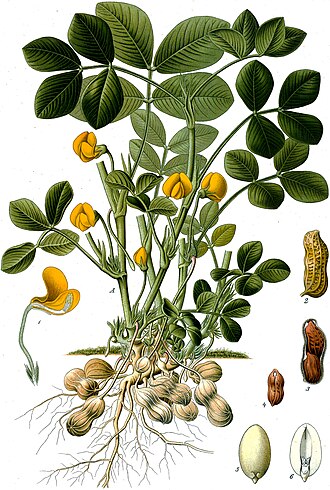
Photo: Wikipedia
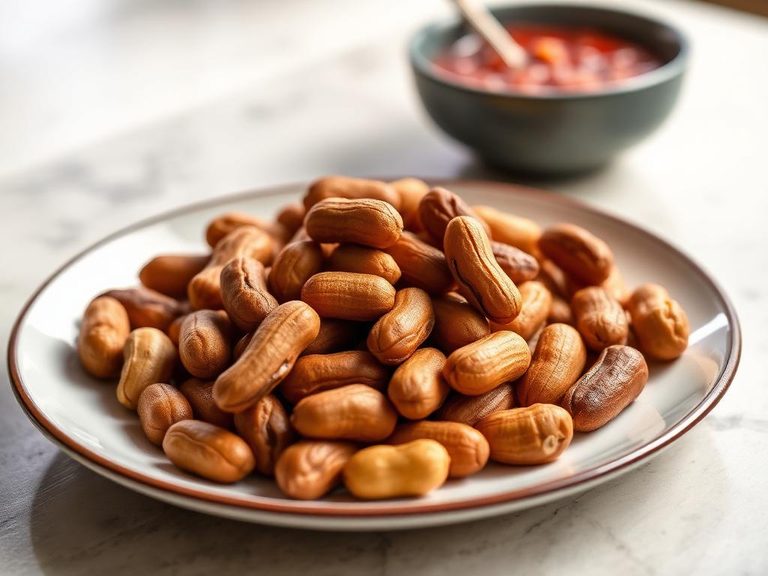
Raw peanuts are the edible seeds of the Arachis hypogaea plant, encased in a thin, papery red or brown skin. They offer a firm, slightly crunchy texture with a mild, earthy, and subtly sweet flavor that intensifies when roasted. Nutritionally, they are a powerhouse of plant-based protein and heart-healthy monounsaturated fats, with a significant fiber content.
Calorie split: 17% protein · 11% carbs · 73% fat
↓ Full nutrition💚 Why it's loved
People love peanuts for their deeply satisfying, savory crunch and rich, nutty flavor that forms the base of countless comfort foods. Their incredible versatility allows them to be eaten raw, roasted, boiled, or ground into butters and sauces across global cuisines.
⚠️ Watch-outs & how to enjoy it better
Peanuts are a top allergen, and raw peanuts contain antinutrients like phytic acid that can reduce mineral absorption. To counteract this, roasting or boiling significantly reduces phytic acid, and pairing with vitamin C-rich foods can enhance iron absorption. Those with allergies must avoid them entirely.
Key benefits
- Excellent source of plant-based protein for muscle maintenance.
- Rich in monounsaturated fats, which support cardiovascular health.
- High in dietary fiber, aiding digestion and promoting satiety.
- Contains important micronutrients like niacin, folate, and manganese.
- Provides antioxidants like resveratrol, especially in the skin.
🍽️ Popular dishes
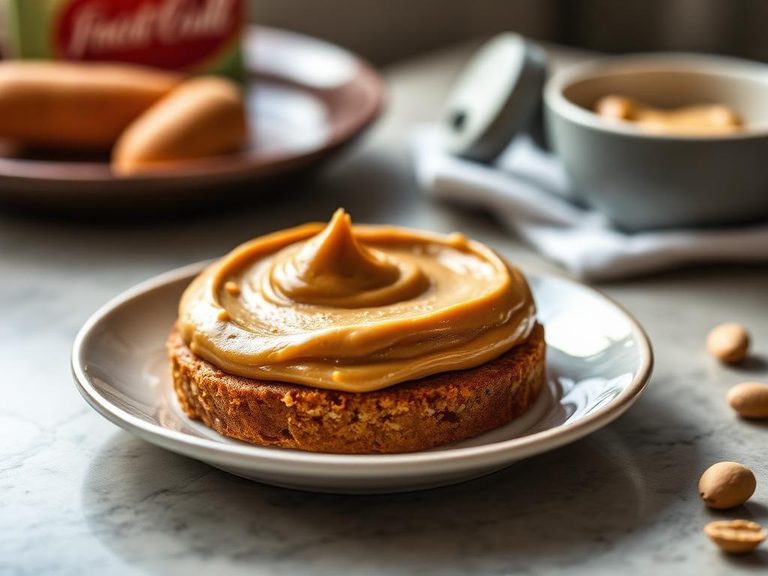
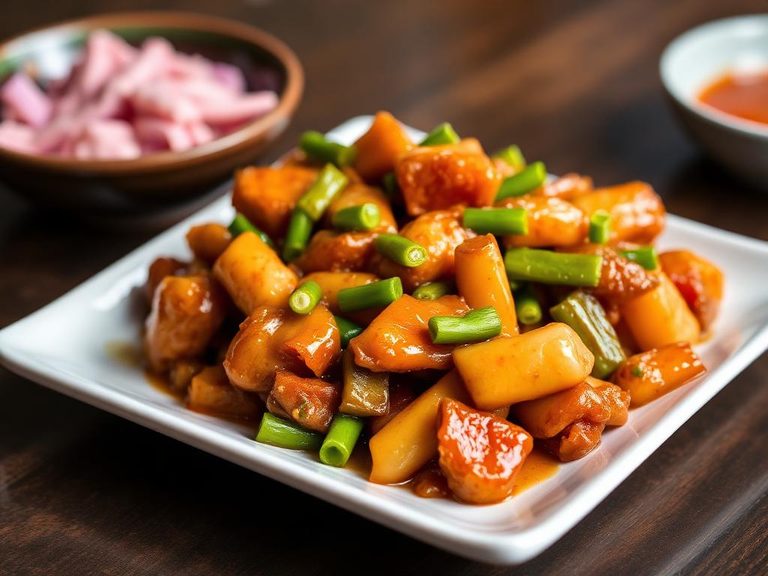
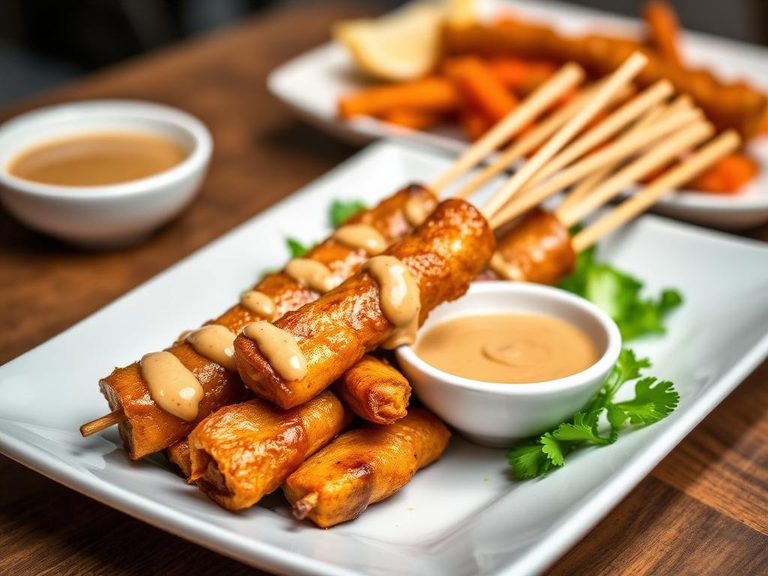
🌍 Where it's eaten
💡 Did you know?
Peanuts are not true nuts; they are legumes that develop their pods underground, a unique process called 'geocarpy' where the flower stalk burrows into the soil.
Full nutrition (USDA data · scales with serving)
| Water | 6.5 g |
| Energy | 567 kcal |
| Energy | 2374 kj |
| Protein | 25.8 g |
| Total lipid (fat) | 49.2 g |
| Ash | 2.3 g |
| Carbohydrate, by difference | 16.1 g |
| Fiber, total dietary | 8.5 g |
| Total Sugars | 4.7 g |
| Calcium, Ca | 92.0 mg |
| Iron, Fe | 4.6 mg |
| Magnesium, Mg | 168 mg |
| Phosphorus, P | 376 mg |
| Potassium, K | 705 mg |
| Sodium, Na | 18.0 mg |
| Zinc, Zn | 3.3 mg |
| Copper, Cu | 1.1 mg |
| Manganese, Mn | 1.9 mg |
| Selenium, Se | 7.2 ug |
| Vitamin C, total ascorbic acid | 0.00 mg |
| Thiamin | 0.64 mg |
| Riboflavin | 0.14 mg |
| Niacin | 12.1 mg |
| Pantothenic acid | 1.8 mg |
| Vitamin B-6 | 0.35 mg |
| Folate, total | 240 ug |
| Folic acid | 0.00 ug |
| Folate, food | 240 ug |
| Folate, DFE | 240 ug |
| Choline, total | 52.5 mg |
| Betaine | 0.60 mg |
| Vitamin B-12 | 0.00 ug |
| Vitamin B-12, added | 0.00 ug |
| Vitamin A, RAE | 0.00 ug |
| Retinol | 0.00 ug |
| Carotene, beta | 0.00 ug |
| Carotene, alpha | 0.00 ug |
| Cryptoxanthin, beta | 0.00 ug |
| Vitamin A, IU | 0.00 iu |
| Lycopene | 0.00 ug |
| Lutein + zeaxanthin | 0.00 ug |
| Vitamin E (alpha-tocopherol) | 8.3 mg |
| Vitamin E, added | 0.00 mg |
| Vitamin D (D2 + D3), International Units | 0.00 iu |
| Vitamin D (D2 + D3) | 0.00 ug |
| Vitamin K (phylloquinone) | 0.00 ug |
| Alcohol, ethyl | 0.00 g |
| Caffeine | 0.00 mg |
| Theobromine | 0.00 mg |
Fat & fatty acid profile (per 100g)
| Fatty acids, total saturated | 6.3 g |
| SFA 4:0 | 0.00 g |
| SFA 6:0 | 0.00 g |
| SFA 8:0 | 0.00 g |
| SFA 10:0 | 0.00 g |
| SFA 12:0 | 0.00 g |
| SFA 14:0 | 0.03 g |
| SFA 16:0 | 5.2 g |
| SFA 18:0 | 1.1 g |
| Fatty acids, total monounsaturated | 24.4 g |
| MUFA 16:1 | 0.01 g |
| MUFA 18:1 | 23.8 g |
| MUFA 20:1 | 0.66 g |
| MUFA 22:1 | 0.00 g |
| Fatty acids, total polyunsaturated | 15.6 g |
| PUFA 18:2 | 15.6 g |
| PUFA 18:3 | 0.00 g |
| PUFA 18:4 | 0.00 g |
| PUFA 20:4 | 0.00 g |
| PUFA 20:5 n-3 (EPA) | 0.00 g |
| PUFA 22:5 n-3 (DPA) | 0.00 g |
| PUFA 22:6 n-3 (DHA) | 0.00 g |
| Fatty acids, total trans | 0.00 g |
| Cholesterol | 0.00 mg |
Amino acid profile (per 100g)
| Tryptophan | 0.25 g |
| Threonine | 0.88 g |
| Isoleucine | 0.91 g |
| Leucine | 1.7 g |
| Lysine | 0.93 g |
| Methionine | 0.32 g |
| Cystine | 0.33 g |
| Phenylalanine | 1.4 g |
| Tyrosine | 1.0 g |
| Valine | 1.1 g |
| Arginine | 3.1 g |
| Histidine | 0.65 g |
| Alanine | 1.0 g |
| Aspartic acid | 3.1 g |
| Glutamic acid | 5.4 g |
| Glycine | 1.6 g |
| Proline | 1.1 g |
| Serine | 1.3 g |
FAQ
Are raw peanuts safe to eat?
Raw peanuts can be eaten, but they may harbor mold (like aflatoxins) or bacteria. It's safer to purchase them from a reputable source intended for raw consumption or to boil/roast them to reduce potential risks.
How do peanuts compare to tree nuts nutritionally?
Peanuts have a similar calorie and fat profile to tree nuts but offer more protein and less total fat. They are also significantly cheaper and more versatile in savory cooking.
Why do some people avoid peanut skins?
The thin red skin is edible and rich in antioxidants, but it can be slightly bitter and astringent. Some people remove it for texture or flavor preference, especially in dishes where a smooth consistency is desired.
Nutrient density (calculated · NRF9.3)
Nutrient Rich Foods index: beneficial nutrients (protein, fiber, vitamins, minerals) minus saturated fat, added sugar & sodium, per 100 kcal.
NRF9.3 index — Fulgoni, Keast & Drewnowski, 2009. Computed from USDA nutrients.
Weight-loss friendliness (composite index)
Energy density 5.67 kcal/g · 18% calories from protein · 8.5 g fiber · 4.7 g sugar per 100 g.
Composite of energy density (Rolls et al., 1999), protein & fiber satiety, minus sugar. A calculated heuristic — ranks satiety-per-calorie, not a clinical measure.
Dietary load (calculated from USDA values)
Potential renal acid load. Positive = acid-forming, negative = alkaline-forming.
Sodium-to-potassium ratio: 0.03 (lower is better — aim for ≤ 1)
Sodium:potassium per WHO potassium guidance. Computed from USDA nutrients.