

Peaches, frozen, sliced, sweetened
Whole food · Fruits and Fruit Juices

Photo: Wikipedia
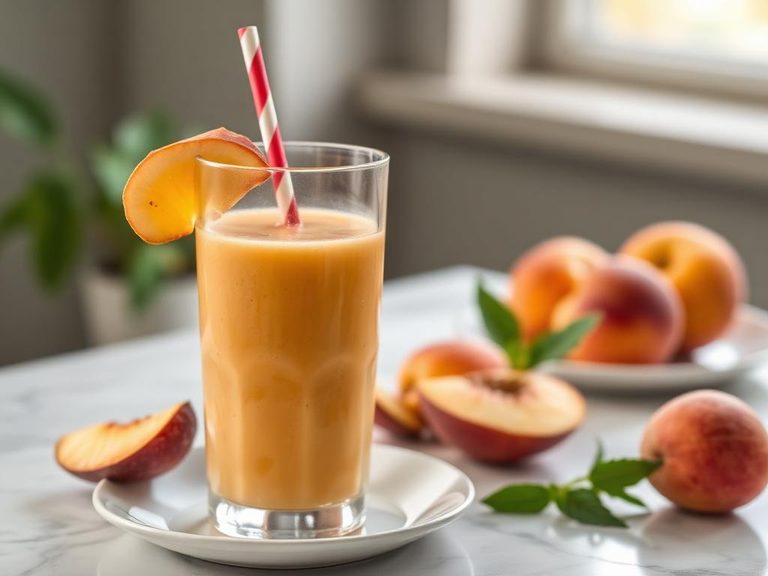
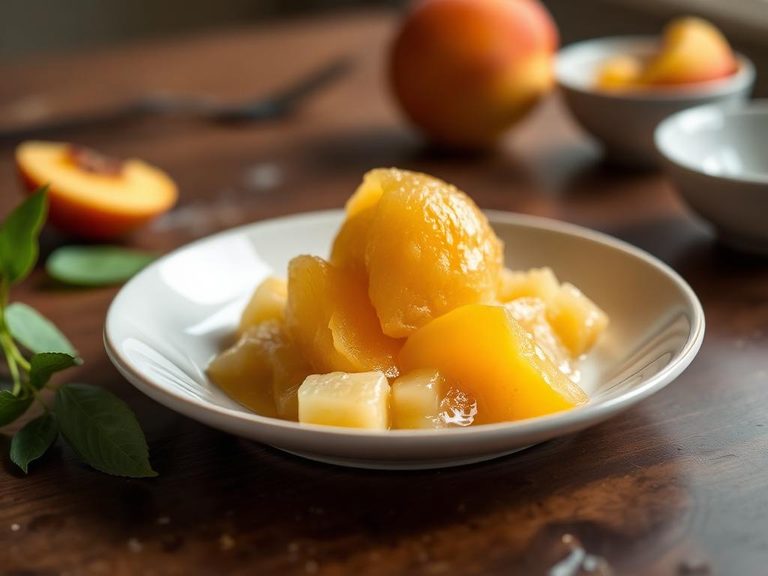
These are peach slices flash-frozen in a light sugar syrup, locking in a vibrant, sun-kissed color and a tender, juicy texture that's perfect for smoothies or thawed for a sweet snack. Nutritionally, they offer a quick energy boost from natural and added sugars, with a modest amount of fiber to aid digestion. Each 100g serving provides a convenient, portion-controlled way to enjoy peach flavor year-round.
Calorie split: 3% protein · 96% carbs · 1% fat
↓ Full nutrition💚 Why it's loved
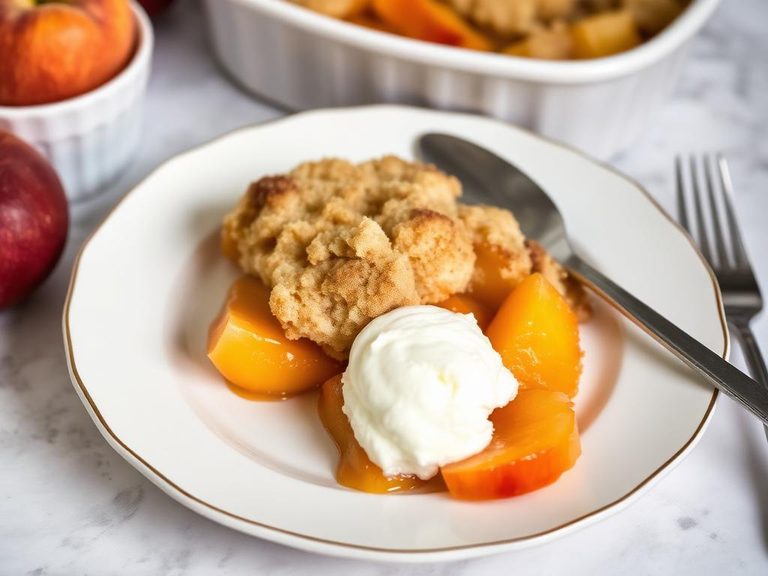
People love them for delivering the authentic, sweet-tart flavor of ripe peaches in any season, with a soft, spoonable texture that's ideal for blending into smoothies, swirling into yogurt, or topping pancakes. They are a nostalgic comfort food, often associated with summer cobblers and homemade ice cream toppings.
⚠️ Watch-outs & how to enjoy it better
The added sugar syrup significantly increases the sugar content, which can cause rapid blood-sugar spikes, making portion control important for those managing glucose levels. To counteract this, pair a serving with a source of protein or healthy fat, like Greek yogurt or nuts, to slow sugar absorption. They may also contain sulfites as a preservative, which some individuals with asthma or sensitivities should check for on the label.
Key benefits
- Provides quick, accessible energy from carbohydrates
- Contains dietary fiber for digestive health
- Offers vitamin C, an antioxidant that supports immune function
- Convenient and reduces food waste with a long freezer life
- A lower-fat dessert or snack option
🍽️ Popular dishes

🌍 Where it's eaten
💡 Did you know?
The process of flash-freezing fruit at its peak ripeness can actually preserve more of certain heat-sensitive nutrients, like vitamin C, than fresh fruit that has traveled long distances and sat on shelves.
Full nutrition (USDA data · scales with serving)
| Water | 74.7 g |
| Energy | 94.0 kcal |
| Energy | 393 kj |
| Protein | 0.63 g |
| Total lipid (fat) | 0.13 g |
| Ash | 0.53 g |
| Carbohydrate, by difference | 24.0 g |
| Fiber, total dietary | 1.8 g |
| Total Sugars | 22.2 g |
| Calcium, Ca | 3.0 mg |
| Iron, Fe | 0.37 mg |
| Magnesium, Mg | 5.0 mg |
| Phosphorus, P | 11.0 mg |
| Potassium, K | 130 mg |
| Sodium, Na | 6.0 mg |
| Zinc, Zn | 0.05 mg |
| Copper, Cu | 0.02 mg |
| Manganese, Mn | 0.03 mg |
| Selenium, Se | 0.40 ug |
| Vitamin C, total ascorbic acid | 94.2 mg |
| Thiamin | 0.01 mg |
| Riboflavin | 0.04 mg |
| Niacin | 0.65 mg |
| Pantothenic acid | 0.13 mg |
| Vitamin B-6 | 0.02 mg |
| Folate, total | 3.0 ug |
| Folic acid | 0.00 ug |
| Folate, food | 3.0 ug |
| Folate, DFE | 3.0 ug |
| Choline, total | 5.1 mg |
| Vitamin B-12 | 0.00 ug |
| Vitamin B-12, added | 0.00 ug |
| Vitamin A, RAE | 14.0 ug |
| Retinol | 0.00 ug |
| Carotene, beta | 141 ug |
| Carotene, alpha | 0.00 ug |
| Cryptoxanthin, beta | 58.0 ug |
| Vitamin A, IU | 284 iu |
| Lycopene | 0.00 ug |
| Lutein + zeaxanthin | 77.0 ug |
| Vitamin E (alpha-tocopherol) | 0.62 mg |
| Vitamin E, added | 0.00 mg |
| Vitamin D (D2 + D3), International Units | 0.00 iu |
| Vitamin D (D2 + D3) | 0.00 ug |
| Vitamin K (phylloquinone) | 2.2 ug |
| Alcohol, ethyl | 0.00 g |
| Caffeine | 0.00 mg |
| Theobromine | 0.00 mg |
Fat & fatty acid profile (per 100g)
| Fatty acids, total saturated | 0.01 g |
| SFA 4:0 | 0.00 g |
| SFA 6:0 | 0.00 g |
| SFA 8:0 | 0.00 g |
| SFA 10:0 | 0.00 g |
| SFA 12:0 | 0.00 g |
| SFA 14:0 | 0.00 g |
| SFA 16:0 | 0.01 g |
| SFA 18:0 | 0.00 g |
| Fatty acids, total monounsaturated | 0.05 g |
| MUFA 16:1 | 0.00 g |
| MUFA 18:1 | 0.05 g |
| MUFA 20:1 | 0.00 g |
| MUFA 22:1 | 0.00 g |
| Fatty acids, total polyunsaturated | 0.06 g |
| PUFA 18:2 | 0.06 g |
| PUFA 18:3 | 0.00 g |
| PUFA 18:4 | 0.00 g |
| PUFA 20:4 | 0.00 g |
| PUFA 20:5 n-3 (EPA) | 0.00 g |
| PUFA 22:5 n-3 (DPA) | 0.00 g |
| PUFA 22:6 n-3 (DHA) | 0.00 g |
| Fatty acids, total trans | 0.00 g |
| Cholesterol | 0.00 mg |
Amino acid profile (per 100g)
| Tryptophan | 0.00 g |
| Threonine | 0.02 g |
| Isoleucine | 0.02 g |
| Leucine | 0.04 g |
| Lysine | 0.02 g |
| Methionine | 0.01 g |
| Cystine | 0.01 g |
| Phenylalanine | 0.02 g |
| Tyrosine | 0.02 g |
| Valine | 0.03 g |
| Arginine | 0.02 g |
| Histidine | 0.01 g |
| Alanine | 0.04 g |
| Aspartic acid | 0.10 g |
| Glutamic acid | 0.10 g |
| Glycine | 0.02 g |
| Proline | 0.03 g |
| Serine | 0.03 g |
FAQ
Can I use these directly in baking without thawing?
Yes, you can often add frozen peach slices directly to batters for cakes or cobblers. You may need to add a few extra minutes to the baking time, and the extra moisture might slightly alter the texture.
Are the sugars all added?
No. Peaches naturally contain fruit sugar (fructose). The 'sweetened' label means additional sugar, typically sucrose, has been added to the syrup before freezing, increasing the total sugar content beyond what's found in the fresh fruit.
How do I prevent them from becoming mushy when thawed?
For the best texture, thaw them in the refrigerator overnight rather than at room temperature or in the microwave. This slower process helps the cell structures retain more of their integrity.
Nutrient density (calculated · NRF9.3)
Nutrient Rich Foods index: beneficial nutrients (protein, fiber, vitamins, minerals) minus saturated fat, added sugar & sodium, per 100 kcal.
NRF9.3 index — Fulgoni, Keast & Drewnowski, 2009. Computed from USDA nutrients.
Weight-loss friendliness (composite index)
Energy density 0.94 kcal/g · 3% calories from protein · 1.8 g fiber · 22.2 g sugar per 100 g.
Composite of energy density (Rolls et al., 1999), protein & fiber satiety, minus sugar. A calculated heuristic — ranks satiety-per-calorie, not a clinical measure.
Dietary load (calculated from USDA values)
Potential renal acid load. Positive = acid-forming, negative = alkaline-forming.
Sodium-to-potassium ratio: 0.05 (lower is better — aim for ≤ 1)
Sodium:potassium per WHO potassium guidance. Computed from USDA nutrients.