

Peaches, canned, water pack, solids and liquids
Whole food · Fruits and Fruit Juices

Photo: Wikipedia
These are peach halves or slices gently preserved in water, offering a tender, juicy bite that's less sweet than syrup-packed versions. Their flavor is a delicate balance of natural peach tartness and subtle floral sweetness, with a soft, yielding texture. Nutritionally, they are a low-calorie, high-fiber fruit option, providing a good source of vitamin C without added sugars.
Calorie split: 7% protein · 91% carbs · 2% fat
↓ Full nutrition💚 Why it's loved
People love them for their comforting, nostalgic flavor and the convenience of having ready-to-eat fruit year-round. Their mild sweetness and soft texture make them a versatile ingredient for both sweet breakfasts and savory dishes.
⚠️ Watch-outs & how to enjoy it better
The primary concern is the natural sugar content (4.81g per 100g), which can cause blood sugar spikes if consumed in large quantities, especially for those managing diabetes. To counteract this, pair them with a source of protein or healthy fat (like Greek yogurt or nuts) to slow sugar absorption, and practice portion control.
Key benefits
- Low in calories (24 kcal per 100g)
- Good source of dietary fiber (1.3g per 100g)
- Naturally fat-free and cholesterol-free
- Provides vitamin C and potassium
- Hydrating due to high water content
🍽️ Popular dishes
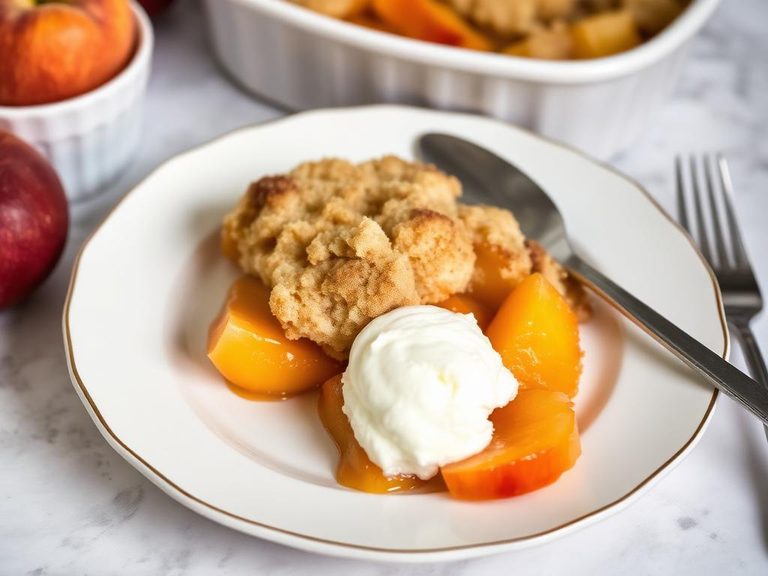
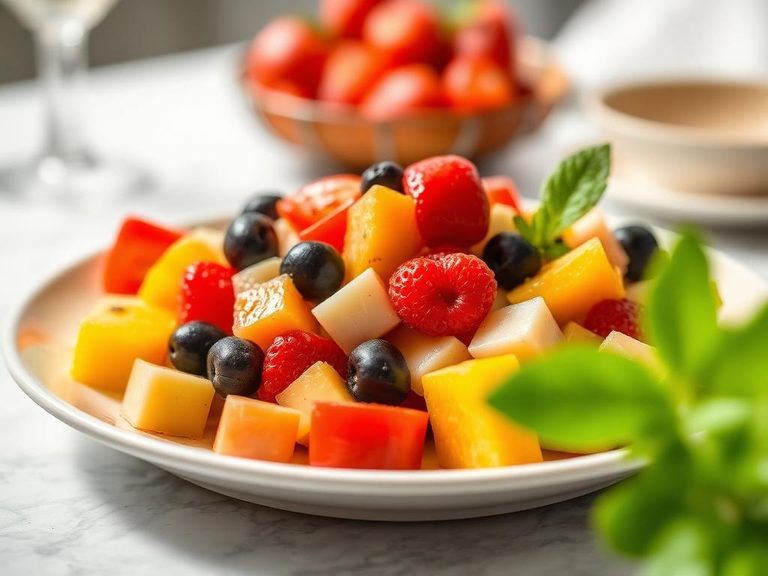
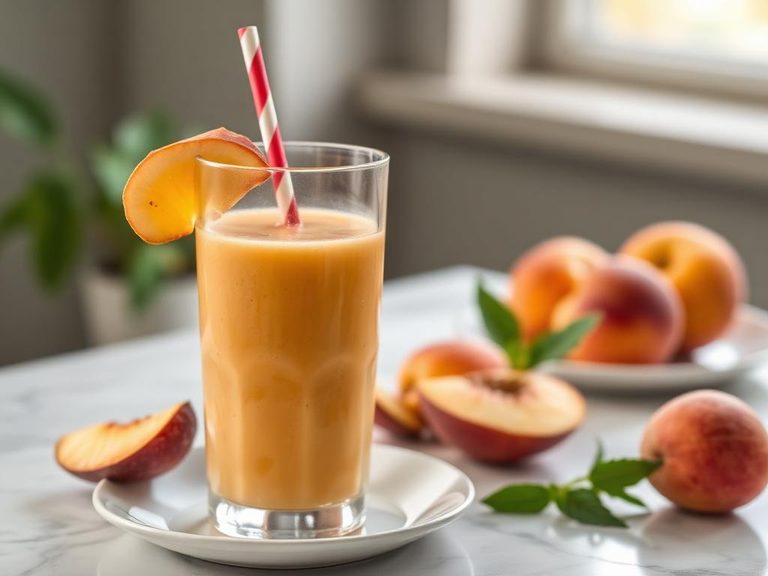



🌍 Where it's eaten
💡 Did you know?
The practice of canning fruit, including peaches, was revolutionized by Nicolas Appert in early 19th-century France as a method to preserve food for Napoleon's armies.
Full nutrition (USDA data · scales with serving)
| Water | 93.1 g |
| Energy | 24.0 kcal |
| Energy | 100 kj |
| Protein | 0.44 g |
| Total lipid (fat) | 0.06 g |
| Ash | 0.27 g |
| Carbohydrate, by difference | 6.1 g |
| Fiber, total dietary | 1.3 g |
| Total Sugars | 4.8 g |
| Calcium, Ca | 2.0 mg |
| Iron, Fe | 0.32 mg |
| Magnesium, Mg | 5.0 mg |
| Phosphorus, P | 10.0 mg |
| Potassium, K | 99.0 mg |
| Sodium, Na | 3.0 mg |
| Zinc, Zn | 0.09 mg |
| Copper, Cu | 0.05 mg |
| Manganese, Mn | 0.05 mg |
| Selenium, Se | 0.30 ug |
| Vitamin C, total ascorbic acid | 2.9 mg |
| Thiamin | 0.01 mg |
| Riboflavin | 0.02 mg |
| Niacin | 0.52 mg |
| Pantothenic acid | 0.05 mg |
| Vitamin B-6 | 0.02 mg |
| Folate, total | 3.0 ug |
| Folic acid | 0.00 ug |
| Folate, food | 3.0 ug |
| Folate, DFE | 3.0 ug |
| Choline, total | 4.1 mg |
| Vitamin B-12 | 0.00 ug |
| Vitamin B-12, added | 0.00 ug |
| Vitamin A, RAE | 27.0 ug |
| Retinol | 0.00 ug |
| Carotene, beta | 264 ug |
| Carotene, alpha | 1.0 ug |
| Cryptoxanthin, beta | 109 ug |
| Vitamin A, IU | 532 iu |
| Lycopene | 0.00 ug |
| Lutein + zeaxanthin | 61.0 ug |
| Vitamin E (alpha-tocopherol) | 0.49 mg |
| Vitamin E, added | 0.00 mg |
| Vitamin D (D2 + D3), International Units | 0.00 iu |
| Vitamin D (D2 + D3) | 0.00 ug |
| Vitamin K (phylloquinone) | 1.7 ug |
| Alcohol, ethyl | 0.00 g |
| Caffeine | 0.00 mg |
| Theobromine | 0.00 mg |
Fat & fatty acid profile (per 100g)
| Fatty acids, total saturated | 0.01 g |
| SFA 4:0 | 0.00 g |
| SFA 6:0 | 0.00 g |
| SFA 8:0 | 0.00 g |
| SFA 10:0 | 0.00 g |
| SFA 12:0 | 0.00 g |
| SFA 14:0 | 0.00 g |
| SFA 16:0 | 0.01 g |
| SFA 18:0 | 0.00 g |
| Fatty acids, total monounsaturated | 0.02 g |
| MUFA 16:1 | 0.00 g |
| MUFA 18:1 | 0.02 g |
| MUFA 20:1 | 0.00 g |
| MUFA 22:1 | 0.00 g |
| Fatty acids, total polyunsaturated | 0.03 g |
| PUFA 18:2 | 0.03 g |
| PUFA 18:3 | 0.00 g |
| PUFA 18:4 | 0.00 g |
| PUFA 20:4 | 0.00 g |
| PUFA 20:5 n-3 (EPA) | 0.00 g |
| PUFA 22:5 n-3 (DPA) | 0.00 g |
| PUFA 22:6 n-3 (DHA) | 0.00 g |
| Fatty acids, total trans | 0.00 g |
| Cholesterol | 0.00 mg |
Amino acid profile (per 100g)
| Tryptophan | 0.00 g |
| Threonine | 0.02 g |
| Isoleucine | 0.01 g |
| Leucine | 0.03 g |
| Lysine | 0.01 g |
| Methionine | 0.01 g |
| Cystine | 0.00 g |
| Phenylalanine | 0.01 g |
| Tyrosine | 0.01 g |
| Valine | 0.02 g |
| Arginine | 0.01 g |
| Histidine | 0.01 g |
| Alanine | 0.03 g |
| Aspartic acid | 0.07 g |
| Glutamic acid | 0.07 g |
| Glycine | 0.01 g |
| Proline | 0.02 g |
| Serine | 0.02 g |
FAQ
Are canned peaches as nutritious as fresh?
They retain most of their vitamins (like vitamin C) and fiber, but the canning process can reduce some heat-sensitive nutrients. Their main nutritional difference is often the packing liquid—water pack is the healthiest choice.
Why choose water pack over syrup pack?
Water pack contains no added sugars, making it lower in calories and better for blood sugar management. It allows the natural peach flavor to shine through more clearly.
Can I use the canning liquid in recipes?
Absolutely. The liquid is essentially peach-infused water and can be used to add subtle flavor to smoothies, oatmeal, or as a base for light syrups or cocktails.
Nutrient density (calculated · NRF9.3)
Nutrient Rich Foods index: beneficial nutrients (protein, fiber, vitamins, minerals) minus saturated fat, added sugar & sodium, per 100 kcal.
NRF9.3 index — Fulgoni, Keast & Drewnowski, 2009. Computed from USDA nutrients.
Weight-loss friendliness (composite index)
Energy density 0.24 kcal/g · 7% calories from protein · 1.3 g fiber · 4.8 g sugar per 100 g.
Composite of energy density (Rolls et al., 1999), protein & fiber satiety, minus sugar. A calculated heuristic — ranks satiety-per-calorie, not a clinical measure.
Dietary load (calculated from USDA values)
Potential renal acid load. Positive = acid-forming, negative = alkaline-forming.
Sodium-to-potassium ratio: 0.03 (lower is better — aim for ≤ 1)
Sodium:potassium per WHO potassium guidance. Computed from USDA nutrients.