

Collards, raw
Whole food · Vegetables and Vegetable Products

Photo: Wikipedia
Raw collard greens are sturdy, dark-green leaves with a robust, slightly bitter, and earthy flavor, reminiscent of a less peppery kale. Their thick, waxy texture holds up well to both raw preparations and cooking, making them a nutritional powerhouse. A 100g serving provides an impressive 4g of fiber and over 100% of your daily Vitamin K, all for just 32 calories.
Calorie split: 31% protein · 55% carbs · 14% fat
↓ Full nutrition💚 Why it's loved
People love collards for their hearty, satisfying texture that doesn't turn mushy, and their deep, savory flavor that forms the soul of Southern U.S. comfort food. They are also incredibly versatile, used raw in salads, braised for hours, or wrapped as low-carb tortilla substitutes.
⚠️ Watch-outs & how to enjoy it better
Raw collards contain oxalates, which can contribute to kidney stones in susceptible individuals, and their tough fibers can be hard to digest for some. To counteract this, blanching or massaging the leaves with an acid (like lemon juice) or salt can reduce bitterness and oxalate content. Pairing them with a fat (like olive oil or bacon) also improves nutrient absorption and palatability.
Key benefits
- Excellent source of Vitamin K for bone health.
- High in fiber to support digestion and gut health.
- Rich in antioxidants like beta-carotene and lutein.
- Provides plant-based protein and essential minerals like calcium.
- Very low in calories and fat.
🍽️ Popular dishes
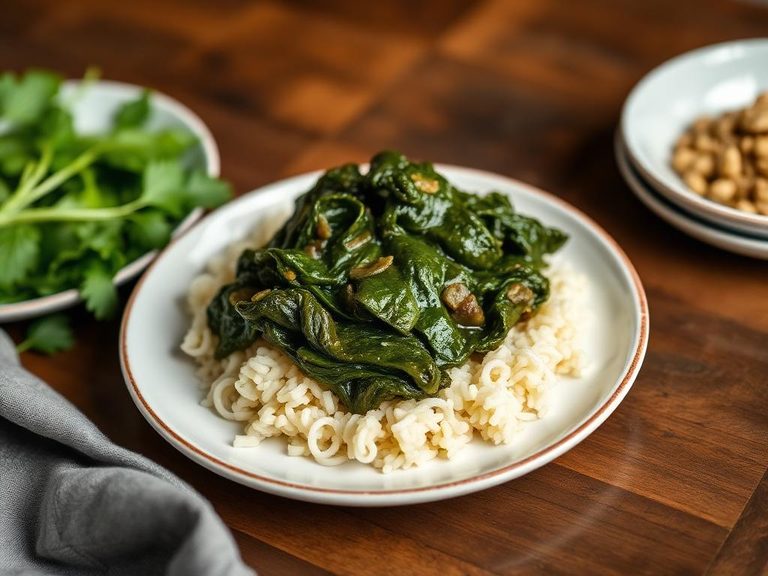
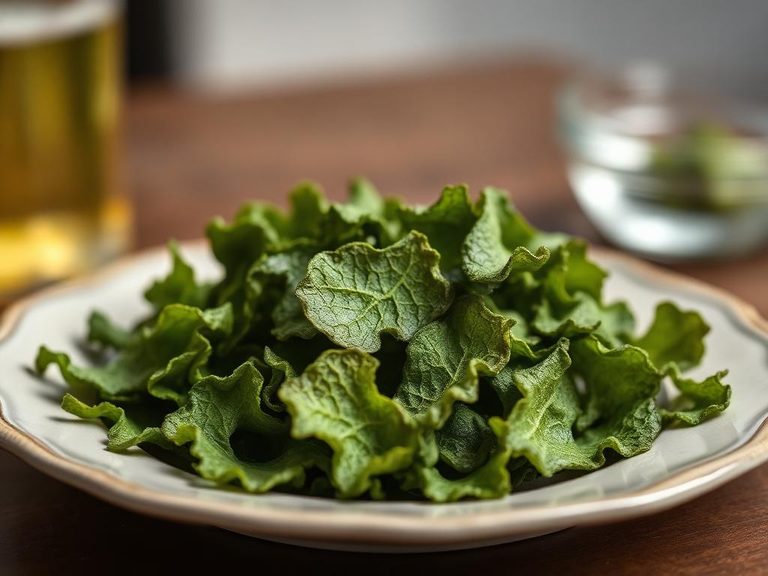
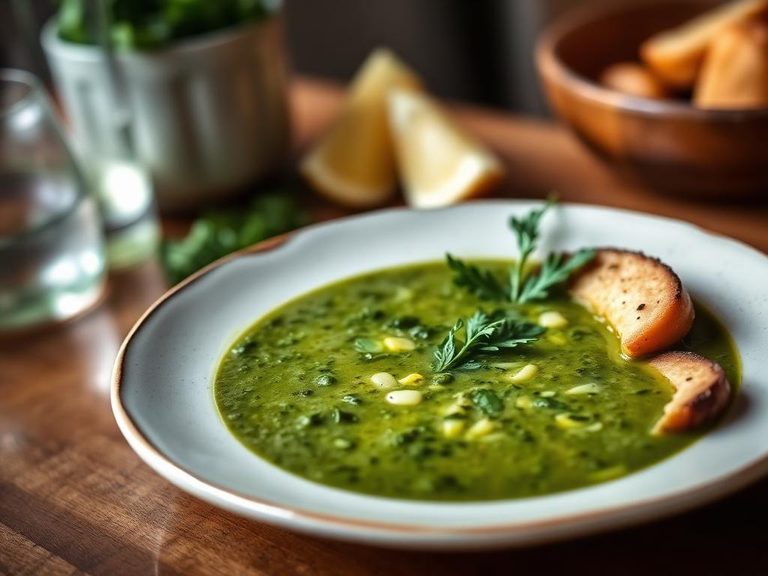
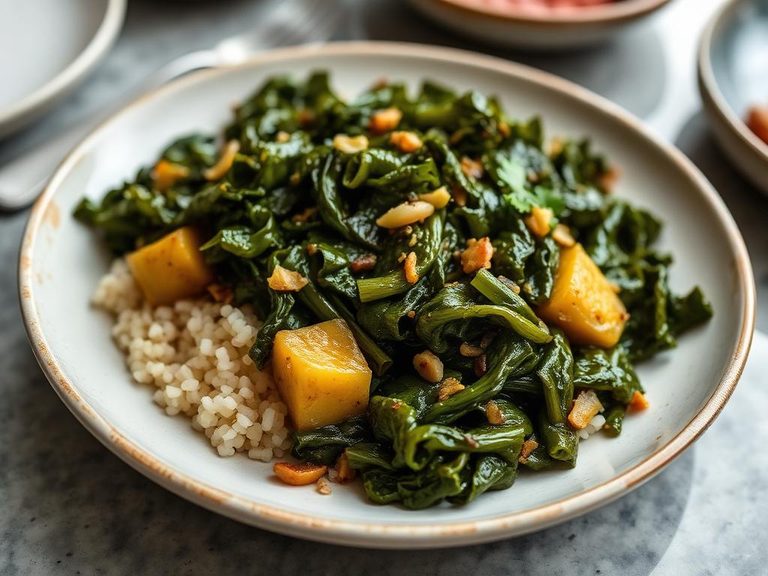
🌍 Where it's eaten
💡 Did you know?
Collards are one of the oldest members of the cabbage family, cultivated since ancient times, and their name likely derives from the Old English word 'coleworts,' meaning 'cabbage plants.'
Full nutrition (USDA data · scales with serving)
| Water | 89.6 g |
| Energy | 32.0 kcal |
| Energy | 133 kj |
| Protein | 3.0 g |
| Total lipid (fat) | 0.61 g |
| Ash | 1.3 g |
| Carbohydrate, by difference | 5.4 g |
| Fiber, total dietary | 4.0 g |
| Total Sugars | 0.46 g |
| Calcium, Ca | 232 mg |
| Iron, Fe | 0.47 mg |
| Magnesium, Mg | 27.0 mg |
| Phosphorus, P | 25.0 mg |
| Potassium, K | 213 mg |
| Sodium, Na | 17.0 mg |
| Zinc, Zn | 0.21 mg |
| Copper, Cu | 0.05 mg |
| Manganese, Mn | 0.66 mg |
| Selenium, Se | 1.3 ug |
| Vitamin C, total ascorbic acid | 35.3 mg |
| Thiamin | 0.05 mg |
| Riboflavin | 0.13 mg |
| Niacin | 0.74 mg |
| Pantothenic acid | 0.27 mg |
| Vitamin B-6 | 0.17 mg |
| Folate, total | 129 ug |
| Folic acid | 0.00 ug |
| Folate, food | 129 ug |
| Folate, DFE | 129 ug |
| Choline, total | 23.2 mg |
| Betaine | 0.40 mg |
| Vitamin B-12 | 0.00 ug |
| Vitamin B-12, added | 0.00 ug |
| Vitamin A, RAE | 251 ug |
| Retinol | 0.00 ug |
| Carotene, beta | 2991 ug |
| Carotene, alpha | 14.0 ug |
| Cryptoxanthin, beta | 28.0 ug |
| Vitamin A, IU | 5019 iu |
| Lycopene | 0.00 ug |
| Lutein + zeaxanthin | 4323 ug |
| Vitamin E (alpha-tocopherol) | 2.3 mg |
| Vitamin E, added | 0.00 mg |
| Vitamin D (D2 + D3), International Units | 0.00 iu |
| Vitamin D (D2 + D3) | 0.00 ug |
| Vitamin K (phylloquinone) | 437 ug |
| Alcohol, ethyl | 0.00 g |
| Caffeine | 0.00 mg |
| Theobromine | 0.00 mg |
Fat & fatty acid profile (per 100g)
| Fatty acids, total saturated | 0.06 g |
| SFA 4:0 | 0.00 g |
| SFA 6:0 | 0.00 g |
| SFA 8:0 | 0.00 g |
| SFA 10:0 | 0.00 g |
| SFA 12:0 | 0.00 g |
| SFA 14:0 | 0.00 g |
| SFA 16:0 | 0.05 g |
| SFA 18:0 | 0.00 g |
| Fatty acids, total monounsaturated | 0.03 g |
| MUFA 16:1 | 0.00 g |
| MUFA 18:1 | 0.03 g |
| MUFA 20:1 | 0.00 g |
| MUFA 22:1 | 0.00 g |
| Fatty acids, total polyunsaturated | 0.20 g |
| PUFA 18:2 | 0.08 g |
| PUFA 18:3 | 0.11 g |
| PUFA 18:4 | 0.00 g |
| PUFA 20:4 | 0.00 g |
| PUFA 20:5 n-3 (EPA) | 0.00 g |
| PUFA 22:5 n-3 (DPA) | 0.00 g |
| PUFA 22:6 n-3 (DHA) | 0.00 g |
| Fatty acids, total trans | 0.00 g |
| Cholesterol | 0.00 mg |
Amino acid profile (per 100g)
| Tryptophan | 0.03 g |
| Threonine | 0.09 g |
| Isoleucine | 0.10 g |
| Leucine | 0.15 g |
| Lysine | 0.12 g |
| Methionine | 0.03 g |
| Cystine | 0.03 g |
| Phenylalanine | 0.09 g |
| Tyrosine | 0.07 g |
| Valine | 0.12 g |
| Arginine | 0.13 g |
| Histidine | 0.05 g |
| Alanine | 0.10 g |
| Aspartic acid | 0.19 g |
| Glutamic acid | 0.20 g |
| Glycine | 0.09 g |
| Proline | 0.10 g |
| Serine | 0.08 g |
FAQ
How do I reduce the bitterness of raw collards for a salad?
Remove the tough central stem, stack and thinly slice the leaves (chiffonade), then massage them with a pinch of salt, lemon juice, or olive oil for 2-3 minutes until they soften and turn a brighter green. This breaks down fibers and mellows the flavor.
Are collards and kale the same thing?
No, they are distinct cultivars of *Brassica oleracea*. Collards have large, smooth, flat leaves on long stems, while kale leaves are typically more ruffled or curly. Collards have a milder, earthier taste compared to kale's more pronounced peppery note.
Can I eat collard stems?
Yes, but they are very tough and fibrous. For raw preparations, it's best to remove them. If cooking, you can finely dice the stems and sauté them for a few minutes before adding the leaves to soften them.
Nutrient density (calculated · NRF9.3)
Nutrient Rich Foods index: beneficial nutrients (protein, fiber, vitamins, minerals) minus saturated fat, added sugar & sodium, per 100 kcal.
NRF9.3 index — Fulgoni, Keast & Drewnowski, 2009. Computed from USDA nutrients.
Weight-loss friendliness (composite index)
Energy density 0.32 kcal/g · 38% calories from protein · 4.0 g fiber · 0.5 g sugar per 100 g.
Composite of energy density (Rolls et al., 1999), protein & fiber satiety, minus sugar. A calculated heuristic — ranks satiety-per-calorie, not a clinical measure.
Dietary load (calculated from USDA values)
Potential renal acid load. Positive = acid-forming, negative = alkaline-forming.
Sodium-to-potassium ratio: 0.08 (lower is better — aim for ≤ 1)
Sodium:potassium per WHO potassium guidance. Computed from USDA nutrients.