

Chili, no beans, canned entree
Whole food · Meals, Entrees, and Side Dishes

Photo: Wikipedia
This is a hearty, meat-forward canned chili, thick with a deep, savory tomato base and a warm, spicy kick. Its texture is dense and satisfying, with tender chunks of ground beef and a smooth sauce. Nutritionally, it's a concentrated source of protein and fat, offering substantial energy in a small serving.
Calorie split: 25% protein · 21% carbs · 54% fat
↓ Full nutrition💚 Why it's loved
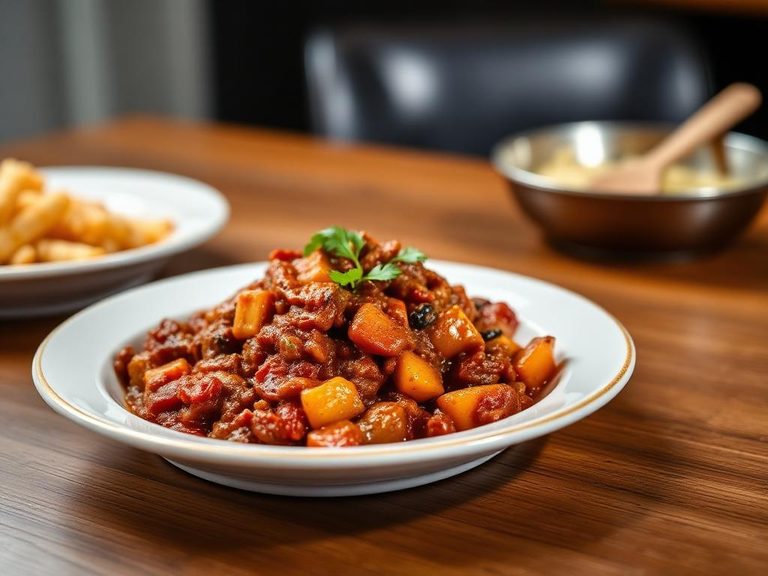
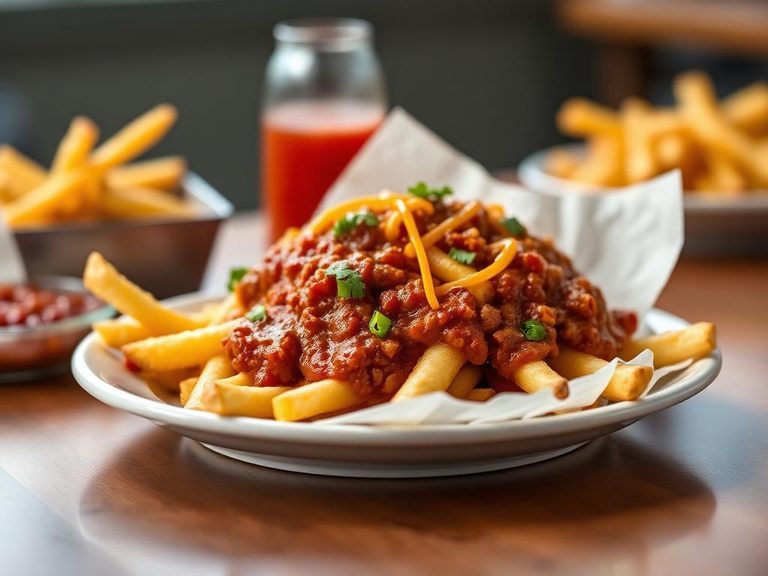
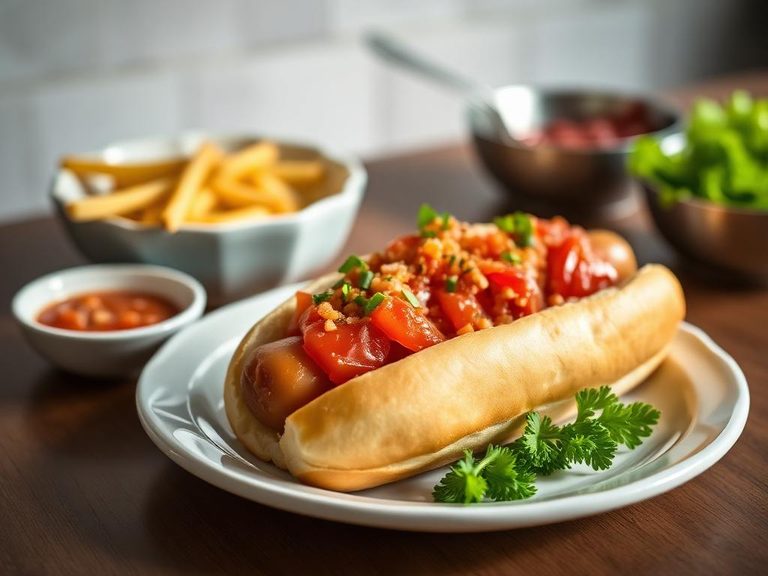
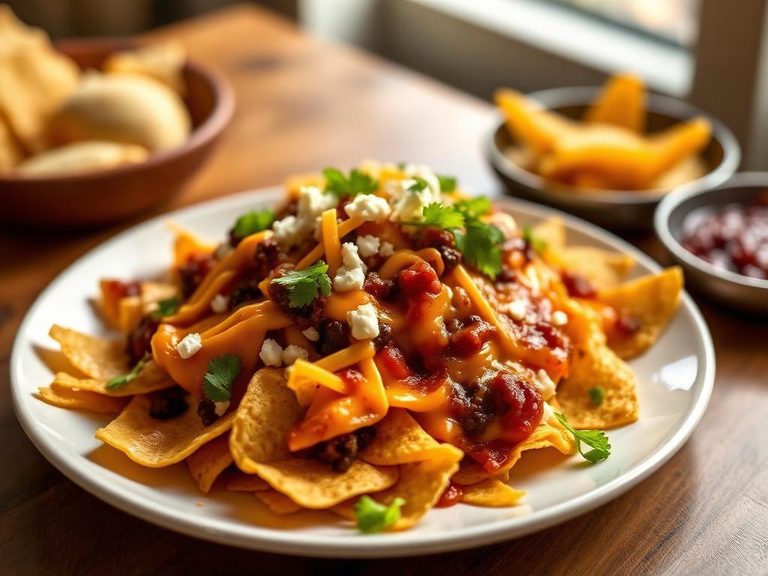
People love it for its robust, comforting flavor—a perfect balance of savory, spicy, and slightly tangy that hits the spot. It's incredibly versatile, serving as a standalone meal, a topping for hot dogs, or a base for nachos and baked potatoes.
⚠️ Watch-outs & how to enjoy it better
This style of canned chili is often very high in sodium, which can contribute to water retention and is a concern for those managing blood pressure. The fat content, while providing flavor, is also significant. To counteract, pair a smaller portion with a large, fresh green salad or steamed vegetables to add volume and fiber, and choose a low-sodium variety if available.
Key benefits
- High in protein for muscle maintenance and satiety.
- Provides a quick, calorie-dense meal for energy.
- Rich in iron from the beef and tomatoes.
- Contains capsaicin from chili peppers, which may boost metabolism.
- Shelf-stable and convenient for emergency or quick meals.
🍽️ Popular dishes

🌍 Where it's eaten
💡 Did you know?
The term 'chili con carne' (chili with meat) first appeared in print in a 1903 New York newspaper article, but the dish's roots trace back to a 19th-century stew made by San Antonio's 'Chili Queens' in open-air markets.
Full nutrition (USDA data · scales with serving)
| Water | 77.7 g |
| Energy | 118 kcal |
| Energy | 495 kj |
| Protein | 7.5 g |
| Total lipid (fat) | 7.1 g |
| Ash | 1.6 g |
| Carbohydrate, by difference | 6.1 g |
| Fiber, total dietary | 0.50 g |
| Total Sugars | 1.1 g |
| Sucrose | 0.68 g |
| Fructose | 0.42 g |
| Starch | 3.4 g |
| Calcium, Ca | 30.0 mg |
| Iron, Fe | 2.0 mg |
| Magnesium, Mg | 20.0 mg |
| Phosphorus, P | 77.0 mg |
| Potassium, K | 185 mg |
| Sodium, Na | 411 mg |
| Zinc, Zn | 1.1 mg |
| Copper, Cu | 0.19 mg |
| Manganese, Mn | 0.28 mg |
| Selenium, Se | 6.5 ug |
| Vitamin C, total ascorbic acid | 1.8 mg |
| Thiamin | 0.03 mg |
| Riboflavin | 0.11 mg |
| Niacin | 1.2 mg |
| Pantothenic acid | 0.16 mg |
| Vitamin B-6 | 0.13 mg |
| Folate, total | 8.0 ug |
| Folic acid | 0.00 ug |
| Folate, food | 8.0 ug |
| Folate, DFE | 8.0 ug |
| Choline, total | 42.2 mg |
| Vitamin B-12 | 1.0 ug |
| Vitamin B-12, added | 0.00 ug |
| Vitamin A, RAE | 14.0 ug |
| Retinol | 0.00 ug |
| Carotene, beta | 138 ug |
| Carotene, alpha | 19.0 ug |
| Cryptoxanthin, beta | 30.0 ug |
| Vitamin A, IU | 271 iu |
| Lycopene | 248 ug |
| Lutein + zeaxanthin | 16.0 ug |
| Vitamin E (alpha-tocopherol) | 0.59 mg |
| Vitamin E, added | 0.00 mg |
| Vitamin D (D2 + D3), International Units | 3.0 iu |
| Vitamin D (D2 + D3) | 0.10 ug |
| Vitamin K (phylloquinone) | 2.2 ug |
| Alcohol, ethyl | 0.00 g |
| Caffeine | 0.00 mg |
| Theobromine | 0.00 mg |
Fat & fatty acid profile (per 100g)
| Fatty acids, total saturated | 2.3 g |
| SFA 4:0 | 0.00 g |
| SFA 6:0 | 0.00 g |
| SFA 8:0 | 0.00 g |
| SFA 10:0 | 0.00 g |
| SFA 12:0 | 0.01 g |
| SFA 14:0 | 0.16 g |
| SFA 15:0 | 0.03 g |
| SFA 16:0 | 1.3 g |
| SFA 17:0 | 0.07 g |
| SFA 18:0 | 0.69 g |
| SFA 20:0 | 0.01 g |
| SFA 22:0 | 0.01 g |
| SFA 24:0 | 0.01 g |
| Fatty acids, total monounsaturated | 2.5 g |
| MUFA 14:1 | 0.05 g |
| MUFA 16:1 | 0.24 g |
| MUFA 17:1 | 0.07 g |
| MUFA 18:1 | 2.1 g |
| MUFA 20:1 | 0.05 g |
| MUFA 22:1 | 0.00 g |
| Fatty acids, total polyunsaturated | 0.50 g |
| PUFA 18:2 | 0.41 g |
| PUFA 18:3 | 0.05 g |
| PUFA 18:4 | 0.00 g |
| PUFA 20:3 | 0.01 g |
| PUFA 20:4 | 0.02 g |
| PUFA 20:5 n-3 (EPA) | 0.00 g |
| PUFA 22:5 n-3 (DPA) | 0.01 g |
| PUFA 22:6 n-3 (DHA) | 0.00 g |
| Cholesterol | 21.0 mg |
Amino acid profile (per 100g)
| Threonine | 0.31 g |
| Isoleucine | 0.30 g |
| Leucine | 0.56 g |
| Lysine | 0.39 g |
| Methionine | 0.10 g |
| Phenylalanine | 0.28 g |
| Tyrosine | 0.19 g |
| Valine | 0.38 g |
| Arginine | 0.41 g |
| Histidine | 0.17 g |
| Alanine | 0.52 g |
| Aspartic acid | 0.64 g |
| Glutamic acid | 1.2 g |
| Glycine | 0.63 g |
| Proline | 0.46 g |
| Serine | 0.33 g |
FAQ
Is this chili spicy?
It typically has a mild to medium heat level from chili powder and peppers, but the spice can vary by brand. The heat is usually more of a warm tingle than an intense burn.
Why is there no beans?
The 'no beans' style is traditional in Texas-style chili con carne, which focuses purely on meat and chili peppers. This creates a thicker, meatier stew often used as a versatile ingredient.
How can I make it healthier?
Dilute it with extra diced tomatoes and bell peppers, serve over a bed of cauliflower rice instead of white rice, and top with a dollop of Greek yogurt instead of sour cream to add protein while reducing fat.
Nutrient density (calculated · NRF9.3)
Nutrient Rich Foods index: beneficial nutrients (protein, fiber, vitamins, minerals) minus saturated fat, added sugar & sodium, per 100 kcal.
NRF9.3 index — Fulgoni, Keast & Drewnowski, 2009. Computed from USDA nutrients.
Weight-loss friendliness (composite index)
Energy density 1.18 kcal/g · 26% calories from protein · 0.5 g fiber · 1.1 g sugar per 100 g.
Composite of energy density (Rolls et al., 1999), protein & fiber satiety, minus sugar. A calculated heuristic — ranks satiety-per-calorie, not a clinical measure.
Dietary load (calculated from USDA values)
Potential renal acid load. Positive = acid-forming, negative = alkaline-forming.
Sodium-to-potassium ratio: 2.22 (lower is better — aim for ≤ 1)
Sodium:potassium per WHO potassium guidance. Computed from USDA nutrients.