

Syrups, table blends, pancake, with butter
Whole food · Sweets
This is a classic, thick, amber-hued syrup designed to mimic the rich flavor of butter while being primarily composed of corn syrup and sugar. It has a smooth, viscous, pourable texture that coats pancakes and waffles in a glossy, sweet layer. Nutritionally, it is a concentrated source of pure carbohydrate, delivering a significant 291 calories and over 72 grams of sugar per 100 grams, with negligible protein, fat, or fiber.
Calorie split: 0% protein · 100% carbs · 0% fat
↓ Full nutrition💚 Why it's loved
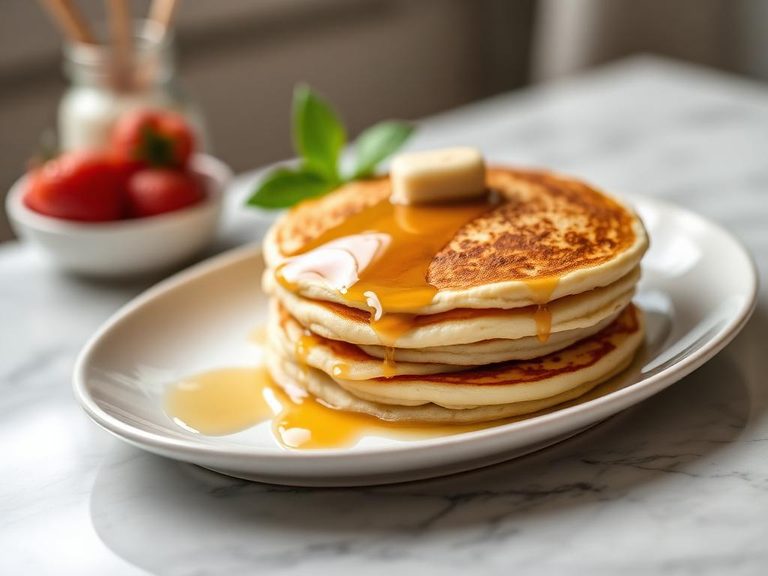
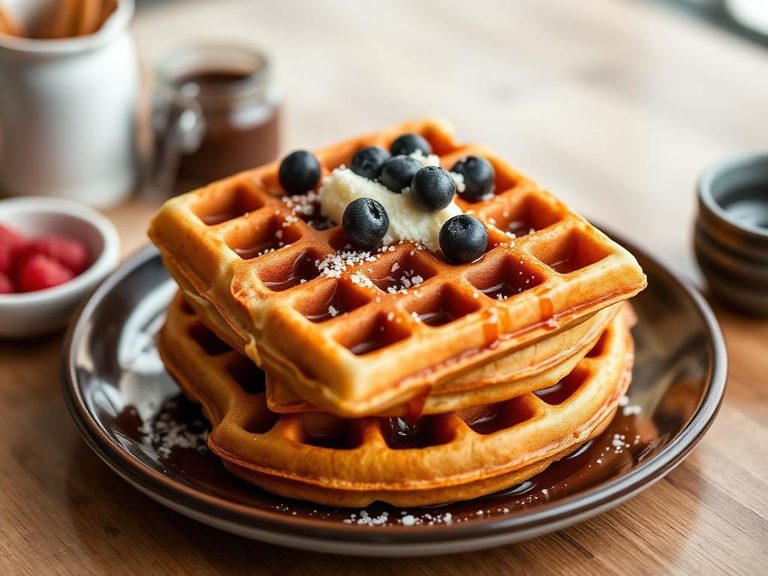
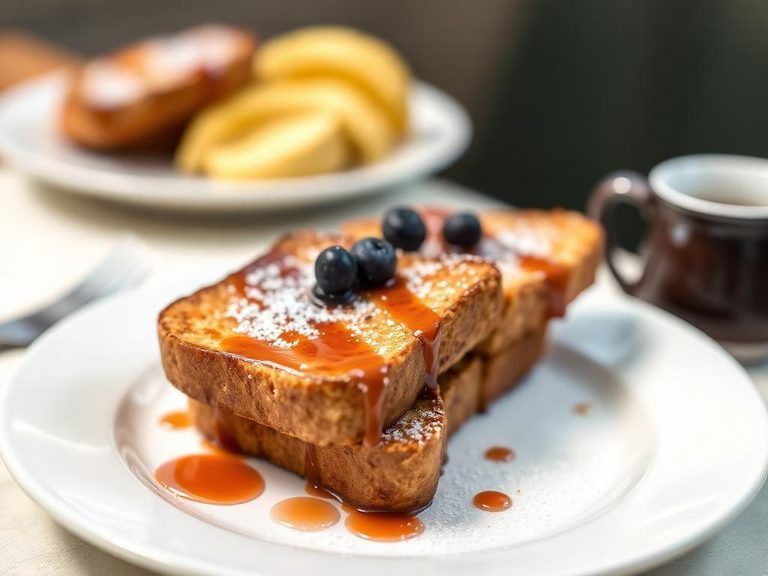
People adore it for its nostalgic, indulgent sweetness and the comforting, familiar buttery aroma it releases when warmed. It's a versatile staple that transforms plain pancakes, waffles, and French toast into a classic, satisfying breakfast treat.
⚠️ Watch-outs & how to enjoy it better
The primary downside is its extremely high sugar content, which can cause rapid blood-sugar spikes, making it a poor choice for those managing diabetes or seeking sustained energy. To counteract this, pair it with a source of protein (like eggs or Greek yogurt) and healthy fats (like nuts or seeds) to slow sugar absorption, and practice strict portion control.
Key benefits
- Provides a quick source of energy from simple carbohydrates.
- Offers a consistent, sweet buttery flavor without the dairy or refrigeration.
- Has a long shelf life and is convenient for storage and use.
- Its thick texture adheres well to breakfast foods without immediate soaking in.
🍽️ Popular dishes

🌍 Where it's eaten
💡 Did you know?
The 'butter' in the name is largely a flavor descriptor; most commercial table blends contain little to no actual butter, relying instead on artificial or natural flavorings to achieve the buttery taste.
Full nutrition (USDA data · scales with serving)
| Water | 26.7 g |
| Energy | 291 kcal |
| Energy | 1216 kj |
| Protein | 0.00 g |
| Total lipid (fat) | 0.09 g |
| Ash | 0.76 g |
| Carbohydrate, by difference | 72.4 g |
| Fiber, total dietary | 0.00 g |
| Total Sugars | 72.3 g |
| Calcium, Ca | 2.0 mg |
| Iron, Fe | 0.09 mg |
| Magnesium, Mg | 0.00 mg |
| Phosphorus, P | 10.0 mg |
| Potassium, K | 3.0 mg |
| Sodium, Na | 287 mg |
| Zinc, Zn | 0.22 mg |
| Copper, Cu | 0.01 mg |
| Manganese, Mn | 0.04 mg |
| Selenium, Se | 0.70 ug |
| Vitamin C, total ascorbic acid | 0.00 mg |
| Thiamin | 0.03 mg |
| Riboflavin | 0.01 mg |
| Niacin | 0.02 mg |
| Pantothenic acid | 0.01 mg |
| Vitamin B-6 | 0.00 mg |
| Folate, total | 0.00 ug |
| Folic acid | 0.00 ug |
| Folate, food | 0.00 ug |
| Folate, DFE | 0.00 ug |
| Choline, total | 0.00 mg |
| Betaine | 0.00 mg |
| Vitamin B-12 | 0.00 ug |
| Vitamin B-12, added | 0.00 ug |
| Vitamin A, RAE | 0.00 ug |
| Retinol | 0.00 ug |
| Carotene, beta | 0.00 ug |
| Carotene, alpha | 0.00 ug |
| Cryptoxanthin, beta | 0.00 ug |
| Vitamin A, IU | 0.00 iu |
| Lycopene | 0.00 ug |
| Lutein + zeaxanthin | 0.00 ug |
| Vitamin E (alpha-tocopherol) | 0.00 mg |
| Vitamin E, added | 0.00 mg |
| Vitamin D (D2 + D3), International Units | 0.00 iu |
| Vitamin D (D2 + D3) | 0.00 ug |
| Vitamin K (phylloquinone) | 0.00 ug |
| Alcohol, ethyl | 0.00 g |
| Caffeine | 0.00 mg |
| Theobromine | 0.00 mg |
Fat & fatty acid profile (per 100g)
| Fatty acids, total saturated | 0.00 g |
| SFA 4:0 | 0.00 g |
| SFA 6:0 | 0.00 g |
| SFA 8:0 | 0.00 g |
| SFA 10:0 | 0.00 g |
| SFA 12:0 | 0.00 g |
| SFA 14:0 | 0.00 g |
| SFA 16:0 | 0.00 g |
| SFA 18:0 | 0.00 g |
| Fatty acids, total monounsaturated | 0.00 g |
| MUFA 16:1 | 0.00 g |
| MUFA 18:1 | 0.00 g |
| MUFA 20:1 | 0.00 g |
| MUFA 22:1 | 0.00 g |
| Fatty acids, total polyunsaturated | 0.00 g |
| PUFA 18:2 | 0.00 g |
| PUFA 18:3 | 0.00 g |
| PUFA 18:4 | 0.00 g |
| PUFA 20:4 | 0.00 g |
| PUFA 20:5 n-3 (EPA) | 0.00 g |
| PUFA 22:5 n-3 (DPA) | 0.00 g |
| PUFA 22:6 n-3 (DHA) | 0.00 g |
| Cholesterol | 0.00 mg |
| Phytosterols | 0.00 mg |
Amino acid profile (per 100g)
Estimated from Syrups, malt — USDA does not publish this profile for Syrups.
| Tryptophan | 0.07 g |
| Threonine | 0.21 g |
| Isoleucine | 0.21 g |
| Leucine | 0.38 g |
| Lysine | 0.27 g |
| Methionine | 0.11 g |
| Cystine | 0.07 g |
| Phenylalanine | 0.26 g |
| Tyrosine | 0.17 g |
| Valine | 0.30 g |
| Arginine | 0.28 g |
| Histidine | 0.13 g |
| Alanine | 0.27 g |
| Aspartic acid | 0.56 g |
| Glutamic acid | 1.0 g |
| Glycine | 0.25 g |
| Proline | 0.46 g |
| Serine | 0.23 g |
FAQ
Is this the same as pure maple syrup?
No. This is a 'table blend,' typically made from corn syrup, sugar, water, and artificial flavoring. Pure maple syrup is a 100% natural product with a more complex flavor profile and different nutritional values.
Can I use this for baking?
Yes, but it will add significant sweetness and moisture. It's often used in recipes for glazed donuts, sweet rolls, or as a component in some cookie doughs for a chewy texture.
Why does it taste like butter?
Manufacturers add 'natural or artificial flavors' that mimic the compound diacetyl, which is the key aroma molecule in real butter.
Nutrient density (calculated · NRF9.3)
Nutrient Rich Foods index: beneficial nutrients (protein, fiber, vitamins, minerals) minus saturated fat, added sugar & sodium, per 100 kcal.
NRF9.3 index — Fulgoni, Keast & Drewnowski, 2009. Computed from USDA nutrients.
Weight-loss friendliness (composite index)
Energy density 2.91 kcal/g · 0% calories from protein · 0.0 g fiber · 72.3 g sugar per 100 g.
Composite of energy density (Rolls et al., 1999), protein & fiber satiety, minus sugar. A calculated heuristic — ranks satiety-per-calorie, not a clinical measure.
Dietary load (calculated from USDA values)
Potential renal acid load. Positive = acid-forming, negative = alkaline-forming.
Sodium-to-potassium ratio: 95.67 (lower is better — aim for ≤ 1)
Sodium:potassium per WHO potassium guidance. Computed from USDA nutrients.