

Potatoes, baked, skin, without salt
Whole food · Vegetables and Vegetable Products

Photo: Wikipedia
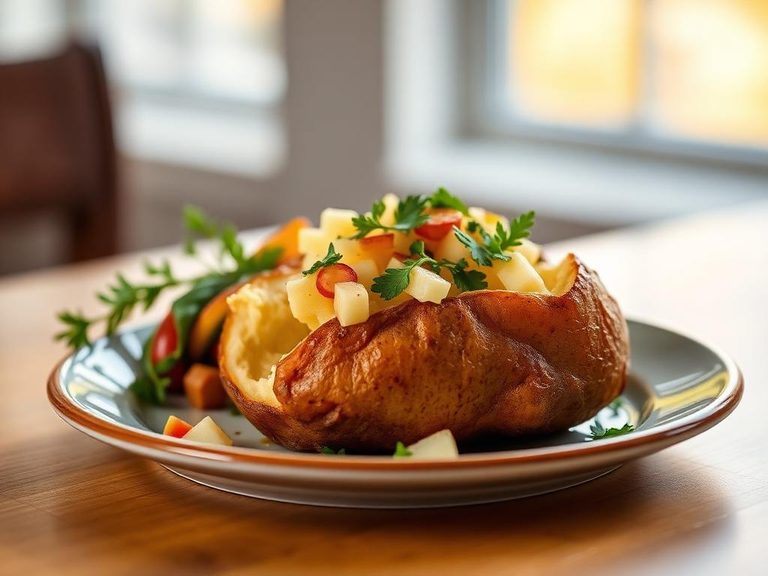
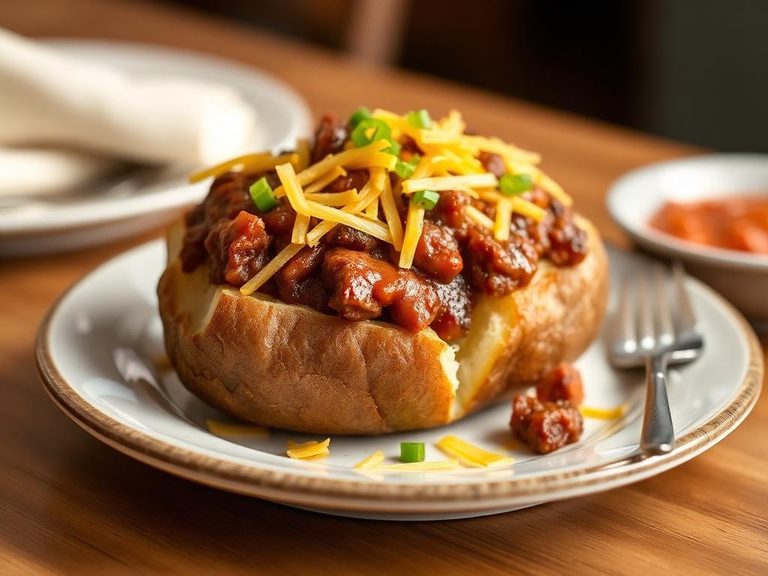
A baked potato with its skin on is a comforting, earthy staple with a fluffy interior and a slightly crisp, nutrient-rich skin. It's a powerhouse of complex carbohydrates and dietary fiber, offering a satisfying, naturally low-fat base for countless meals.
Calorie split: 8% protein · 91% carbs · 0% fat
↓ Full nutrition💚 Why it's loved
People love it for its incredible versatility and hearty, satisfying nature. It's a blank canvas that can be loaded with savory or sweet toppings, making it a beloved comfort food across cultures.
⚠️ Watch-outs & how to enjoy it better
Its high carbohydrate content can lead to rapid blood sugar spikes, especially for those with insulin resistance. To mitigate this, pair it with a protein (like beans or chicken) or a healthy fat (like avocado or olive oil) to slow digestion, and practice portion control. The skin, while nutritious, contains oxalates, which may be a concern for individuals prone to certain kidney stones.
Key benefits
- Excellent source of energy from complex carbohydrates
- High in dietary fiber, especially with the skin on
- Naturally fat-free and low in sodium without added salt
- Good source of potassium and vitamin C
- Provides resistant starch, which supports gut health
🍽️ Popular dishes
🌍 Where it's eaten
💡 Did you know?
The skin of a baked potato contains nearly half of its total fiber and is also a concentrated source of iron and potassium.
Full nutrition (USDA data · scales with serving)
| Water | 47.3 g |
| Energy | 198 kcal |
| Energy | 830 kj |
| Protein | 4.3 g |
| Total lipid (fat) | 0.10 g |
| Ash | 2.2 g |
| Carbohydrate, by difference | 46.1 g |
| Fiber, total dietary | 7.9 g |
| Total Sugars | 1.4 g |
| Calcium, Ca | 34.0 mg |
| Iron, Fe | 7.0 mg |
| Magnesium, Mg | 43.0 mg |
| Phosphorus, P | 101 mg |
| Potassium, K | 573 mg |
| Sodium, Na | 21.0 mg |
| Zinc, Zn | 0.49 mg |
| Copper, Cu | 0.82 mg |
| Manganese, Mn | 0.62 mg |
| Selenium, Se | 0.70 ug |
| Vitamin C, total ascorbic acid | 13.5 mg |
| Thiamin | 0.12 mg |
| Riboflavin | 0.11 mg |
| Niacin | 3.1 mg |
| Pantothenic acid | 0.86 mg |
| Vitamin B-6 | 0.61 mg |
| Folate, total | 22.0 ug |
| Folic acid | 0.00 ug |
| Folate, food | 22.0 ug |
| Folate, DFE | 22.0 ug |
| Choline, total | 31.0 mg |
| Betaine | 0.50 mg |
| Vitamin B-12 | 0.00 ug |
| Vitamin B-12, added | 0.00 ug |
| Vitamin A, RAE | 1.0 ug |
| Retinol | 0.00 ug |
| Carotene, beta | 6.0 ug |
| Carotene, alpha | 0.00 ug |
| Cryptoxanthin, beta | 0.00 ug |
| Vitamin A, IU | 10.0 iu |
| Lycopene | 0.00 ug |
| Lutein + zeaxanthin | 30.0 ug |
| Vitamin E (alpha-tocopherol) | 0.04 mg |
| Vitamin E, added | 0.00 mg |
| Vitamin D (D2 + D3), International Units | 0.00 iu |
| Vitamin D (D2 + D3) | 0.00 ug |
| Vitamin K (phylloquinone) | 1.7 ug |
| Alcohol, ethyl | 0.00 g |
| Caffeine | 0.00 mg |
| Theobromine | 0.00 mg |
Fat & fatty acid profile (per 100g)
| Fatty acids, total saturated | 0.03 g |
| SFA 4:0 | 0.00 g |
| SFA 6:0 | 0.00 g |
| SFA 8:0 | 0.00 g |
| SFA 10:0 | 0.00 g |
| SFA 12:0 | 0.00 g |
| SFA 14:0 | 0.00 g |
| SFA 16:0 | 0.02 g |
| SFA 18:0 | 0.00 g |
| Fatty acids, total monounsaturated | 0.00 g |
| MUFA 16:1 | 0.00 g |
| MUFA 18:1 | 0.00 g |
| MUFA 20:1 | 0.00 g |
| MUFA 22:1 | 0.00 g |
| Fatty acids, total polyunsaturated | 0.04 g |
| PUFA 18:2 | 0.03 g |
| PUFA 18:3 | 0.01 g |
| PUFA 18:4 | 0.00 g |
| PUFA 20:4 | 0.00 g |
| PUFA 20:5 n-3 (EPA) | 0.00 g |
| PUFA 22:5 n-3 (DPA) | 0.00 g |
| PUFA 22:6 n-3 (DHA) | 0.00 g |
| Fatty acids, total trans | 0.00 g |
| Cholesterol | 0.00 mg |
Amino acid profile (per 100g)
Estimated from Potatoes, french fried, all types, salt added in processing, frozen, unprepared — USDA does not publish this profile for Potatoes.
| Tryptophan | 0.02 g |
| Threonine | 0.08 g |
| Isoleucine | 0.08 g |
| Leucine | 0.13 g |
| Lysine | 0.13 g |
| Methionine | 0.04 g |
| Cystine | 0.04 g |
| Phenylalanine | 0.10 g |
| Tyrosine | 0.08 g |
| Valine | 0.12 g |
| Arginine | 0.13 g |
| Histidine | 0.05 g |
| Alanine | 0.09 g |
| Aspartic acid | 0.50 g |
| Glutamic acid | 0.40 g |
| Glycine | 0.07 g |
| Proline | 0.08 g |
| Serine | 0.10 g |
FAQ
Is the skin of a baked potato nutritious?
Yes, the skin is very nutritious. It contains a significant portion of the potato's fiber, as well as vitamins, minerals, and antioxidants. Eating it maximizes the nutritional benefit.
How does baking affect the potato's nutrition compared to boiling?
Baking with the skin on preserves more water-soluble vitamins like vitamin C and potassium than boiling, where they can leach into the cooking water. It also concentrates the natural flavors.
Can I eat baked potatoes on a low-carb diet?
A medium baked potato has about 26 grams of net carbs, which is significant for strict low-carb diets. Those following such diets typically limit or avoid them, opting for lower-carb vegetables instead.
Nutrient density (calculated · NRF9.3)
Nutrient Rich Foods index: beneficial nutrients (protein, fiber, vitamins, minerals) minus saturated fat, added sugar & sodium, per 100 kcal.
NRF9.3 index — Fulgoni, Keast & Drewnowski, 2009. Computed from USDA nutrients.
Weight-loss friendliness (composite index)
Energy density 1.98 kcal/g · 9% calories from protein · 7.9 g fiber · 1.4 g sugar per 100 g.
Composite of energy density (Rolls et al., 1999), protein & fiber satiety, minus sugar. A calculated heuristic — ranks satiety-per-calorie, not a clinical measure.
Dietary load (calculated from USDA values)
Potential renal acid load. Positive = acid-forming, negative = alkaline-forming.
Sodium-to-potassium ratio: 0.04 (lower is better — aim for ≤ 1)
Sodium:potassium per WHO potassium guidance. Computed from USDA nutrients.