

Jams, preserves, marmalade, reduced sugar
Whole food · Sweets

Photo: Wikipedia
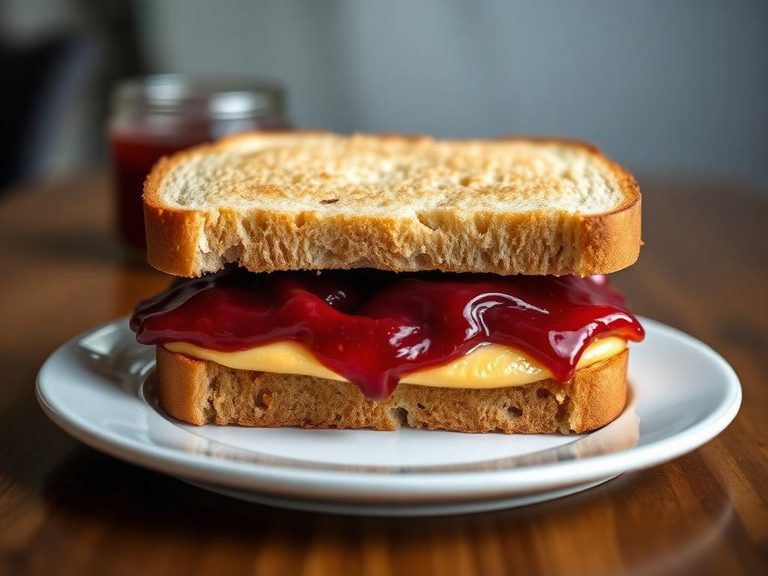
Reduced-sugar jams, preserves, and marmalades are fruit spreads where a portion of the sugar is replaced by sweeteners like polydextrose or fruit juice concentrates, creating a thick, glossy, and spreadable texture with a vibrant, fruity taste. Nutritionally, they offer a similar carbohydrate profile to regular versions but with a modest reduction in total sugars, making them a slightly lighter option for sweetening breakfasts and snacks.
Calorie split: 0% protein · 99% carbs · 1% fat
↓ Full nutrition💚 Why it's loved
People love them for delivering the familiar, comforting taste of fruit preserves with a lighter nutritional profile, allowing for enjoyment without completely forgoing sweetness. Their versatility makes them a staple for spreading on toast, swirled into yogurt, or used as a glaze for meats.
⚠️ Watch-outs & how to enjoy it better
The primary caution is that they are still a concentrated source of carbohydrates and sugars (29.41g per 100g), which can cause blood-sugar spikes if consumed in large amounts, especially for individuals with diabetes. To counteract this, practice strict portion control (e.g., 1 tablespoon) and pair with a source of protein or healthy fat, like whole-grain toast with nut butter or full-fat Greek yogurt, to slow sugar absorption.
Key benefits
- Provides a fruit-based flavor with fewer calories than full-sugar versions
- Offers a modest reduction in sugar content per serving
- Can be part of a balanced diet when used in moderation
- Delivers a quick source of carbohydrates for energy
🍽️ Popular dishes




🌍 Where it's eaten
💡 Did you know?
The term 'jam' originally meant fruit crushed and preserved, while 'preserve' indicated whole fruit pieces suspended in a thick syrup, and 'marmalade' specifically refers to a citrus peel preserve.
Full nutrition (USDA data · scales with serving)
| Water | 62.0 g |
| Energy | 151 kcal |
| Energy | 633 kj |
| Protein | 0.00 g |
| Total lipid (fat) | 0.10 g |
| Ash | 0.30 g |
| Carbohydrate, by difference | 37.6 g |
| Fiber, total dietary | 1.5 g |
| Total Sugars | 29.4 g |
| Calcium, Ca | 0.00 mg |
| Iron, Fe | 0.00 mg |
| Magnesium, Mg | 4.0 mg |
| Phosphorus, P | 7.0 mg |
| Potassium, K | 59.0 mg |
| Sodium, Na | 0.00 mg |
| Zinc, Zn | 0.05 mg |
| Copper, Cu | 0.04 mg |
| Manganese, Mn | 0.29 mg |
| Selenium, Se | 0.40 ug |
| Fluoride, F | 3.3 ug |
| Vitamin C, total ascorbic acid | 15.0 mg |
| Thiamin | 0.01 mg |
| Riboflavin | 0.02 mg |
| Niacin | 0.08 mg |
| Pantothenic acid | 0.09 mg |
| Vitamin B-6 | 0.02 mg |
| Folate, total | 18.0 ug |
| Folic acid | 0.00 ug |
| Folate, food | 18.0 ug |
| Folate, DFE | 18.0 ug |
| Choline, total | 4.2 mg |
| Vitamin B-12 | 0.00 ug |
| Vitamin B-12, added | 0.00 ug |
| Vitamin A, RAE | 0.00 ug |
| Retinol | 0.00 ug |
| Carotene, beta | 5.0 ug |
| Carotene, alpha | 0.00 ug |
| Cryptoxanthin, beta | 0.00 ug |
| Vitamin A, IU | 9.0 iu |
| Lycopene | 0.00 ug |
| Lutein + zeaxanthin | 20.0 ug |
| Vitamin E (alpha-tocopherol) | 0.21 mg |
| Vitamin E, added | 0.00 mg |
| Vitamin D (D2 + D3), International Units | 0.00 iu |
| Vitamin D (D2 + D3) | 0.00 ug |
| Vitamin K (phylloquinone) | 1.6 ug |
| Vitamin K (Dihydrophylloquinone) | 0.00 ug |
| Alcohol, ethyl | 0.00 g |
| Caffeine | 0.00 mg |
| Theobromine | 0.00 mg |
Fat & fatty acid profile (per 100g)
| Fatty acids, total saturated | 0.01 g |
| SFA 4:0 | 0.00 g |
| SFA 6:0 | 0.00 g |
| SFA 8:0 | 0.00 g |
| SFA 10:0 | 0.00 g |
| SFA 12:0 | 0.00 g |
| SFA 14:0 | 0.00 g |
| SFA 16:0 | 0.00 g |
| SFA 18:0 | 0.00 g |
| Fatty acids, total monounsaturated | 0.01 g |
| MUFA 16:1 | 0.00 g |
| MUFA 18:1 | 0.01 g |
| MUFA 20:1 | 0.00 g |
| MUFA 22:1 | 0.00 g |
| Fatty acids, total polyunsaturated | 0.05 g |
| PUFA 18:2 | 0.03 g |
| PUFA 18:3 | 0.02 g |
| PUFA 18:4 | 0.00 g |
| PUFA 20:4 | 0.00 g |
| PUFA 20:5 n-3 (EPA) | 0.00 g |
| PUFA 22:5 n-3 (DPA) | 0.00 g |
| PUFA 22:6 n-3 (DHA) | 0.00 g |
| Cholesterol | 0.00 mg |
Amino acid profile (per 100g)
Estimated from Jams and preserves — USDA does not publish this profile for Jams.
| Tryptophan | 0.01 g |
| Threonine | 0.02 g |
| Isoleucine | 0.02 g |
| Leucine | 0.04 g |
| Lysine | 0.03 g |
| Methionine | 0.00 g |
| Cystine | 0.01 g |
| Phenylalanine | 0.02 g |
| Tyrosine | 0.03 g |
| Valine | 0.02 g |
| Arginine | 0.03 g |
| Histidine | 0.01 g |
| Alanine | 0.04 g |
| Aspartic acid | 0.17 g |
| Glutamic acid | 0.11 g |
| Glycine | 0.03 g |
| Proline | 0.02 g |
| Serine | 0.03 g |
FAQ
How is reduced-sugar jam different from regular jam?
Reduced-sugar jams replace a portion of the sucrose with other sweeteners or bulking agents like polydextrose, fruit juice concentrates, or sugar alcohols, resulting in a lower total sugar and sometimes calorie count while attempting to maintain a similar taste and texture.
Can I use reduced-sugar jam for canning or baking?
It is not recommended for home canning as the altered sugar ratio can affect the gel set and safety. For baking, it can be used as a filling or glaze, but may not caramelize or set the same way as full-sugar jam.
Does 'reduced sugar' mean it's low-carb or keto-friendly?
No. With 37.6g of carbohydrates per 100g, it is still a high-carbohydrate food. The 'reduced sugar' claim is relative to a standard jam, not to a low-carb diet.
Nutrient density (calculated · NRF9.3)
Nutrient Rich Foods index: beneficial nutrients (protein, fiber, vitamins, minerals) minus saturated fat, added sugar & sodium, per 100 kcal.
NRF9.3 index — Fulgoni, Keast & Drewnowski, 2009. Computed from USDA nutrients.
Weight-loss friendliness (composite index)
Energy density 1.51 kcal/g · 0% calories from protein · 1.5 g fiber · 29.4 g sugar per 100 g.
Composite of energy density (Rolls et al., 1999), protein & fiber satiety, minus sugar. A calculated heuristic — ranks satiety-per-calorie, not a clinical measure.
Dietary load (calculated from USDA values)
Potential renal acid load. Positive = acid-forming, negative = alkaline-forming.
Sodium-to-potassium ratio: 0.00 (lower is better — aim for ≤ 1)
Sodium:potassium per WHO potassium guidance. Computed from USDA nutrients.