

Fish, salmon, chinook, smoked
Whole food · Finfish and Shellfish Products

Photo: Wikipedia
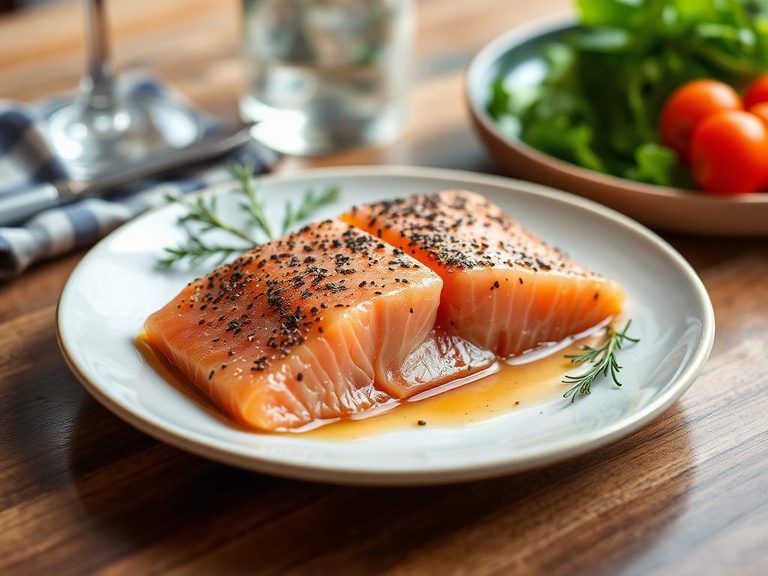
Chinook salmon, prized for its high oil content, is transformed by cold-smoking into a silky, luxuriously fatty delicacy with a deep, savory flavor. The process yields a vibrant, coral-pink flesh that is tender and almost buttery, with a pronounced smoky aroma. It's a nutritional powerhouse, delivering an exceptional amount of protein with virtually no carbohydrates.
Calorie split: 65% protein · 0% carbs · 35% fat
↓ Full nutrition💚 Why it's loved
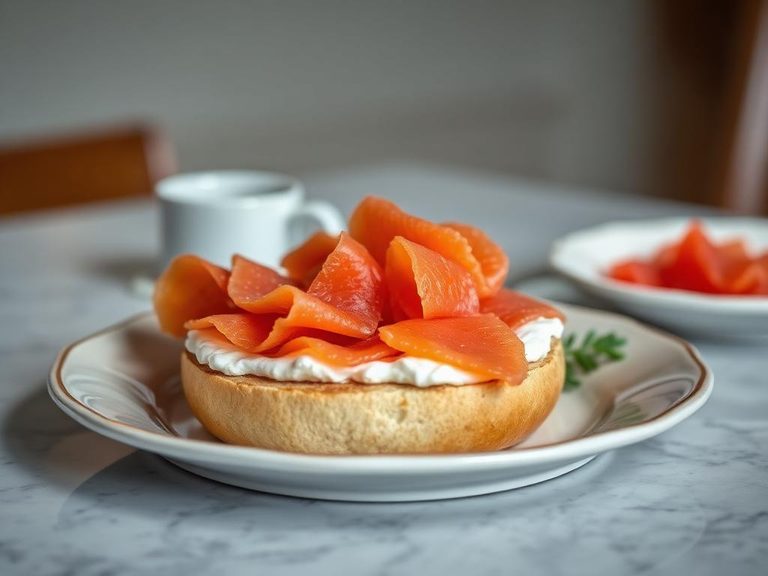
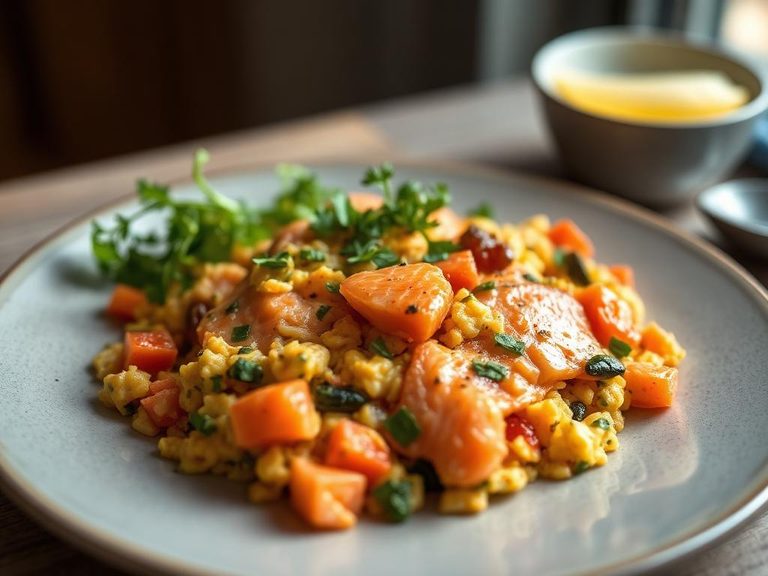
People adore its intensely rich, smoky flavor and melt-in-the-mouth texture, which make it a luxurious centerpiece for appetizers and brunch. Its versatility allows it to shine in everything from elegant canapés to simple bagel toppings.
⚠️ Watch-outs & how to enjoy it better
The smoking process can result in high sodium content, which may be a concern for those monitoring salt intake. As a fish, it is a common allergen. To manage sodium, look for low-sodium varieties or rinse slices briefly before serving, and always practice strict portion control.
Key benefits
- Excellent source of complete, high-quality protein
- Rich in heart-healthy omega-3 fatty acids (EPA and DHA)
- Provides significant vitamin D and B12
- Naturally low in carbohydrates and sugar
🍽️ Popular dishes
🌍 Where it's eaten
💡 Did you know?
Chinook salmon is also known as 'King Salmon' for its large size and rich flavor, and the wild populations in the Pacific Northwest are so culturally significant that they are legally protected as a 'treasured resource' in several treaties.
Full nutrition (USDA data · scales with serving)
| Water | 72.0 g |
| Energy | 117 kcal |
| Energy | 490 kj |
| Protein | 18.3 g |
| Total lipid (fat) | 4.3 g |
| Ash | 2.6 g |
| Carbohydrate, by difference | 0.00 g |
| Fiber, total dietary | 0.00 g |
| Total Sugars | 0.00 g |
| Calcium, Ca | 11.0 mg |
| Iron, Fe | 0.85 mg |
| Magnesium, Mg | 18.0 mg |
| Phosphorus, P | 164 mg |
| Potassium, K | 175 mg |
| Sodium, Na | 672 mg |
| Zinc, Zn | 0.31 mg |
| Copper, Cu | 0.23 mg |
| Manganese, Mn | 0.02 mg |
| Selenium, Se | 32.4 ug |
| Vitamin C, total ascorbic acid | 0.00 mg |
| Thiamin | 0.02 mg |
| Riboflavin | 0.10 mg |
| Niacin | 4.7 mg |
| Pantothenic acid | 0.87 mg |
| Vitamin B-6 | 0.28 mg |
| Folate, total | 2.0 ug |
| Folic acid | 0.00 ug |
| Folate, food | 2.0 ug |
| Folate, DFE | 2.0 ug |
| Choline, total | 89.0 mg |
| Vitamin B-12 | 3.3 ug |
| Vitamin B-12, added | 0.00 ug |
| Vitamin A, RAE | 26.0 ug |
| Retinol | 26.0 ug |
| Carotene, beta | 0.00 ug |
| Carotene, alpha | 0.00 ug |
| Cryptoxanthin, beta | 0.00 ug |
| Vitamin A, IU | 87.0 iu |
| Lycopene | 0.00 ug |
| Lutein + zeaxanthin | 0.00 ug |
| Vitamin E (alpha-tocopherol) | 1.4 mg |
| Vitamin E, added | 0.00 mg |
| Vitamin D (D2 + D3), International Units | 685 iu |
| Vitamin D (D2 + D3) | 17.1 ug |
| Vitamin D3 (cholecalciferol) | 17.1 ug |
| Vitamin K (phylloquinone) | 0.10 ug |
| Alcohol, ethyl | 0.00 g |
| Caffeine | 0.00 mg |
| Theobromine | 0.00 mg |
Fat & fatty acid profile (per 100g)
| Fatty acids, total saturated | 0.93 g |
| SFA 4:0 | 0.00 g |
| SFA 6:0 | 0.00 g |
| SFA 8:0 | 0.00 g |
| SFA 10:0 | 0.00 g |
| SFA 12:0 | 0.00 g |
| SFA 14:0 | 0.18 g |
| SFA 16:0 | 0.56 g |
| SFA 18:0 | 0.19 g |
| Fatty acids, total monounsaturated | 2.0 g |
| MUFA 16:1 | 0.30 g |
| MUFA 18:1 | 0.95 g |
| MUFA 20:1 | 0.47 g |
| MUFA 22:1 | 0.30 g |
| Fatty acids, total polyunsaturated | 0.99 g |
| PUFA 18:2 | 0.47 g |
| PUFA 18:3 | 0.00 g |
| PUFA 18:4 | 0.00 g |
| PUFA 20:4 | 0.00 g |
| PUFA 20:5 n-3 (EPA) | 0.18 g |
| PUFA 22:5 n-3 (DPA) | 0.07 g |
| PUFA 22:6 n-3 (DHA) | 0.27 g |
| Cholesterol | 23.0 mg |
Amino acid profile (per 100g)
| Tryptophan | 0.20 g |
| Threonine | 0.80 g |
| Isoleucine | 0.84 g |
| Leucine | 1.5 g |
| Lysine | 1.7 g |
| Methionine | 0.54 g |
| Cystine | 0.20 g |
| Phenylalanine | 0.71 g |
| Tyrosine | 0.62 g |
| Valine | 0.94 g |
| Arginine | 1.1 g |
| Histidine | 0.54 g |
| Alanine | 1.1 g |
| Aspartic acid | 1.9 g |
| Glutamic acid | 2.7 g |
| Glycine | 0.88 g |
| Proline | 0.65 g |
| Serine | 0.75 g |
FAQ
Is smoked salmon cooked?
It is typically 'cold-smoked,' meaning it is cured and exposed to smoke at low temperatures (below 80°F/27°C). This process does not fully cook the fish, so it retains a raw-like, silky texture. It is safe to eat as-is but can be cooked further.
How is it different from lox?
Lox is traditionally cured only in a salt brine (and sometimes sugar), with no smoking step. Smoked salmon undergoes both curing and smoking, giving it a distinct smoky flavor absent in pure lox.
What's the best way to store it?
Keep it refrigerated at 32-38°F (0-3°C) in its original sealed packaging or wrapped tightly. Consume within 3-5 days of opening. It can also be frozen for up to 3 months, though the texture may become slightly drier upon thawing.
Nutrient density (calculated · NRF9.3)
Nutrient Rich Foods index: beneficial nutrients (protein, fiber, vitamins, minerals) minus saturated fat, added sugar & sodium, per 100 kcal.
NRF9.3 index — Fulgoni, Keast & Drewnowski, 2009. Computed from USDA nutrients.
Weight-loss friendliness (composite index)
Energy density 1.17 kcal/g · 62% calories from protein · 0.0 g fiber · 0.0 g sugar per 100 g.
Composite of energy density (Rolls et al., 1999), protein & fiber satiety, minus sugar. A calculated heuristic — ranks satiety-per-calorie, not a clinical measure.
Dietary load (calculated from USDA values)
Potential renal acid load. Positive = acid-forming, negative = alkaline-forming.
Sodium-to-potassium ratio: 3.84 (lower is better — aim for ≤ 1)
Sodium:potassium per WHO potassium guidance. Computed from USDA nutrients.