

Eggs, scrambled, frozen mixture
Whole food · Dairy and Egg Products

Photo: Wikipedia
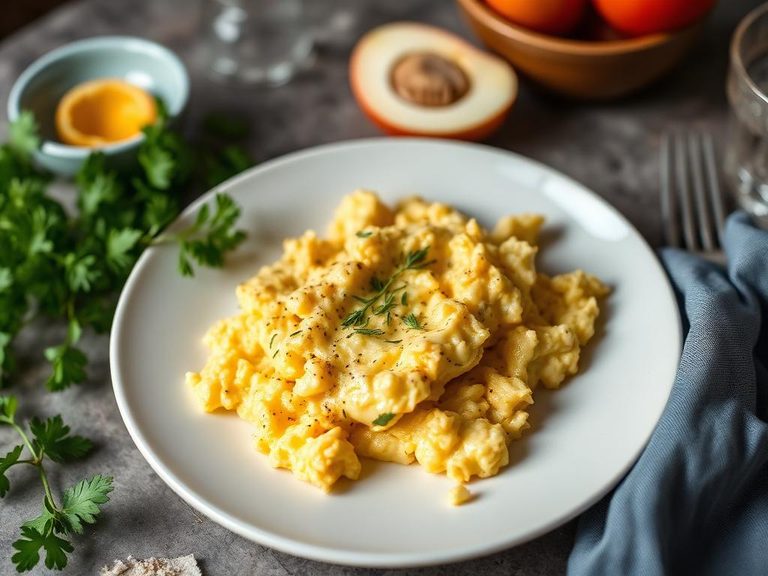
This is a convenient, pre-mixed liquid or semi-solid blend of eggs, often with added milk, salt, and sometimes other ingredients, designed to be scrambled directly from a frozen state. It cooks up into soft, tender curds with a mild, familiar eggy flavor and a slightly uniform, less rich texture than freshly beaten eggs. Nutritionally, it's a solid source of protein with a moderate calorie count, but watch for added sugars and potential sodium.
Calorie split: 39% protein · 23% carbs · 38% fat
↓ Full nutrition💚 Why it's loved
People love it for its absolute convenience and reliability; it's a foolproof way to get a protein-packed meal on the table in minutes, making it a staple for busy families, students, and institutional kitchens like schools and cafeterias.
⚠️ Watch-outs & how to enjoy it better
The texture can be less custardy and more uniformly spongy than fresh scrambled eggs, and the added sugars (7.5g per 100g) might surprise those watching their intake. To counteract, pair it with high-fiber vegetables like spinach or bell peppers to slow sugar absorption, and consider adding a sprinkle of cheese for extra fat and flavor to improve mouthfeel.
Key benefits
- Excellent source of high-quality protein (13.1g per 100g)
- Convenient and time-saving for quick meals
- Consistent texture and flavor every time
- Low in fat compared to many breakfast proteins
- Fortified with vitamins and minerals in some brands
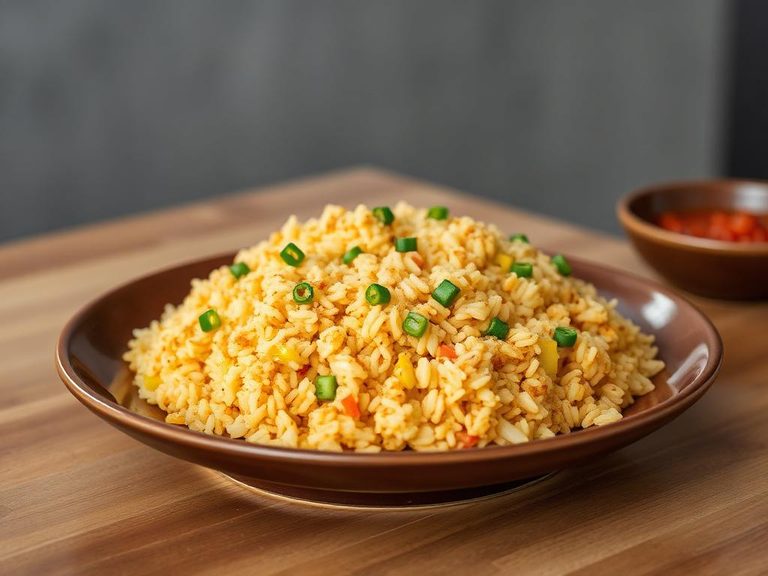
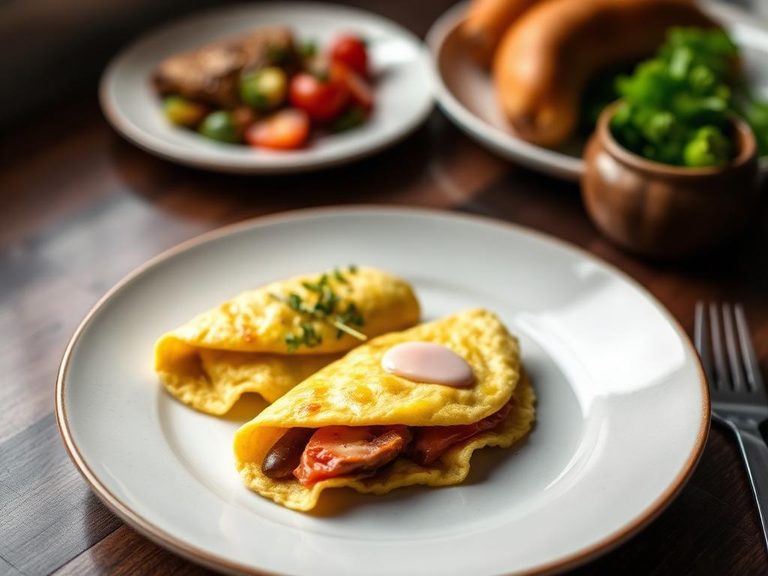
🍽️ Popular dishes
🌍 Where it's eaten
💡 Did you know?
The frozen scrambled egg mixture was a key innovation for the U.S. military and NASA, providing a shelf-stable, quick-prep protein source for soldiers and astronauts alike.
Full nutrition (USDA data · scales with serving)
| Water | 72.7 g |
| Energy | 131 kcal |
| Energy | 548 kj |
| Protein | 13.1 g |
| Total lipid (fat) | 5.6 g |
| Ash | 1.1 g |
| Carbohydrate, by difference | 7.5 g |
| Fiber, total dietary | 0.00 g |
| Total Sugars | 7.5 g |
| Calcium, Ca | 17.0 mg |
| Iron, Fe | 0.23 mg |
| Magnesium, Mg | 10.0 mg |
| Phosphorus, P | 30.0 mg |
| Potassium, K | 147 mg |
| Sodium, Na | 162 mg |
| Zinc, Zn | 0.14 mg |
| Copper, Cu | 0.03 mg |
| Selenium, Se | 22.9 ug |
| Vitamin C, total ascorbic acid | 0.00 mg |
| Thiamin | 0.01 mg |
| Riboflavin | 0.30 mg |
| Niacin | 0.09 mg |
| Vitamin B-6 | 0.01 mg |
| Folate, total | 17.0 ug |
| Folic acid | 0.00 ug |
| Folate, food | 17.0 ug |
| Folate, DFE | 17.0 ug |
| Choline, total | 256 mg |
| Vitamin B-12 | 0.17 ug |
| Vitamin B-12, added | 0.00 ug |
| Vitamin A, RAE | 21.0 ug |
| Retinol | 0.00 ug |
| Carotene, beta | 246 ug |
| Carotene, alpha | 0.00 ug |
| Cryptoxanthin, beta | 0.00 ug |
| Vitamin A, IU | 410 iu |
| Lycopene | 0.00 ug |
| Lutein + zeaxanthin | 0.00 ug |
| Vitamin E (alpha-tocopherol) | 0.84 mg |
| Vitamin E, added | 0.00 mg |
| Vitamin D (D2 + D3), International Units | 72.0 iu |
| Vitamin D (D2 + D3) | 1.8 ug |
| Vitamin D3 (cholecalciferol) | 1.8 ug |
| Vitamin K (phylloquinone) | 1.8 ug |
| Alcohol, ethyl | 0.00 g |
| Caffeine | 0.00 mg |
| Theobromine | 0.00 mg |
Fat & fatty acid profile (per 100g)
| Fatty acids, total saturated | 1.1 g |
| SFA 4:0 | 0.00 g |
| SFA 6:0 | 0.00 g |
| SFA 8:0 | 0.00 g |
| SFA 10:0 | 0.00 g |
| SFA 12:0 | 0.00 g |
| SFA 14:0 | 0.01 g |
| SFA 16:0 | 0.72 g |
| SFA 18:0 | 0.32 g |
| Fatty acids, total monounsaturated | 2.3 g |
| MUFA 16:1 | 0.06 g |
| MUFA 18:1 | 2.3 g |
| MUFA 20:1 | 0.00 g |
| MUFA 22:1 | 0.00 g |
| Fatty acids, total polyunsaturated | 1.8 g |
| PUFA 18:2 | 1.6 g |
| PUFA 18:3 | 0.12 g |
| PUFA 18:4 | 0.00 g |
| PUFA 20:4 | 0.02 g |
| PUFA 20:5 n-3 (EPA) | 0.00 g |
| PUFA 22:5 n-3 (DPA) | 0.00 g |
| PUFA 22:6 n-3 (DHA) | 0.01 g |
| Cholesterol | 277 mg |
Amino acid profile (per 100g)
Estimated from Eggs, Grade A, Large, egg whole — USDA does not publish this profile for Eggs.
| Tryptophan | 0.17 g |
| Threonine | 0.59 g |
| Isoleucine | 0.62 g |
| Leucine | 1.1 g |
| Lysine | 0.83 g |
| Methionine | 0.42 g |
| Phenylalanine | 0.66 g |
| Tyrosine | 0.51 g |
| Valine | 0.73 g |
| Arginine | 0.79 g |
| Histidine | 0.28 g |
| Alanine | 0.67 g |
| Aspartic acid | 1.3 g |
| Glutamic acid | 1.6 g |
| Glycine | 0.41 g |
| Proline | 0.56 g |
| Serine | 0.92 g |
| Hydroxyproline | 0.00 g |
| Cysteine | 0.39 g |
FAQ
Is frozen scrambled egg mixture as nutritious as fresh eggs?
It's very close. The primary nutritional profile (protein, fats) is preserved through flash-freezing. However, check labels for added ingredients like milk, salt, or sugar which alter the nutritional content compared to plain eggs.
Why does it contain sugar?
Small amounts of sugar are often added to commercial mixes to enhance browning, improve texture, and balance flavors, especially in products meant for quick-service restaurants.
Can I use it for baking?
Yes, it can be a convenient substitute for beaten eggs in many baking recipes like cakes, muffins, and pancakes. Thaw it first and measure by volume or weight as specified in your recipe.
Nutrient density (calculated · NRF9.3)
Nutrient Rich Foods index: beneficial nutrients (protein, fiber, vitamins, minerals) minus saturated fat, added sugar & sodium, per 100 kcal.
NRF9.3 index — Fulgoni, Keast & Drewnowski, 2009. Computed from USDA nutrients.
Weight-loss friendliness (composite index)
Energy density 1.31 kcal/g · 40% calories from protein · 0.0 g fiber · 7.5 g sugar per 100 g.
Composite of energy density (Rolls et al., 1999), protein & fiber satiety, minus sugar. A calculated heuristic — ranks satiety-per-calorie, not a clinical measure.
Dietary load (calculated from USDA values)
Potential renal acid load. Positive = acid-forming, negative = alkaline-forming.
Sodium-to-potassium ratio: 1.10 (lower is better — aim for ≤ 1)
Sodium:potassium per WHO potassium guidance. Computed from USDA nutrients.