

Bratwurst, pork, cooked
Whole food · Sausages and Luncheon Meats

Photo: Wikipedia
Bratwurst is a finely ground, seasoned German pork sausage, typically encased in a natural casing and cooked until the exterior is golden-brown and slightly crisp, yielding a juicy, savory, and herb-forward interior. Nutritionally, it is a dense source of energy and protein, with nearly 30 grams of fat per 100 grams providing a rich mouthfeel and long-lasting satiety.
Calorie split: 17% protein · 3% carbs · 80% fat
↓ Full nutrition💚 Why it's loved
People adore the bratwurst for its signature juicy snap and deep, savory flavor profile that balances garlic, marjoram, and caraway. It's a beloved centerpiece of casual gatherings, from German beer gardens to American backyard grills, symbolizing hearty, communal comfort food.
⚠️ Watch-outs & how to enjoy it better
Its high saturated fat and sodium content can be a concern for heart health and blood pressure management. To counteract this, pair it with fiber-rich sides like sauerkraut or roasted vegetables, and practice portion control by treating it as a flavorful accent within a larger, balanced meal rather than the sole protein.
Key benefits
- High-quality complete protein for muscle maintenance
- Excellent source of energy-dense calories for active lifestyles
- Rich in B vitamins, especially B12 and niacin, from pork
- Contains essential minerals like zinc and selenium
🍽️ Popular dishes

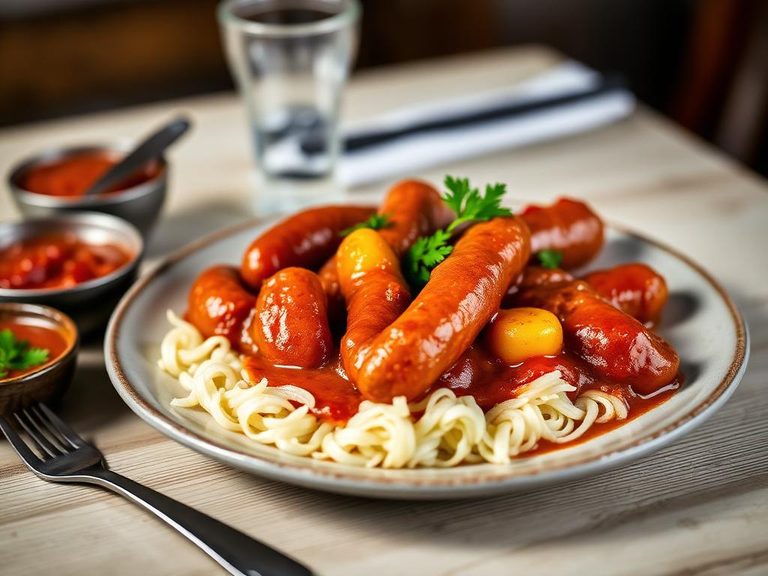
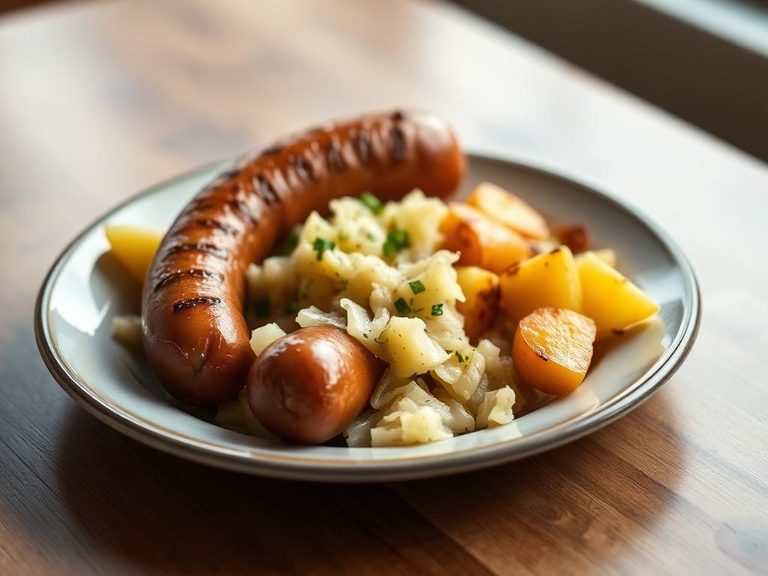
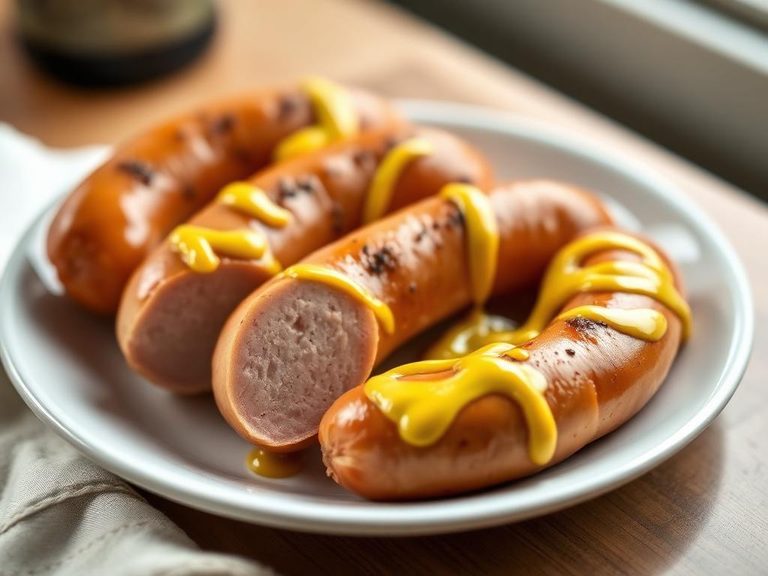
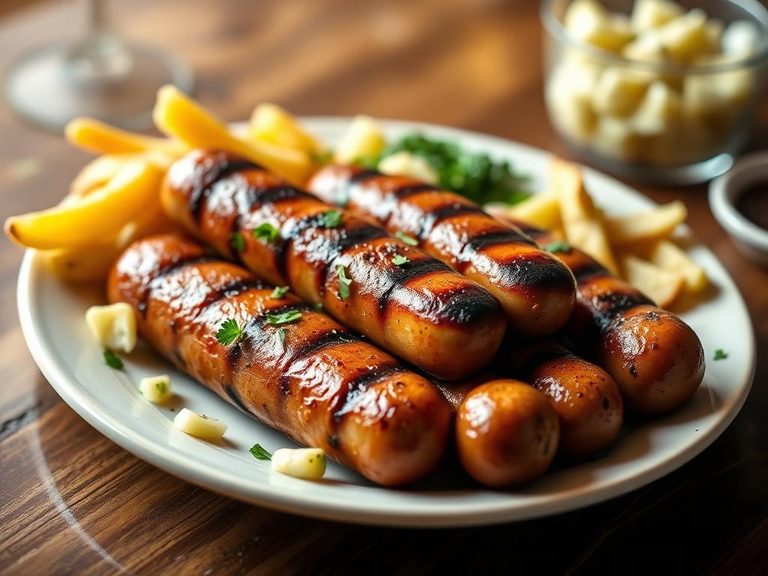
🌍 Where it's eaten
💡 Did you know?
The city of Nuremberg is so famous for its tiny, thumb-sized Bratwurst (Nürnberger Rostbratwurst) that it has a protected geographical indication (PGI) under EU law, specifying they must be no longer than 7-9 cm.
Full nutrition (USDA data · scales with serving)
| Water | 51.5 g |
| Energy | 333 kcal |
| Energy | 1393 kj |
| Protein | 13.7 g |
| Total lipid (fat) | 29.2 g |
| Ash | 2.8 g |
| Carbohydrate, by difference | 2.9 g |
| Fiber, total dietary | 0.00 g |
| Total Sugars | 0.00 g |
| Calcium, Ca | 28.0 mg |
| Iron, Fe | 0.53 mg |
| Magnesium, Mg | 21.0 mg |
| Phosphorus, P | 208 mg |
| Potassium, K | 348 mg |
| Sodium, Na | 846 mg |
| Zinc, Zn | 3.3 mg |
| Copper, Cu | 0.10 mg |
| Manganese, Mn | 0.01 mg |
| Selenium, Se | 39.7 ug |
| Vitamin C, total ascorbic acid | 0.00 mg |
| Thiamin | 0.46 mg |
| Riboflavin | 0.31 mg |
| Niacin | 4.8 mg |
| Pantothenic acid | 0.67 mg |
| Vitamin B-6 | 0.33 mg |
| Folate, total | 3.0 ug |
| Folic acid | 0.00 ug |
| Folate, food | 3.0 ug |
| Folate, DFE | 3.0 ug |
| Choline, total | 94.0 mg |
| Betaine | 3.6 mg |
| Vitamin B-12 | 0.73 ug |
| Vitamin B-12, added | 0.00 ug |
| Vitamin A, RAE | 2.0 ug |
| Retinol | 2.0 ug |
| Carotene, beta | 0.00 ug |
| Carotene, alpha | 0.00 ug |
| Cryptoxanthin, beta | 0.00 ug |
| Vitamin A, IU | 6.0 iu |
| Lycopene | 0.00 ug |
| Lutein + zeaxanthin | 0.00 ug |
| Vitamin E (alpha-tocopherol) | 0.26 mg |
| Vitamin E, added | 0.00 mg |
| Vitamin D (D2 + D3), International Units | 44.0 iu |
| Vitamin D (D2 + D3) | 1.1 ug |
| Vitamin K (phylloquinone) | 3.4 ug |
| Vitamin K (Dihydrophylloquinone) | 0.00 ug |
| Alcohol, ethyl | 0.00 g |
| Caffeine | 0.00 mg |
| Theobromine | 0.00 mg |
Fat & fatty acid profile (per 100g)
| Fatty acids, total saturated | 10.0 g |
| SFA 4:0 | 0.00 g |
| SFA 6:0 | 0.00 g |
| SFA 8:0 | 0.00 g |
| SFA 10:0 | 0.01 g |
| SFA 12:0 | 0.01 g |
| SFA 14:0 | 0.34 g |
| SFA 16:0 | 6.2 g |
| SFA 18:0 | 3.4 g |
| Fatty acids, total monounsaturated | 14.7 g |
| MUFA 16:1 | 0.87 g |
| MUFA 18:1 | 13.6 g |
| MUFA 20:1 | 0.27 g |
| MUFA 22:1 | 0.00 g |
| Fatty acids, total polyunsaturated | 2.6 g |
| PUFA 18:2 | 2.4 g |
| PUFA 18:3 | 0.10 g |
| PUFA 18:4 | 0.00 g |
| PUFA 20:4 | 0.11 g |
| PUFA 20:5 n-3 (EPA) | 0.00 g |
| PUFA 22:5 n-3 (DPA) | 0.00 g |
| PUFA 22:6 n-3 (DHA) | 0.00 g |
| Cholesterol | 74.0 mg |
| Phytosterols | 0.00 mg |
Amino acid profile (per 100g)
| Tryptophan | 0.35 g |
| Threonine | 1.2 g |
| Isoleucine | 1.3 g |
| Leucine | 2.2 g |
| Lysine | 2.5 g |
| Methionine | 0.72 g |
| Cystine | 0.35 g |
| Phenylalanine | 1.1 g |
| Tyrosine | 0.95 g |
| Valine | 1.5 g |
| Arginine | 1.7 g |
| Histidine | 1.1 g |
| Alanine | 1.6 g |
| Aspartic acid | 2.5 g |
| Glutamic acid | 4.3 g |
| Glycine | 1.3 g |
| Proline | 1.1 g |
| Serine | 1.1 g |
FAQ
What's the difference between bratwurst and other sausages like hot dogs?
Bratwurst is typically raw, fresh pork sausage that must be cooked before eating, offering a coarser grind and distinct herb seasoning. Hot dogs are pre-cooked, emulsified sausages with a smoother texture and different spice profile.
Is bratwurst gluten-free?
Traditional bratwurst is gluten-free, made from pork, fat, and spices. However, some commercial brands may use fillers or binders containing wheat, so always check the ingredient label for certified gluten-free options.
What's the best way to cook bratwurst to prevent it from bursting?
The key is to cook it gently. Start by simmering in beer or water until just cooked through (about 10-15 minutes), then finish on a preheated grill or in a skillet to brown the exterior. Avoid piercing the casing with a fork, as this lets the juices escape.
Nutrient density (calculated · NRF9.3)
Nutrient Rich Foods index: beneficial nutrients (protein, fiber, vitamins, minerals) minus saturated fat, added sugar & sodium, per 100 kcal.
NRF9.3 index — Fulgoni, Keast & Drewnowski, 2009. Computed from USDA nutrients.
Weight-loss friendliness (composite index)
Energy density 3.33 kcal/g · 16% calories from protein · 0.0 g fiber · 0.0 g sugar per 100 g.
Composite of energy density (Rolls et al., 1999), protein & fiber satiety, minus sugar. A calculated heuristic — ranks satiety-per-calorie, not a clinical measure.
Dietary load (calculated from USDA values)
Potential renal acid load. Positive = acid-forming, negative = alkaline-forming.
Sodium-to-potassium ratio: 2.43 (lower is better — aim for ≤ 1)
Sodium:potassium per WHO potassium guidance. Computed from USDA nutrients.