

Beverages, Energy Drink, Monster, fortified with vitamins C, B2, B3, B6, B12
Whole food · Beverages
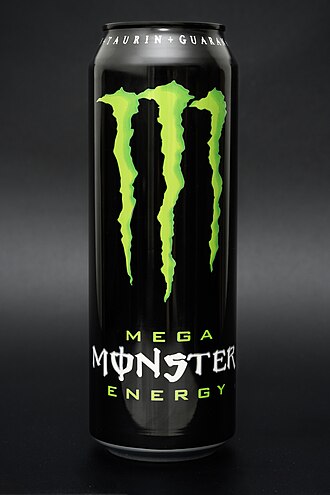
Photo: Wikipedia
This is a classic, carbonated energy drink with a bright, citrusy-green color and a sweet, tangy flavor profile reminiscent of citrus candy. It delivers a quick hit of sugar and B-vitamins, designed for a rapid energy boost. Nutritionally, it's almost entirely simple carbohydrates, providing 47 calories and nearly 11 grams of sugar per 100ml.
Calorie split: 4% protein · 96% carbs · 0% fat
↓ Full nutrition💚 Why it's loved
People love it for its intensely sweet, citrus-burst flavor and the immediate, noticeable jolt of alertness and energy it provides. It's deeply embedded in gaming, music, and extreme sports culture as a go-to performance and social beverage.
⚠️ Watch-outs & how to enjoy it better
The high sugar content (10.93g per 100g) can lead to a rapid blood-sugar spike followed by a crash, potentially increasing hunger and fatigue later. To counteract this, pair it with a source of protein or healthy fat (like nuts or yogurt) to slow sugar absorption, or opt for a zero-sugar version. Those sensitive to caffeine should be cautious with portion size and timing.
Key benefits
- Provides a quick source of calories and carbohydrates for energy.
- Fortified with B-vitamins (B2, B3, B6, B12) involved in energy metabolism.
- Contains Vitamin C as an antioxidant.
- Zero fat and zero protein.
- Highly portable and widely available for immediate consumption.
🍽️ Popular dishes

🌍 Where it's eaten
💡 Did you know?
The original Monster Energy drink was launched in 2002 in a distinctive black can with a green 'M' claw mark, designed to look like it had been torn open by a monster's claws.
Full nutrition (USDA data · scales with serving)
| Water | 88.0 g |
| Energy | 47.0 kcal |
| Energy | 197 kj |
| Protein | 0.47 g |
| Total lipid (fat) | 0.00 g |
| Ash | 0.19 g |
| Carbohydrate, by difference | 11.3 g |
| Fiber, total dietary | 0.00 g |
| Total Sugars | 10.9 g |
| Sucrose | 4.4 g |
| Glucose | 4.1 g |
| Fructose | 2.4 g |
| Lactose | 0.00 g |
| Maltose | 0.00 g |
| Galactose | 0.00 g |
| Calcium, Ca | 0.00 mg |
| Iron, Fe | 0.04 mg |
| Magnesium, Mg | 0.00 mg |
| Phosphorus, P | 0.00 mg |
| Potassium, K | 2.0 mg |
| Sodium, Na | 77.0 mg |
| Zinc, Zn | 0.01 mg |
| Copper, Cu | 0.00 mg |
| Manganese, Mn | 0.01 mg |
| Selenium, Se | 0.00 ug |
| Vitamin C, total ascorbic acid | 0.00 mg |
| Thiamin | 0.04 mg |
| Riboflavin | 0.81 mg |
| Niacin | 10.2 mg |
| Pantothenic acid | 0.00 mg |
| Vitamin B-6 | 1.0 mg |
| Folate, total | 0.00 ug |
| Folic acid | 0.00 ug |
| Folate, food | 0.00 ug |
| Folate, DFE | 0.00 ug |
| Choline, total | 0.00 mg |
| Vitamin B-12 | 2.6 ug |
| Vitamin B-12, added | 2.6 ug |
| Vitamin A, RAE | 0.00 ug |
| Retinol | 0.00 ug |
| Carotene, beta | 0.00 ug |
| Carotene, alpha | 0.00 ug |
| Cryptoxanthin, beta | 0.00 ug |
| Vitamin A, IU | 0.00 iu |
| Lycopene | 0.00 ug |
| Lutein + zeaxanthin | 0.00 ug |
| Vitamin E (alpha-tocopherol) | 0.00 mg |
| Vitamin E, added | 0.00 mg |
| Vitamin D (D2 + D3), International Units | 0.00 iu |
| Vitamin D (D2 + D3) | 0.00 ug |
| Vitamin K (phylloquinone) | 0.00 ug |
| Alcohol, ethyl | 0.00 g |
| Caffeine | 33.0 mg |
| Theobromine | 0.00 mg |
Fat & fatty acid profile (per 100g)
| Fatty acids, total saturated | 0.00 g |
| SFA 4:0 | 0.00 g |
| SFA 6:0 | 0.00 g |
| SFA 8:0 | 0.00 g |
| SFA 10:0 | 0.00 g |
| SFA 12:0 | 0.00 g |
| SFA 14:0 | 0.00 g |
| SFA 16:0 | 0.00 g |
| SFA 18:0 | 0.00 g |
| Fatty acids, total monounsaturated | 0.00 g |
| MUFA 16:1 | 0.00 g |
| MUFA 18:1 | 0.00 g |
| MUFA 20:1 | 0.00 g |
| MUFA 22:1 | 0.00 g |
| Fatty acids, total polyunsaturated | 0.00 g |
| PUFA 18:2 | 0.00 g |
| PUFA 18:3 | 0.00 g |
| PUFA 18:4 | 0.00 g |
| PUFA 20:4 | 0.00 g |
| PUFA 20:5 n-3 (EPA) | 0.00 g |
| PUFA 22:5 n-3 (DPA) | 0.00 g |
| PUFA 22:6 n-3 (DHA) | 0.00 g |
| Fatty acids, total trans | 0.00 g |
| Cholesterol | 0.00 mg |
Amino acid profile (per 100g)
Estimated from Beverages, carbonated, tonic water — USDA does not publish this profile for Beverages.
| Tryptophan | 0.00 g |
| Threonine | 0.00 g |
| Isoleucine | 0.00 g |
| Leucine | 0.00 g |
| Lysine | 0.00 g |
| Methionine | 0.00 g |
| Cystine | 0.00 g |
| Phenylalanine | 0.00 g |
| Tyrosine | 0.00 g |
| Valine | 0.00 g |
| Arginine | 0.00 g |
| Histidine | 0.00 g |
| Alanine | 0.00 g |
| Aspartic acid | 0.00 g |
| Glutamic acid | 0.00 g |
| Glycine | 0.00 g |
| Proline | 0.00 g |
| Serine | 0.00 g |
FAQ
How much caffeine is in Monster Energy?
A standard 16 fl oz (473ml) can contains about 160mg of caffeine, which is roughly equivalent to two cups of coffee.
Is it bad for you to drink energy drinks?
Occasional consumption by healthy adults is generally considered low-risk. However, regular high intake can contribute to excess sugar and caffeine, potentially affecting sleep, heart rate, and blood sugar. Moderation is key.
What do the B-vitamins in it actually do?
B-vitamins like B2, B3, B6, and B12 are essential cofactors in your body's metabolic processes, helping convert the carbohydrates from the drink into usable cellular energy (ATP).
Nutrient density (calculated · NRF9.3)
Nutrient Rich Foods index: beneficial nutrients (protein, fiber, vitamins, minerals) minus saturated fat, added sugar & sodium, per 100 kcal.
NRF9.3 index — Fulgoni, Keast & Drewnowski, 2009. Computed from USDA nutrients.
Weight-loss friendliness (composite index)
Energy density 0.47 kcal/g · 4% calories from protein · 0.0 g fiber · 10.9 g sugar per 100 g.
Composite of energy density (Rolls et al., 1999), protein & fiber satiety, minus sugar. A calculated heuristic — ranks satiety-per-calorie, not a clinical measure.
Dietary load (calculated from USDA values)
Potential renal acid load. Positive = acid-forming, negative = alkaline-forming.
Sodium-to-potassium ratio: 38.50 (lower is better — aim for ≤ 1)
Sodium:potassium per WHO potassium guidance. Computed from USDA nutrients.