

Beef, rib eye, small end (ribs 10-12), separable lean and fat, trimmed to 0" fat, select, cooked, broiled
Whole food · Beef Products

Photo: Wikipedia
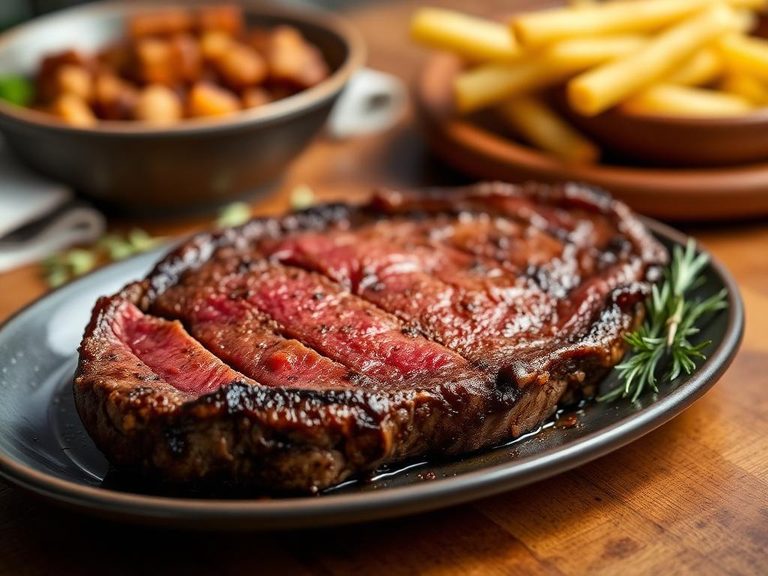
This is a premium cut of beef from the rib section, prized for its rich, beefy flavor and tender, juicy texture due to well-marbled intramuscular fat. Broiling gives it a beautifully caramelized crust while keeping the interior succulent. It's a high-protein, zero-carb powerhouse, delivering nearly 28 grams of protein per 100-gram serving.
Calorie split: 49% protein · 0% carbs · 51% fat
↓ Full nutrition💚 Why it's loved
People adore rib eye for its perfect balance of robust, beefy flavor and melt-in-your-mouth tenderness, a direct result of its signature marbling. It's a versatile star that shines simply seasoned and seared, or as the centerpiece of a luxurious steakhouse dinner.
⚠️ Watch-outs & how to enjoy it better
As a fatty cut, it is calorie-dense and high in saturated fat, which should be considered in moderation, especially for those managing heart health or calorie intake. To counteract, practice portion control (see below) and pair it with fiber-rich, non-starchy vegetables like roasted broccoli or a leafy salad to add volume and nutrients without excess calories.
Key benefits
- Excellent source of complete, high-quality protein for muscle maintenance.
- Rich in heme iron, which is highly absorbable and supports energy levels.
- Provides essential B vitamins like B12 and niacin for metabolic health.
- Contains zinc, which is important for immune function.
- Naturally free of carbohydrates and sugars.
🍽️ Popular dishes
🌍 Where it's eaten
💡 Did you know?
The 'eye' in rib eye refers to the longissimus dorsi muscle, which runs along the spine and is the same muscle that creates the prized strip loin (New York strip) further down the back.
Full nutrition (USDA data · scales with serving)
| Water | 59.2 g |
| Energy | 234 kcal |
| Energy | 979 kj |
| Protein | 27.9 g |
| Total lipid (fat) | 12.7 g |
| Ash | 1.1 g |
| Carbohydrate, by difference | 0.00 g |
| Fiber, total dietary | 0.00 g |
| Total Sugars | 0.00 g |
| Calcium, Ca | 22.0 mg |
| Iron, Fe | 1.7 mg |
| Magnesium, Mg | 24.0 mg |
| Phosphorus, P | 223 mg |
| Potassium, K | 355 mg |
| Sodium, Na | 59.0 mg |
| Zinc, Zn | 5.1 mg |
| Copper, Cu | 0.08 mg |
| Manganese, Mn | 0.01 mg |
| Selenium, Se | 30.1 ug |
| Vitamin C, total ascorbic acid | 0.00 mg |
| Thiamin | 0.08 mg |
| Riboflavin | 0.15 mg |
| Niacin | 7.3 mg |
| Pantothenic acid | 0.55 mg |
| Vitamin B-6 | 0.61 mg |
| Folate, total | 9.0 ug |
| Folic acid | 0.00 ug |
| Folate, food | 9.0 ug |
| Folate, DFE | 9.0 ug |
| Vitamin B-12 | 1.4 ug |
| Vitamin A, RAE | 0.00 ug |
| Retinol | 0.00 ug |
| Carotene, beta | 0.00 ug |
| Carotene, alpha | 0.00 ug |
| Cryptoxanthin, beta | 0.00 ug |
| Vitamin A, IU | 0.00 iu |
| Lycopene | 0.00 ug |
| Lutein + zeaxanthin | 0.00 ug |
| Vitamin E (alpha-tocopherol) | 0.44 mg |
| Tocopherol, beta | 0.00 mg |
| Tocopherol, gamma | 0.00 mg |
| Tocopherol, delta | 0.00 mg |
| Vitamin K (phylloquinone) | 1.5 ug |
| Alcohol, ethyl | 0.00 g |
| Caffeine | 0.00 mg |
| Theobromine | 0.00 mg |
Fat & fatty acid profile (per 100g)
| Fatty acids, total saturated | 4.9 g |
| SFA 4:0 | 0.00 g |
| SFA 6:0 | 0.00 g |
| SFA 8:0 | 0.00 g |
| SFA 10:0 | 0.02 g |
| SFA 12:0 | 0.02 g |
| SFA 14:0 | 0.37 g |
| SFA 16:0 | 2.9 g |
| SFA 18:0 | 1.6 g |
| Fatty acids, total monounsaturated | 5.2 g |
| MUFA 16:1 | 0.44 g |
| MUFA 18:1 | 4.8 g |
| MUFA 20:1 | 0.01 g |
| MUFA 22:1 | 0.00 g |
| Fatty acids, total polyunsaturated | 0.47 g |
| PUFA 18:2 | 0.35 g |
| PUFA 18:3 | 0.08 g |
| PUFA 18:4 | 0.00 g |
| PUFA 20:4 | 0.05 g |
| PUFA 20:5 n-3 (EPA) | 0.00 g |
| PUFA 22:5 n-3 (DPA) | 0.00 g |
| PUFA 22:6 n-3 (DHA) | 0.00 g |
| Cholesterol | 92.0 mg |
Amino acid profile (per 100g)
| Tryptophan | 0.18 g |
| Threonine | 1.1 g |
| Isoleucine | 1.3 g |
| Leucine | 2.2 g |
| Lysine | 2.4 g |
| Methionine | 0.73 g |
| Cystine | 0.36 g |
| Phenylalanine | 1.1 g |
| Tyrosine | 0.89 g |
| Valine | 1.4 g |
| Arginine | 1.8 g |
| Histidine | 0.89 g |
| Alanine | 1.7 g |
| Aspartic acid | 2.5 g |
| Glutamic acid | 4.2 g |
| Glycine | 1.7 g |
| Proline | 1.3 g |
| Serine | 1.1 g |
| Hydroxyproline | 0.29 g |
FAQ
What's the difference between rib eye and prime rib?
They come from the same rib section. A rib eye is a boneless steak cut from the roast, while prime rib (or standing rib roast) is a larger, bone-in roast typically served sliced.
Is this cut suitable for a low-carb or keto diet?
Yes, it's an excellent choice. With zero carbs and high fat/protein content, it fits perfectly into ketogenic and low-carb dietary patterns.
How do I prevent the fat from causing flare-ups when broiling?
Keep the oven rack 4-6 inches from the broiler element, use a broiler pan with a drip tray, and consider a quick chill in the fridge before cooking to slightly firm the fat. Watch it closely.
Nutrient density (calculated · NRF9.3)
Nutrient Rich Foods index: beneficial nutrients (protein, fiber, vitamins, minerals) minus saturated fat, added sugar & sodium, per 100 kcal.
NRF9.3 index — Fulgoni, Keast & Drewnowski, 2009. Computed from USDA nutrients.
Weight-loss friendliness (composite index)
Energy density 2.34 kcal/g · 48% calories from protein · 0.0 g fiber · 0.0 g sugar per 100 g.
Composite of energy density (Rolls et al., 1999), protein & fiber satiety, minus sugar. A calculated heuristic — ranks satiety-per-calorie, not a clinical measure.
Dietary load (calculated from USDA values)
Potential renal acid load. Positive = acid-forming, negative = alkaline-forming.
Sodium-to-potassium ratio: 0.17 (lower is better — aim for ≤ 1)
Sodium:potassium per WHO potassium guidance. Computed from USDA nutrients.