

Babyfood, vegetables, spinach, creamed, strained
Whole food · Baby Foods

Photo: Wikipedia
This is a smooth, velvety purée of spinach leaves blended with a touch of cream, designed for easy digestion. It has a mild, earthy spinach flavor with a subtle richness from the dairy, and a texture that is completely uniform and spoonable. Nutritionally, it's a concentrated source of iron and vitamins A & K, packed into a very low-calorie, low-fat package.
Calorie split: 22% protein · 51% carbs · 26% fat
↓ Full nutrition💚 Why it's loved
It's loved as a convenient, nutrient-dense first food that introduces babies to green vegetables. For adults, it's a nostalgic comfort food and a quick way to add a serving of greens to a meal without any preparation.
⚠️ Watch-outs & how to enjoy it better
The primary concern is the presence of naturally occurring oxalates in spinach, which can bind minerals like calcium and iron, potentially reducing their absorption. To counteract this, serve it alongside a source of vitamin C (like a little fruit purée) to boost iron uptake, or pair it with a calcium-rich food at a different meal. Some commercial versions may also contain added sodium, so checking labels is wise.
Key benefits
- Excellent source of vitamin K for bone health.
- Provides non-heme iron for oxygen transport.
- High in vitamin A (as beta-carotene) for vision and immunity.
- Low in calories and fat, supporting weight management.
- Contains fiber for digestive health.
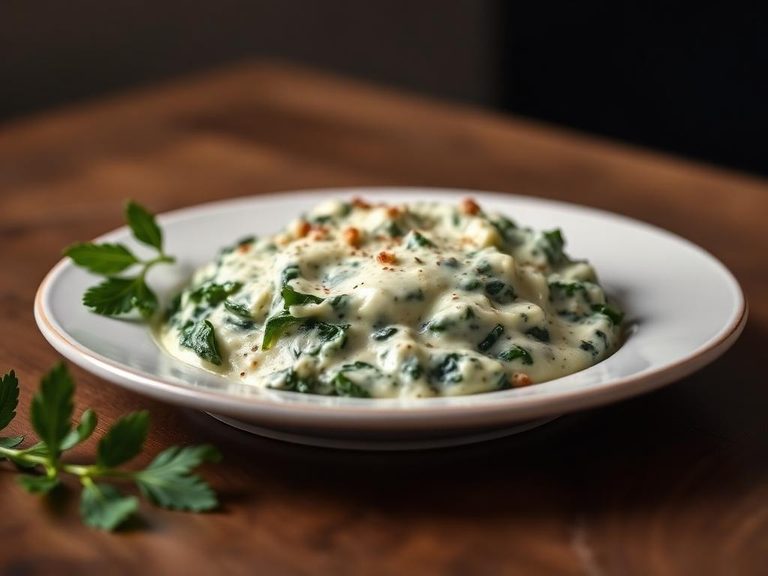
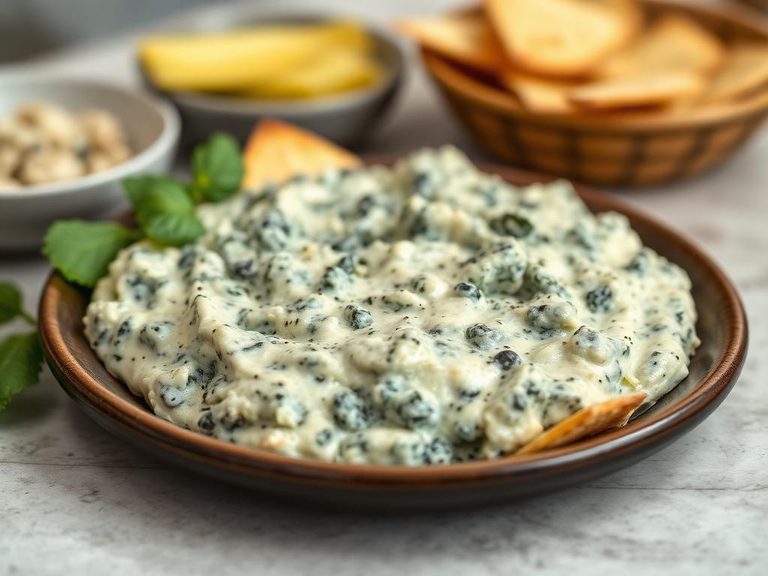
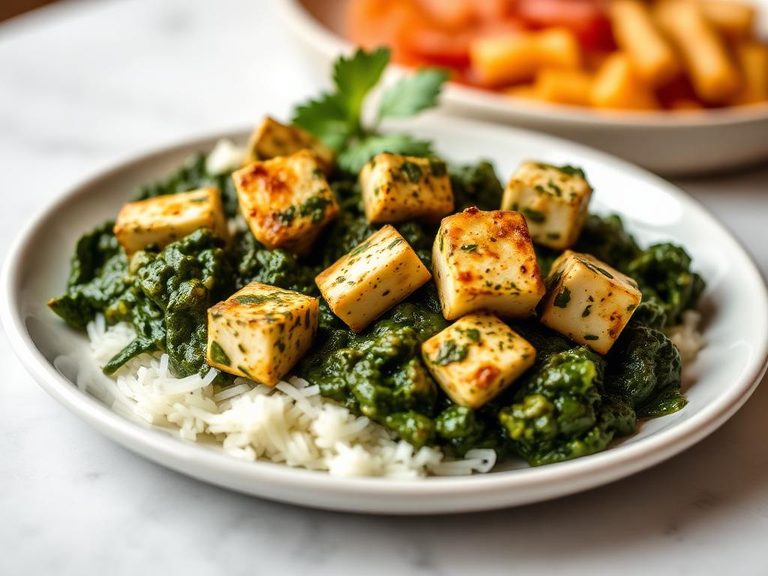
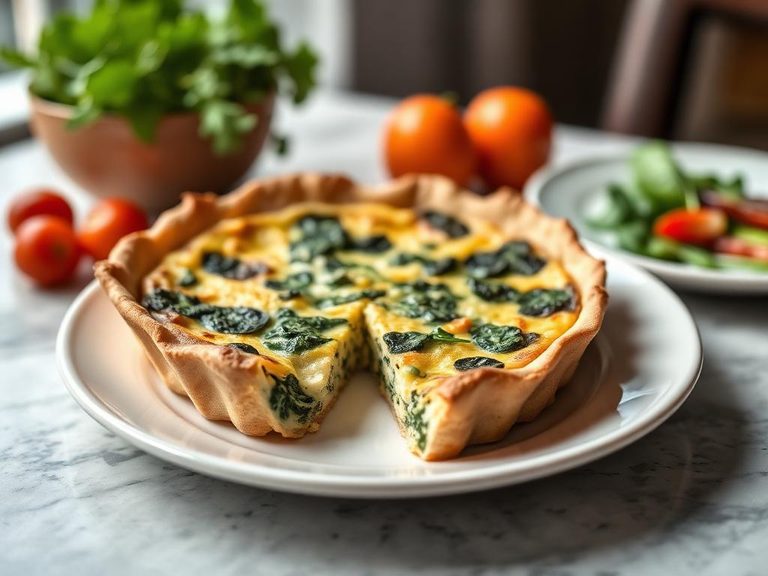
🍽️ Popular dishes


🌍 Where it's eaten
💡 Did you know?
The process of creaming spinach was popularized in American steakhouses in the mid-20th century, transforming a humble vegetable into a decadent side dish.
Full nutrition (USDA data · scales with serving)
| Water | 89.6 g |
| Energy | 37.0 kcal |
| Energy | 155 kj |
| Protein | 2.5 g |
| Total lipid (fat) | 1.3 g |
| Ash | 1.0 g |
| Carbohydrate, by difference | 5.7 g |
| Fiber, total dietary | 1.8 g |
| Total Sugars | 2.3 g |
| Calcium, Ca | 89.0 mg |
| Iron, Fe | 0.62 mg |
| Magnesium, Mg | 55.0 mg |
| Phosphorus, P | 54.0 mg |
| Potassium, K | 191 mg |
| Sodium, Na | 49.0 mg |
| Zinc, Zn | 0.31 mg |
| Copper, Cu | 0.06 mg |
| Selenium, Se | 2.4 ug |
| Vitamin C, total ascorbic acid | 8.7 mg |
| Thiamin | 0.01 mg |
| Riboflavin | 0.10 mg |
| Niacin | 0.22 mg |
| Vitamin B-6 | 0.07 mg |
| Folate, total | 61.0 ug |
| Folic acid | 0.00 ug |
| Folate, food | 61.0 ug |
| Folate, DFE | 61.0 ug |
| Choline, total | 16.1 mg |
| Vitamin B-12 | 0.06 ug |
| Vitamin B-12, added | 0.00 ug |
| Vitamin A, RAE | 227 ug |
| Retinol | 23.0 ug |
| Carotene, beta | 2456 ug |
| Carotene, alpha | 0.00 ug |
| Cryptoxanthin, beta | 0.00 ug |
| Vitamin A, IU | 4170 iu |
| Lycopene | 0.00 ug |
| Lutein + zeaxanthin | 4505 ug |
| Vitamin E (alpha-tocopherol) | 0.83 mg |
| Vitamin E, added | 0.00 mg |
| Vitamin D (D2 + D3), International Units | 0.00 iu |
| Vitamin D (D2 + D3) | 0.00 ug |
| Vitamin K (phylloquinone) | 197 ug |
| Alcohol, ethyl | 0.00 g |
| Caffeine | 0.00 mg |
| Theobromine | 0.00 mg |
Fat & fatty acid profile (per 100g)
| Fatty acids, total saturated | 0.70 g |
| SFA 4:0 | 0.04 g |
| SFA 6:0 | 0.02 g |
| SFA 8:0 | 0.01 g |
| SFA 10:0 | 0.03 g |
| SFA 12:0 | 0.03 g |
| SFA 14:0 | 0.11 g |
| SFA 16:0 | 0.31 g |
| SFA 18:0 | 0.13 g |
| Fatty acids, total monounsaturated | 0.33 g |
| MUFA 16:1 | 0.03 g |
| MUFA 18:1 | 0.29 g |
| MUFA 20:1 | 0.00 g |
| MUFA 22:1 | 0.00 g |
| Fatty acids, total polyunsaturated | 0.13 g |
| PUFA 18:2 | 0.06 g |
| PUFA 18:3 | 0.07 g |
| PUFA 18:4 | 0.00 g |
| PUFA 20:4 | 0.00 g |
| PUFA 20:5 n-3 (EPA) | 0.00 g |
| PUFA 22:5 n-3 (DPA) | 0.00 g |
| PUFA 22:6 n-3 (DHA) | 0.00 g |
| Cholesterol | 5.0 mg |
Amino acid profile (per 100g)
| Tryptophan | 0.04 g |
| Threonine | 0.10 g |
| Isoleucine | 0.11 g |
| Leucine | 0.22 g |
| Lysine | 0.15 g |
| Methionine | 0.06 g |
| Cystine | 0.03 g |
| Phenylalanine | 0.10 g |
| Tyrosine | 0.12 g |
| Valine | 0.15 g |
| Arginine | 0.15 g |
| Histidine | 0.06 g |
| Alanine | 0.12 g |
| Aspartic acid | 0.20 g |
| Glutamic acid | 0.42 g |
| Glycine | 0.10 g |
| Proline | 0.21 g |
| Serine | 0.10 g |
FAQ
Is this the same as frozen creamed spinach?
Not exactly. Baby food is typically a simpler, smoother purée with minimal added ingredients (often just spinach, water, and a little cream or milk). Frozen creamed spinach is usually a cooked side dish with a chunkier texture, more cream, butter, and seasonings like garlic and nutmeg.
Can adults eat baby food vegetables?
Yes, they are safe and can be a convenient, low-sodium way to add vegetables to a meal, smoothie, or sauce. However, they are not formulated for adult nutritional needs and lack the texture variety of whole foods.
Why is it so low in calories?
Spinach itself is very low in calories (about 23 kcal per 100g raw), and the creamed baby food version uses minimal added fats or sugars, focusing on the vegetable purée itself.
Nutrient density (calculated · NRF9.3)
Nutrient Rich Foods index: beneficial nutrients (protein, fiber, vitamins, minerals) minus saturated fat, added sugar & sodium, per 100 kcal.
NRF9.3 index — Fulgoni, Keast & Drewnowski, 2009. Computed from USDA nutrients.
Weight-loss friendliness (composite index)
Energy density 0.37 kcal/g · 27% calories from protein · 1.8 g fiber · 2.3 g sugar per 100 g.
Composite of energy density (Rolls et al., 1999), protein & fiber satiety, minus sugar. A calculated heuristic — ranks satiety-per-calorie, not a clinical measure.
Dietary load (calculated from USDA values)
Potential renal acid load. Positive = acid-forming, negative = alkaline-forming.
Sodium-to-potassium ratio: 0.26 (lower is better — aim for ≤ 1)
Sodium:potassium per WHO potassium guidance. Computed from USDA nutrients.