

Apples, raw, without skin, cooked, microwave
Whole food · Fruits and Fruit Juices

Photo: Wikipedia
Microwaved, peeled apple slices transform into a soft, tender, and warmly sweet treat, releasing a concentrated, jammy apple aroma. The cooking process softens the flesh while preserving its natural sugars, making it a quick, comforting snack. Nutritionally, it's a light, low-calorie source of carbohydrates and fiber, with a notable amount of natural sugar.
Calorie split: 2% protein · 92% carbs · 6% fat
↓ Full nutrition💚 Why it's loved
People adore it for its comforting, nostalgic warmth and the way microwaving intensifies the apple's natural sweetness into a quick, homemade compote. It's a beloved hack for a fast, healthy dessert or breakfast topping.
⚠️ Watch-outs & how to enjoy it better
The high natural sugar content (11.61g per 100g) can cause a rapid blood-sugar spike, especially when eaten alone. To counteract this, pair it with a source of protein or fat, like a dollop of Greek yogurt, a handful of nuts, or a slice of cheese, to slow sugar absorption.
Key benefits
- Quick and easy to prepare with minimal cleanup
- Soft texture is gentle for all ages, including toddlers and those with dental issues
- Provides a quick source of energy from natural sugars
- Retains most of the apple's dietary fiber, aiding digestion
- Low in fat and sodium, making it a heart-healthy snack option
🍽️ Popular dishes
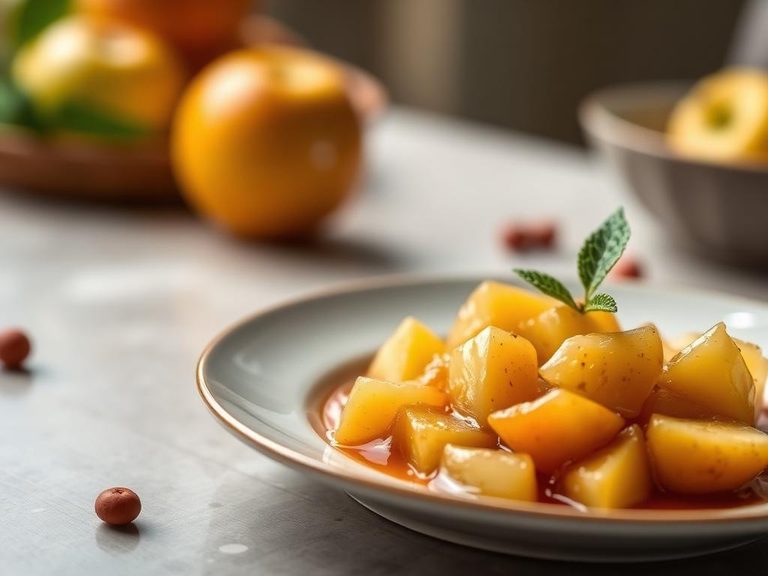
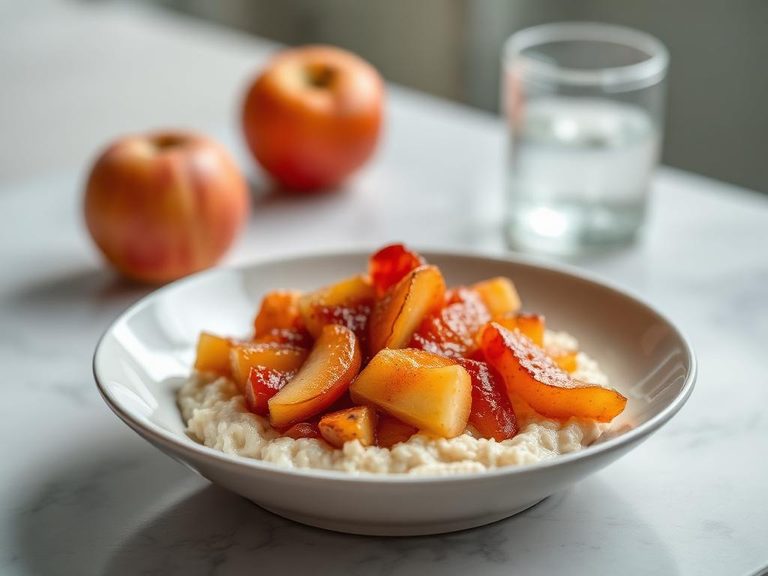
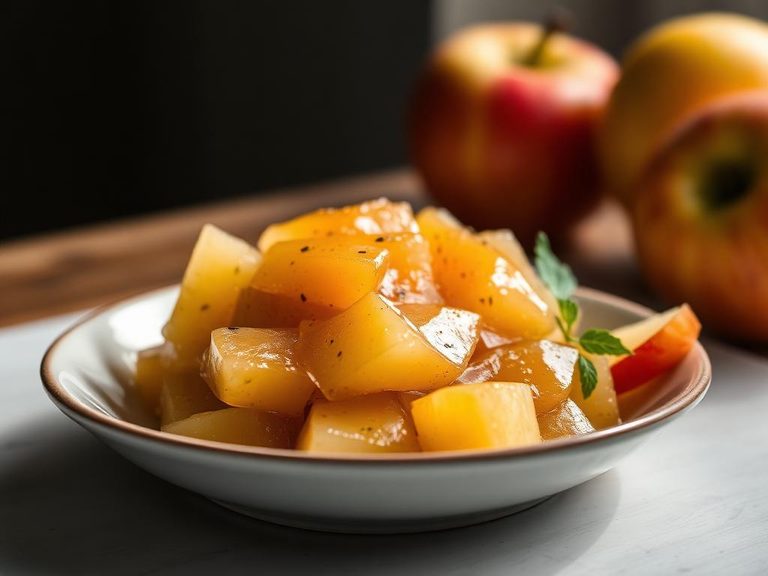
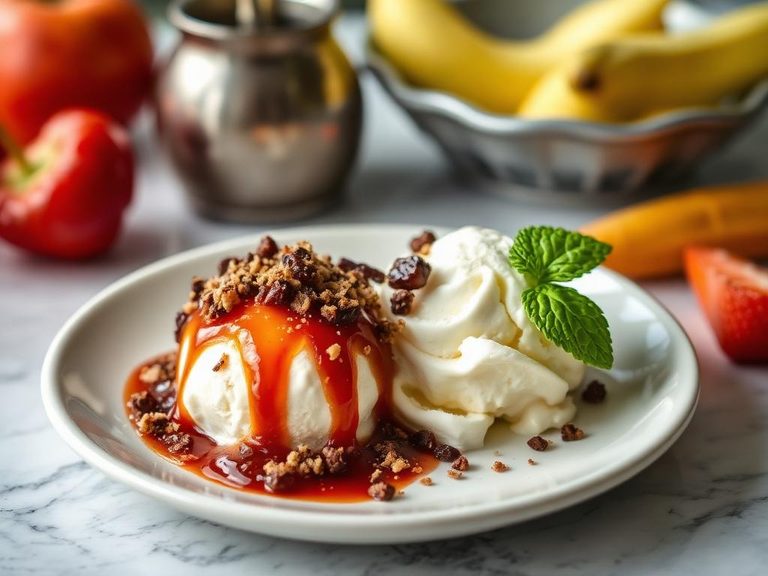

🌍 Where it's eaten
💡 Did you know?
Microwaving apples actually increases the availability of certain antioxidants, like phenolic compounds, because the heat breaks down the plant's cell walls, making them easier for your body to absorb.
Full nutrition (USDA data · scales with serving)
| Water | 84.6 g |
| Energy | 56.0 kcal |
| Energy | 234 kj |
| Protein | 0.28 g |
| Total lipid (fat) | 0.42 g |
| Ash | 0.26 g |
| Carbohydrate, by difference | 14.4 g |
| Fiber, total dietary | 2.8 g |
| Total Sugars | 11.6 g |
| Calcium, Ca | 5.0 mg |
| Iron, Fe | 0.17 mg |
| Magnesium, Mg | 3.0 mg |
| Phosphorus, P | 8.0 mg |
| Potassium, K | 93.0 mg |
| Sodium, Na | 1.0 mg |
| Zinc, Zn | 0.04 mg |
| Copper, Cu | 0.05 mg |
| Manganese, Mn | 0.14 mg |
| Selenium, Se | 0.30 ug |
| Vitamin C, total ascorbic acid | 0.30 mg |
| Thiamin | 0.02 mg |
| Riboflavin | 0.01 mg |
| Niacin | 0.06 mg |
| Pantothenic acid | 0.05 mg |
| Vitamin B-6 | 0.05 mg |
| Folate, total | 1.0 ug |
| Folic acid | 0.00 ug |
| Folate, food | 1.0 ug |
| Folate, DFE | 1.0 ug |
| Choline, total | 3.4 mg |
| Vitamin B-12 | 0.00 ug |
| Vitamin B-12, added | 0.00 ug |
| Vitamin A, RAE | 2.0 ug |
| Retinol | 0.00 ug |
| Carotene, beta | 17.0 ug |
| Carotene, alpha | 0.00 ug |
| Cryptoxanthin, beta | 13.0 ug |
| Vitamin A, IU | 40.0 iu |
| Lycopene | 0.00 ug |
| Lutein + zeaxanthin | 21.0 ug |
| Vitamin E (alpha-tocopherol) | 0.05 mg |
| Vitamin E, added | 0.00 mg |
| Vitamin D (D2 + D3), International Units | 0.00 iu |
| Vitamin D (D2 + D3) | 0.00 ug |
| Vitamin K (phylloquinone) | 0.70 ug |
| Alcohol, ethyl | 0.00 g |
| Caffeine | 0.00 mg |
| Theobromine | 0.00 mg |
Fat & fatty acid profile (per 100g)
| Fatty acids, total saturated | 0.07 g |
| SFA 4:0 | 0.00 g |
| SFA 6:0 | 0.00 g |
| SFA 8:0 | 0.00 g |
| SFA 10:0 | 0.00 g |
| SFA 12:0 | 0.00 g |
| SFA 14:0 | 0.00 g |
| SFA 16:0 | 0.06 g |
| SFA 18:0 | 0.01 g |
| Fatty acids, total monounsaturated | 0.02 g |
| MUFA 16:1 | 0.00 g |
| MUFA 18:1 | 0.02 g |
| MUFA 20:1 | 0.00 g |
| MUFA 22:1 | 0.00 g |
| Fatty acids, total polyunsaturated | 0.12 g |
| PUFA 18:2 | 0.10 g |
| PUFA 18:3 | 0.02 g |
| PUFA 18:4 | 0.00 g |
| PUFA 20:4 | 0.00 g |
| PUFA 20:5 n-3 (EPA) | 0.00 g |
| PUFA 22:5 n-3 (DPA) | 0.00 g |
| PUFA 22:6 n-3 (DHA) | 0.00 g |
| Fatty acids, total trans | 0.00 g |
| Cholesterol | 0.00 mg |
Amino acid profile (per 100g)
| Tryptophan | 0.00 g |
| Threonine | 0.01 g |
| Isoleucine | 0.01 g |
| Leucine | 0.02 g |
| Lysine | 0.02 g |
| Methionine | 0.00 g |
| Cystine | 0.00 g |
| Phenylalanine | 0.01 g |
| Tyrosine | 0.01 g |
| Valine | 0.01 g |
| Arginine | 0.01 g |
| Histidine | 0.00 g |
| Alanine | 0.01 g |
| Aspartic acid | 0.05 g |
| Glutamic acid | 0.03 g |
| Glycine | 0.01 g |
| Proline | 0.01 g |
| Serine | 0.01 g |
FAQ
How does the nutrition compare to a raw apple?
The calorie and macronutrient profile is very similar per 100g. The main difference is texture and water content; microwaving concentrates the flavor and softens the fiber, making it easier to digest.
Can I make this without peeling the apple?
Absolutely. Keeping the skin on adds extra fiber and nutrients. Simply wash, core, and slice the apple with the skin on before microwaving.
What's the best way to microwave it?
Place sliced apples in a microwave-safe bowl, cover, and microwave on high for 2-3 minutes, stirring halfway, until tender. For a saucier texture, add a tablespoon of water and microwave for an extra minute.
Nutrient density (calculated · NRF9.3)
Nutrient Rich Foods index: beneficial nutrients (protein, fiber, vitamins, minerals) minus saturated fat, added sugar & sodium, per 100 kcal.
NRF9.3 index — Fulgoni, Keast & Drewnowski, 2009. Computed from USDA nutrients.
Weight-loss friendliness (composite index)
Energy density 0.56 kcal/g · 2% calories from protein · 2.8 g fiber · 11.6 g sugar per 100 g.
Composite of energy density (Rolls et al., 1999), protein & fiber satiety, minus sugar. A calculated heuristic — ranks satiety-per-calorie, not a clinical measure.
Dietary load (calculated from USDA values)
Potential renal acid load. Positive = acid-forming, negative = alkaline-forming.
Sodium-to-potassium ratio: 0.01 (lower is better — aim for ≤ 1)
Sodium:potassium per WHO potassium guidance. Computed from USDA nutrients.