

Ravioli, cheese-filled, canned
Whole food · Meals, Entrees, and Side Dishes

Photo: Wikipedia
Canned cheese ravioli are soft, pillow-like pasta pockets pre-filled with a mild cheese blend, swimming in a simple tomato sauce. The texture is tender and uniform, designed for quick heating rather than al dente bite. Nutritionally, it's a low-calorie, carb-forward convenience meal with modest protein.
Calorie split: 13% protein · 70% carbs · 17% fat
↓ Full nutrition💚 Why it's loved
People love it for its nostalgic, comforting simplicity and the convenience of a hot, saucy meal ready in minutes. It's a versatile base that can be dressed up with spices or extra ingredients.
⚠️ Watch-outs & how to enjoy it better
The high carbohydrate and sugar content can cause rapid blood-sugar spikes, especially without added protein or fat. It may also be high in sodium (typical for canned goods) and contains common allergens like wheat (gluten) and dairy. To counteract, pair a portion with a side of steamed vegetables and a lean protein like chicken, or stir in a handful of spinach and a drizzle of olive oil.
Key benefits
- Extremely quick to prepare (heat and serve).
- Low in fat per 100g serving.
- Provides a modest source of dietary fiber.
- Shelf-stable for long-term pantry storage.
- Consistent, mild flavor profile.
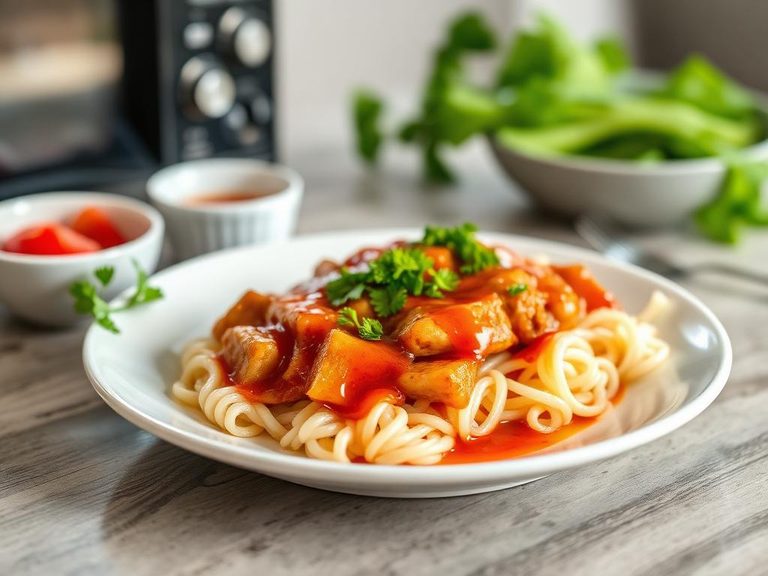
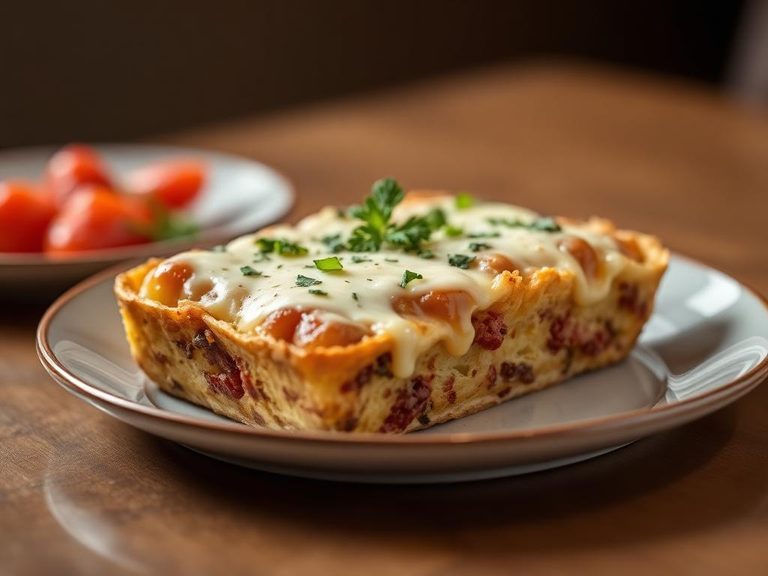
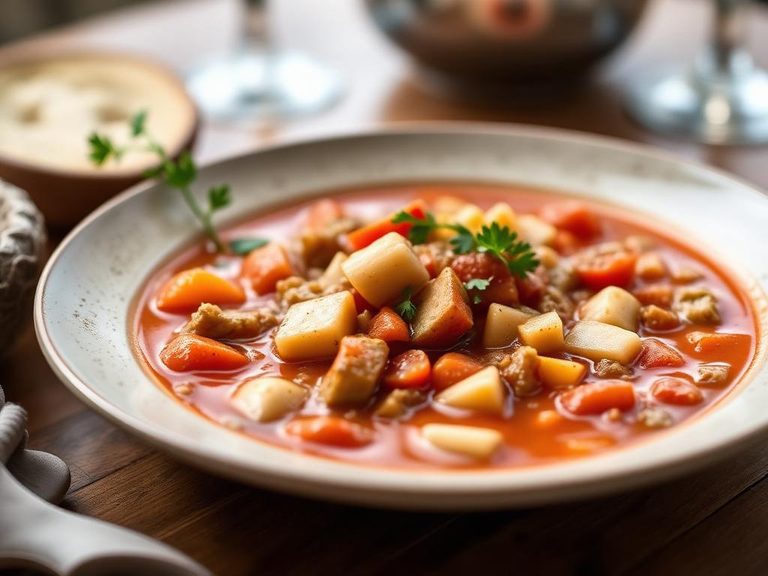
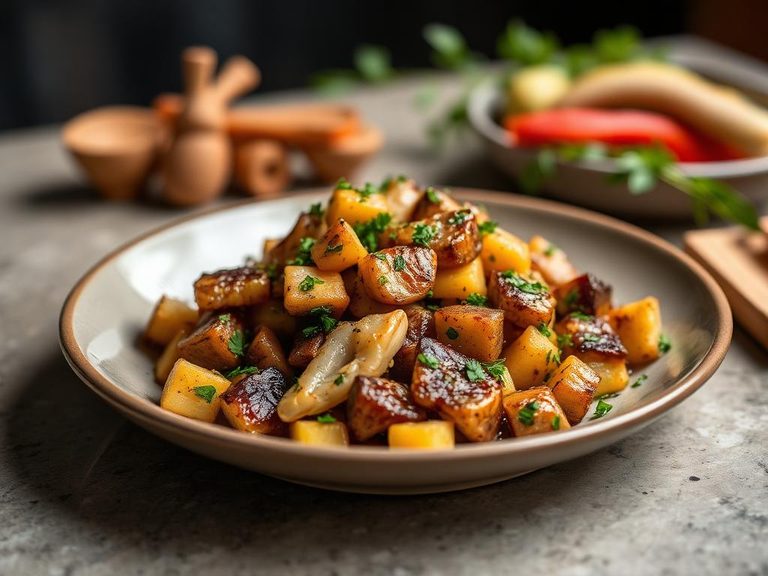
🍽️ Popular dishes
🌍 Where it's eaten
💡 Did you know?
The canned version was popularized in the US by Chef Boyardee in the 1950s, marketed as a complete, ready-to-eat meal long before the modern microwave era.
Full nutrition (USDA data · scales with serving)
| Water | 80.9 g |
| Energy | 77.0 kcal |
| Energy | 324 kj |
| Protein | 2.5 g |
| Total lipid (fat) | 1.4 g |
| Ash | 1.5 g |
| Carbohydrate, by difference | 13.6 g |
| Fiber, total dietary | 1.3 g |
| Total Sugars | 3.7 g |
| Calcium, Ca | 33.0 mg |
| Iron, Fe | 0.74 mg |
| Magnesium, Mg | 15.0 mg |
| Phosphorus, P | 50.0 mg |
| Potassium, K | 232 mg |
| Sodium, Na | 306 mg |
| Zinc, Zn | 0.36 mg |
| Copper, Cu | 0.14 mg |
| Manganese, Mn | 0.18 mg |
| Selenium, Se | 3.5 ug |
| Vitamin C, total ascorbic acid | 0.00 mg |
| Thiamin | 0.07 mg |
| Riboflavin | 0.08 mg |
| Niacin | 1.1 mg |
| Pantothenic acid | 0.27 mg |
| Vitamin B-6 | 0.10 mg |
| Folate, total | 20.0 ug |
| Folic acid | 9.0 ug |
| Folate, food | 11.0 ug |
| Folate, DFE | 26.0 ug |
| Choline, total | 9.5 mg |
| Vitamin B-12 | 0.03 ug |
| Vitamin B-12, added | 0.00 ug |
| Vitamin A, RAE | 10.0 ug |
| Retinol | 0.00 ug |
| Carotene, beta | 124 ug |
| Carotene, alpha | 0.00 ug |
| Cryptoxanthin, beta | 0.00 ug |
| Vitamin A, IU | 207 iu |
| Lycopene | 8625 ug |
| Lutein + zeaxanthin | 16.0 ug |
| Vitamin E (alpha-tocopherol) | 0.85 mg |
| Vitamin E, added | 0.00 mg |
| Vitamin D (D2 + D3), International Units | 0.00 iu |
| Vitamin D (D2 + D3) | 0.00 ug |
| Vitamin K (phylloquinone) | 2.3 ug |
| Alcohol, ethyl | 0.00 g |
| Caffeine | 0.00 mg |
| Theobromine | 0.00 mg |
Fat & fatty acid profile (per 100g)
| Fatty acids, total saturated | 0.72 g |
| SFA 4:0 | 0.03 g |
| SFA 6:0 | 0.02 g |
| SFA 8:0 | 0.01 g |
| SFA 10:0 | 0.02 g |
| SFA 12:0 | 0.02 g |
| SFA 14:0 | 0.11 g |
| SFA 16:0 | 0.35 g |
| SFA 18:0 | 0.14 g |
| SFA 20:0 | 0.00 g |
| SFA 22:0 | 0.00 g |
| SFA 24:0 | 0.00 g |
| Fatty acids, total monounsaturated | 0.42 g |
| MUFA 14:1 | 0.00 g |
| MUFA 16:1 | 0.04 g |
| MUFA 18:1 | 0.36 g |
| MUFA 20:1 | 0.00 g |
| MUFA 22:1 | 0.00 g |
| Fatty acids, total polyunsaturated | 0.18 g |
| PUFA 18:2 | 0.16 g |
| PUFA 18:3 | 0.03 g |
| PUFA 18:4 | 0.00 g |
| PUFA 20:2 n-6 c,c | 0.00 g |
| PUFA 20:3 | 0.00 g |
| PUFA 20:4 | 0.00 g |
| PUFA 20:5 n-3 (EPA) | 0.00 g |
| PUFA 22:5 n-3 (DPA) | 0.00 g |
| PUFA 22:6 n-3 (DHA) | 0.00 g |
| Cholesterol | 3.0 mg |
Amino acid profile (per 100g)
Estimated from Ravioli, cheese with tomato sauce, frozen, not prepared, includes regular and light entrees — USDA does not publish this profile for Ravioli.
| Tryptophan | 0.06 g |
| Threonine | 0.15 g |
| Isoleucine | 0.18 g |
| Leucine | 0.35 g |
| Lysine | 0.23 g |
| Methionine | 0.08 g |
| Cystine | 0.08 g |
| Phenylalanine | 0.20 g |
| Tyrosine | 0.12 g |
| Valine | 0.23 g |
| Arginine | 0.14 g |
| Histidine | 0.11 g |
| Alanine | 0.17 g |
| Aspartic acid | 0.39 g |
| Glutamic acid | 1.3 g |
| Glycine | 0.12 g |
| Proline | 0.36 g |
| Serine | 0.22 g |
FAQ
Is canned ravioli the same as frozen or fresh?
No. Canned ravioli is fully cooked and preserved in sauce, resulting in a very soft texture. Frozen or fresh versions are uncooked or par-cooked, offering better texture and often higher-quality ingredients.
How can I improve the taste?
Heat it in a saucepan (not a microwave) for better texture, then stir in fresh basil, grated Parmesan, red pepper flakes, or a pat of butter. Serving it over a little cooked pasta or with garlic bread also elevates it.
Is it a good source of protein?
Not really. At 2.48g per 100g, it provides some protein but is not a significant source. You'd need to add a protein-rich side like beans, meat, or eggs to make it a balanced meal.
Nutrient density (calculated · NRF9.3)
Nutrient Rich Foods index: beneficial nutrients (protein, fiber, vitamins, minerals) minus saturated fat, added sugar & sodium, per 100 kcal.
NRF9.3 index — Fulgoni, Keast & Drewnowski, 2009. Computed from USDA nutrients.
Weight-loss friendliness (composite index)
Energy density 0.77 kcal/g · 13% calories from protein · 1.3 g fiber · 3.7 g sugar per 100 g.
Composite of energy density (Rolls et al., 1999), protein & fiber satiety, minus sugar. A calculated heuristic — ranks satiety-per-calorie, not a clinical measure.
Dietary load (calculated from USDA values)
Potential renal acid load. Positive = acid-forming, negative = alkaline-forming.
Sodium-to-potassium ratio: 1.32 (lower is better — aim for ≤ 1)
Sodium:potassium per WHO potassium guidance. Computed from USDA nutrients.