

POPEYES, Fried Chicken, Mild, Breast, meat and skin with breading
Whole food · Fast Foods

Photo: Wikipedia
This is a classic, golden-brown chicken breast from Popeyes, featuring a juicy, tender white meat interior beneath a crispy, seasoned breading and the attached skin. The flavor profile is savory and mildly spiced, with a satisfying crunch that gives way to succulent chicken. Nutritionally, it's a high-protein option, delivering over 21 grams of protein per 100 grams.
Calorie split: 32% protein · 14% carbs · 54% fat
↓ Full nutrition💚 Why it's loved
People adore it for the iconic Southern-style flavor—the perfect balance of a seasoned, crunchy coating and juicy, tender meat. It's a beloved comfort food and a staple of American fast-food culture, often enjoyed on its own or as part of a larger meal.
⚠️ Watch-outs & how to enjoy it better
The combination of fried skin and breading makes it high in saturated fat and sodium, which may be a concern for heart health or blood pressure management. To counteract this, consider pairing it with a fiber-rich side like coleslaw or green beans, and practice portion control by enjoying a single breast as part of a balanced plate.
Key benefits
- Excellent source of high-quality protein for muscle maintenance
- Provides essential B vitamins like niacin and B6
- Contains minerals such as selenium and phosphorus
- A convenient, ready-to-eat protein source
🍽️ Popular dishes
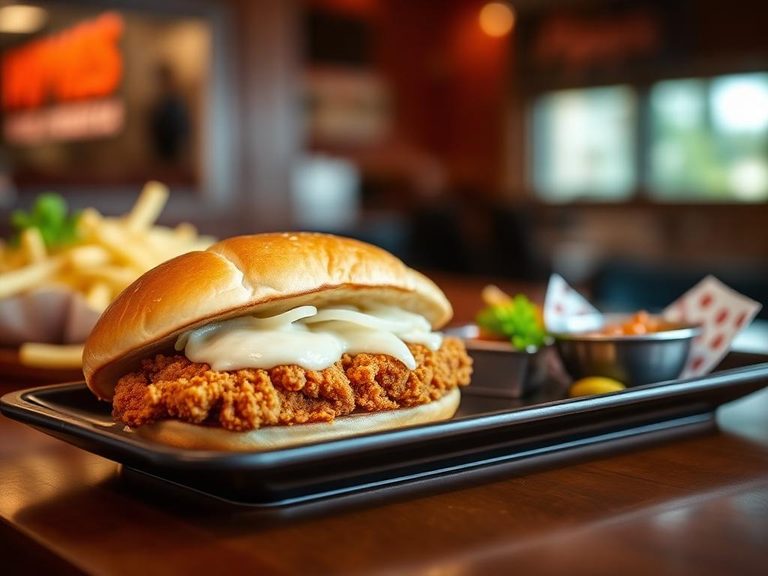


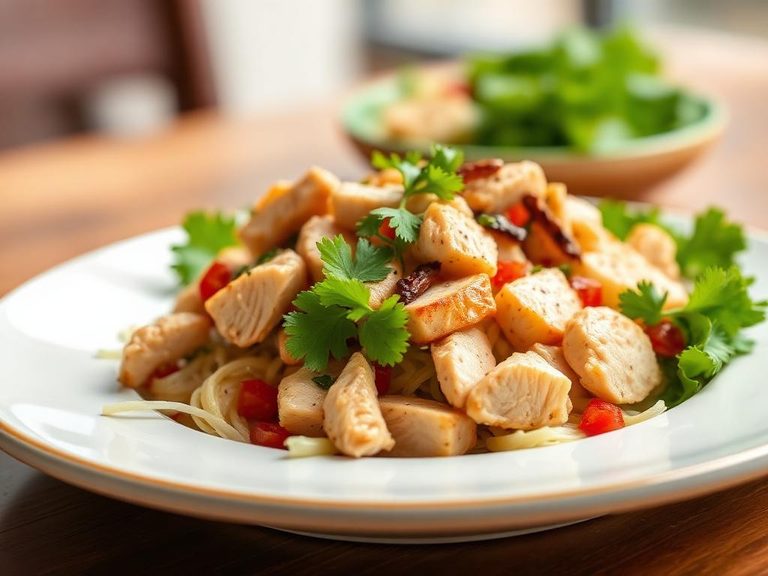

🌍 Where it's eaten
💡 Did you know?
Popeyes was originally named 'Chicken on the Run' when it opened in 1972 in Arabi, Louisiana, but was rebranded to 'Popeyes' after the character Jimmy 'Popeye' Doyle from the film 'The French Connection.'
Full nutrition (USDA data · scales with serving)
| Water | 49.5 g |
| Energy | 274 kcal |
| Energy | 1147 kj |
| Protein | 21.7 g |
| Total lipid (fat) | 16.5 g |
| Ash | 2.5 g |
| Carbohydrate, by difference | 9.8 g |
| Fiber, total dietary | 0.40 g |
| Total Sugars | 0.00 g |
| Sucrose | 0.00 g |
| Glucose | 0.00 g |
| Fructose | 0.00 g |
| Lactose | 0.00 g |
| Maltose | 0.00 g |
| Galactose | 0.00 g |
| Starch | 7.9 g |
| Calcium, Ca | 23.0 mg |
| Iron, Fe | 0.74 mg |
| Magnesium, Mg | 25.0 mg |
| Phosphorus, P | 191 mg |
| Potassium, K | 283 mg |
| Sodium, Na | 540 mg |
| Zinc, Zn | 0.76 mg |
| Copper, Cu | 0.04 mg |
| Manganese, Mn | 0.11 mg |
| Selenium, Se | 29.4 ug |
| Thiamin | 0.10 mg |
| Riboflavin | 0.16 mg |
| Niacin | 9.0 mg |
| Pantothenic acid | 1.4 mg |
| Vitamin B-6 | 0.39 mg |
| Vitamin B-12 | 0.36 ug |
| Vitamin A, RAE | 16.0 ug |
| Vitamin A, IU | 53.0 iu |
Fat & fatty acid profile (per 100g)
| Fatty acids, total saturated | 5.8 g |
| SFA 4:0 | 0.00 g |
| SFA 6:0 | 0.00 g |
| SFA 8:0 | 0.00 g |
| SFA 10:0 | 0.01 g |
| SFA 12:0 | 0.01 g |
| SFA 14:0 | 0.28 g |
| SFA 15:0 | 0.04 g |
| SFA 16:0 | 3.7 g |
| SFA 17:0 | 0.09 g |
| SFA 18:0 | 1.6 g |
| SFA 20:0 | 0.01 g |
| SFA 22:0 | 0.01 g |
| SFA 24:0 | 0.00 g |
| Fatty acids, total monounsaturated | 7.3 g |
| MUFA 14:1 | 0.07 g |
| MUFA 15:1 | 0.00 g |
| MUFA 16:1 | 0.87 g |
| MUFA 17:1 | 0.05 g |
| MUFA 18:1 | 6.2 g |
| MUFA 20:1 | 0.06 g |
| MUFA 22:1 | 0.00 g |
| MUFA 24:1 c | 0.00 g |
| Fatty acids, total polyunsaturated | 1.8 g |
| PUFA 18:2 | 1.6 g |
| PUFA 18:3 | 0.09 g |
| PUFA 18:4 | 0.00 g |
| PUFA 20:2 n-6 c,c | 0.01 g |
| PUFA 20:3 | 0.03 g |
| PUFA 20:4 | 0.04 g |
| PUFA 20:5 n-3 (EPA) | 0.00 g |
| PUFA 22:4 | 0.01 g |
| PUFA 22:5 n-3 (DPA) | 0.01 g |
| PUFA 22:6 n-3 (DHA) | 0.00 g |
| Fatty acids, total trans | 0.49 g |
| Cholesterol | 98.0 mg |
Amino acid profile (per 100g)
| Tryptophan | 0.17 g |
| Threonine | 0.71 g |
| Isoleucine | 0.64 g |
| Leucine | 1.3 g |
| Lysine | 0.94 g |
| Methionine | 0.31 g |
| Cystine | 0.25 g |
| Phenylalanine | 0.83 g |
| Tyrosine | 0.66 g |
| Valine | 0.79 g |
| Arginine | 1.2 g |
| Histidine | 0.52 g |
| Alanine | 1.2 g |
| Aspartic acid | 1.5 g |
| Glutamic acid | 5.1 g |
| Glycine | 1.8 g |
| Proline | 1.7 g |
| Serine | 0.84 g |
| Hydroxyproline | 0.59 g |
FAQ
Is the mild version spicy?
No, the 'Mild' seasoning is savory and flavorful but not spicy. It's designed to be approachable for those who prefer no heat.
Does the breading contain common allergens?
Yes, the breading typically contains wheat (gluten) and may be prepared in shared fryers with other allergens like soy or milk.
How does the nutrition compare to grilled chicken?
Fried chicken breast has significantly more fat and calories due to the skin and breading, but the protein content remains high.
Nutrient density (calculated · NRF9.3)
Nutrient Rich Foods index: beneficial nutrients (protein, fiber, vitamins, minerals) minus saturated fat, added sugar & sodium, per 100 kcal.
NRF9.3 index — Fulgoni, Keast & Drewnowski, 2009. Computed from USDA nutrients.
Weight-loss friendliness (composite index)
Energy density 2.74 kcal/g · 32% calories from protein · 0.4 g fiber · 0.0 g sugar per 100 g.
Composite of energy density (Rolls et al., 1999), protein & fiber satiety, minus sugar. A calculated heuristic — ranks satiety-per-calorie, not a clinical measure.
Dietary load (calculated from USDA values)
Potential renal acid load. Positive = acid-forming, negative = alkaline-forming.
Sodium-to-potassium ratio: 1.91 (lower is better — aim for ≤ 1)
Sodium:potassium per WHO potassium guidance. Computed from USDA nutrients.