

Milk, evaporated, 2% fat, with added vitamin A and vitamin D
Whole food · Dairy and Egg Products

Photo: Wikipedia
Evaporated 2% milk is a shelf-stable, creamy liquid made by removing about 60% of the water from regular milk, concentrating its flavor and nutrients. It has a slightly caramelized, cooked-milk taste and a velvety texture that adds richness without the heaviness of cream. Fortified with vitamins A and D, it offers a protein and calcium boost in a convenient, long-lasting form.
Calorie split: 25% protein · 58% carbs · 17% fat
↓ Full nutrition💚 Why it's loved
People love it for its ability to add a deep, creamy richness to both sweet and savory dishes, from pies to curries. Its long shelf life and concentrated flavor make it a reliable pantry staple for quick meals and baking.
⚠️ Watch-outs & how to enjoy it better
The cooking process gives it a distinct 'cooked' flavor some find less fresh than regular milk, and it contains lactose, which can be problematic for the intolerant. To mitigate, pair it with fiber-rich foods to slow sugar absorption, and choose lactose-free versions if needed.
Key benefits
- Shelf-stable without refrigeration until opened
- Good source of calcium and protein for bone and muscle health
- Fortified with vitamins A and D for immune and eye support
- Lower in fat than whole evaporated milk
- Provides a creamy texture in cooking without heavy cream
🍽️ Popular dishes


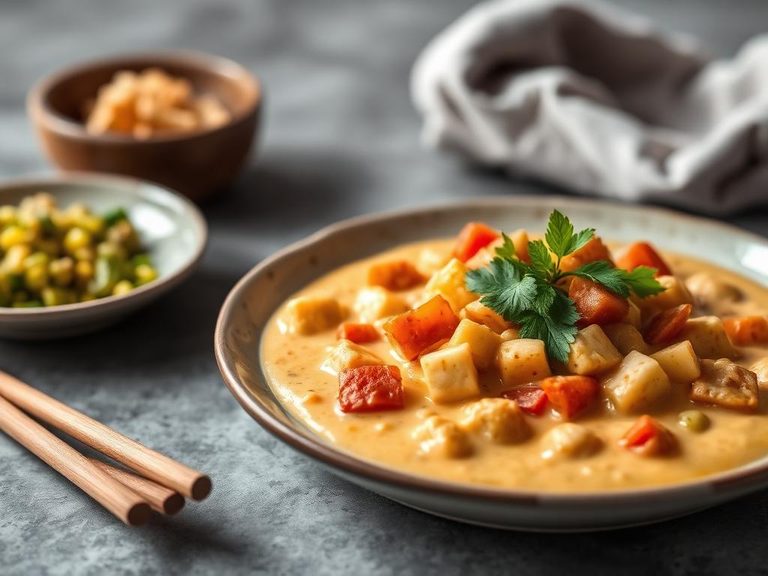
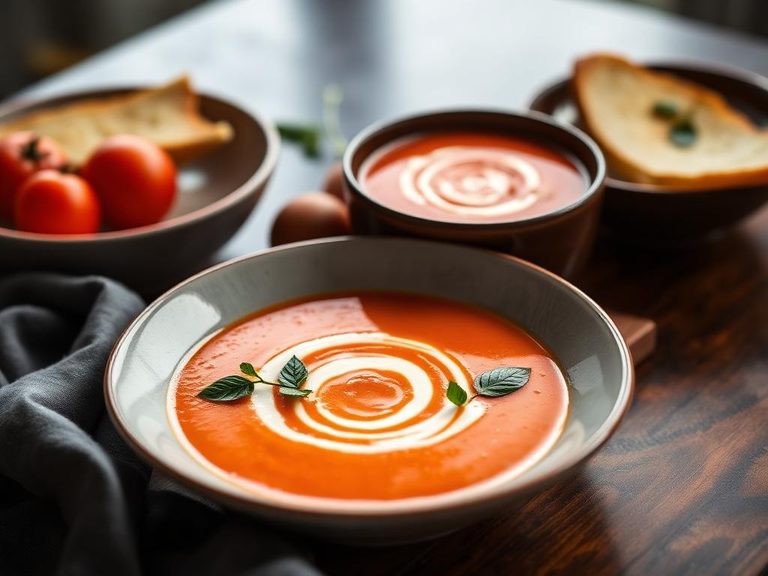
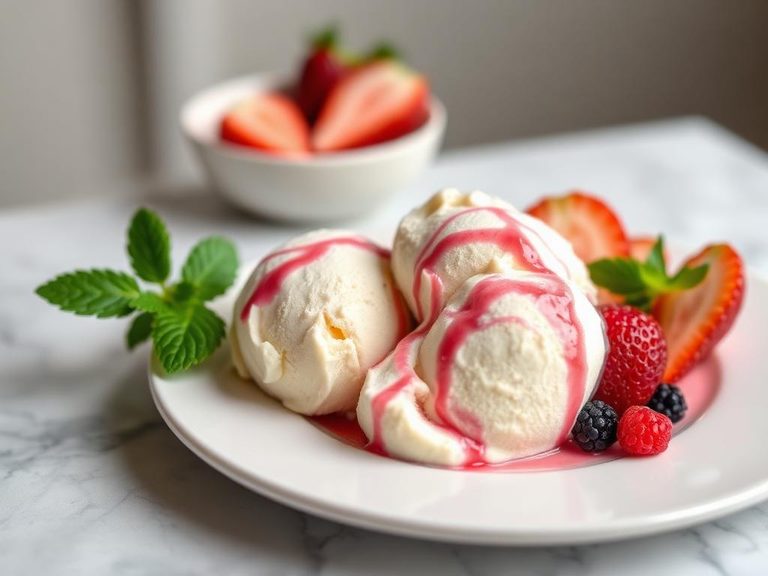

🌍 Where it's eaten
💡 Did you know?
The canning process that creates evaporated milk was developed in the 1880s as a way to provide safe, portable milk for urban populations and military use.
Full nutrition (USDA data · scales with serving)
| Water | 74.0 g |
| Energy | 107 kcal |
| Energy | 448 kj |
| Protein | 6.7 g |
| Total lipid (fat) | 2.0 g |
| Ash | 1.6 g |
| Carbohydrate, by difference | 15.7 g |
| Fiber, total dietary | 0.00 g |
| Total Sugars | 6.7 g |
| Calcium, Ca | 267 mg |
| Iron, Fe | 0.19 mg |
| Magnesium, Mg | 24.0 mg |
| Phosphorus, P | 203 mg |
| Potassium, K | 303 mg |
| Sodium, Na | 100 mg |
| Zinc, Zn | 0.77 mg |
| Copper, Cu | 0.02 mg |
| Manganese, Mn | 0.01 mg |
| Selenium, Se | 2.3 ug |
| Vitamin C, total ascorbic acid | 16.0 mg |
| Thiamin | 0.05 mg |
| Riboflavin | 0.32 mg |
| Niacin | 0.19 mg |
| Pantothenic acid | 0.64 mg |
| Vitamin B-6 | 0.05 mg |
| Folate, total | 8.0 ug |
| Folic acid | 0.00 ug |
| Folate, food | 8.0 ug |
| Folate, DFE | 8.0 ug |
| Choline, total | 16.6 mg |
| Vitamin B-12 | 0.16 ug |
| Vitamin B-12, added | 0.00 ug |
| Vitamin A, RAE | 56.0 ug |
| Retinol | 56.0 ug |
| Carotene, beta | 4.0 ug |
| Carotene, alpha | 0.00 ug |
| Cryptoxanthin, beta | 0.00 ug |
| Vitamin A, IU | 192 iu |
| Lycopene | 0.00 ug |
| Lutein + zeaxanthin | 0.00 ug |
| Vitamin E (alpha-tocopherol) | 0.18 mg |
| Vitamin E, added | 0.00 mg |
| Vitamin D (D2 + D3), International Units | 160 iu |
| Vitamin D (D2 + D3) | 4.0 ug |
| Vitamin K (phylloquinone) | 0.20 ug |
| Alcohol, ethyl | 0.00 g |
| Caffeine | 0.00 mg |
| Theobromine | 0.00 mg |
Fat & fatty acid profile (per 100g)
| Fatty acids, total saturated | 1.2 g |
| SFA 4:0 | 0.05 g |
| SFA 6:0 | 0.04 g |
| SFA 8:0 | 0.01 g |
| SFA 10:0 | 0.03 g |
| SFA 12:0 | 0.04 g |
| SFA 14:0 | 0.20 g |
| SFA 16:0 | 0.56 g |
| SFA 18:0 | 0.26 g |
| Fatty acids, total monounsaturated | 0.63 g |
| MUFA 16:1 | 0.04 g |
| MUFA 18:1 | 0.58 g |
| MUFA 20:1 | 0.00 g |
| MUFA 22:1 | 0.00 g |
| Fatty acids, total polyunsaturated | 0.07 g |
| PUFA 18:2 | 0.05 g |
| PUFA 18:3 | 0.02 g |
| PUFA 18:4 | 0.00 g |
| PUFA 20:4 | 0.00 g |
| PUFA 20:5 n-3 (EPA) | 0.00 g |
| PUFA 22:5 n-3 (DPA) | 0.00 g |
| PUFA 22:6 n-3 (DHA) | 0.00 g |
| Fatty acids, total trans | 0.00 g |
| Cholesterol | 0.00 mg |
Amino acid profile (per 100g)
| Tryptophan | 0.10 g |
| Threonine | 0.31 g |
| Isoleucine | 0.41 g |
| Leucine | 0.67 g |
| Lysine | 0.54 g |
| Methionine | 0.17 g |
| Cystine | 0.06 g |
| Phenylalanine | 0.33 g |
| Tyrosine | 0.33 g |
| Valine | 0.46 g |
| Arginine | 0.25 g |
| Histidine | 0.18 g |
| Alanine | 0.23 g |
| Aspartic acid | 0.52 g |
| Glutamic acid | 1.4 g |
| Glycine | 0.14 g |
| Proline | 0.66 g |
| Serine | 0.37 g |
FAQ
What's the difference between evaporated and condensed milk?
Evaporated milk is unsweetened, with only water removed. Sweetened condensed milk has a large amount of sugar added after evaporation, making it thick and syrupy.
Can I use it as a substitute for regular milk?
Yes, but it's richer and more concentrated. A common ratio is 1 part evaporated milk to 1 part water to approximate the consistency and richness of whole milk.
Why does it sometimes curdle in hot or acidic dishes?
The high heat of canning can cause proteins to denature. When added to very hot or acidic foods (like tomatoes), it may curdle. Temper it by mixing with a small amount of the hot liquid first, or add it at the end of cooking.
Nutrient density (calculated · NRF9.3)
Nutrient Rich Foods index: beneficial nutrients (protein, fiber, vitamins, minerals) minus saturated fat, added sugar & sodium, per 100 kcal.
NRF9.3 index — Fulgoni, Keast & Drewnowski, 2009. Computed from USDA nutrients.
Weight-loss friendliness (composite index)
Energy density 1.07 kcal/g · 25% calories from protein · 0.0 g fiber · 6.7 g sugar per 100 g.
Composite of energy density (Rolls et al., 1999), protein & fiber satiety, minus sugar. A calculated heuristic — ranks satiety-per-calorie, not a clinical measure.
Dietary load (calculated from USDA values)
Potential renal acid load. Positive = acid-forming, negative = alkaline-forming.
Sodium-to-potassium ratio: 0.33 (lower is better — aim for ≤ 1)
Sodium:potassium per WHO potassium guidance. Computed from USDA nutrients.