

Fish, herring, Atlantic, kippered
Whole food · Finfish and Shellfish Products

Photo: Wikipedia
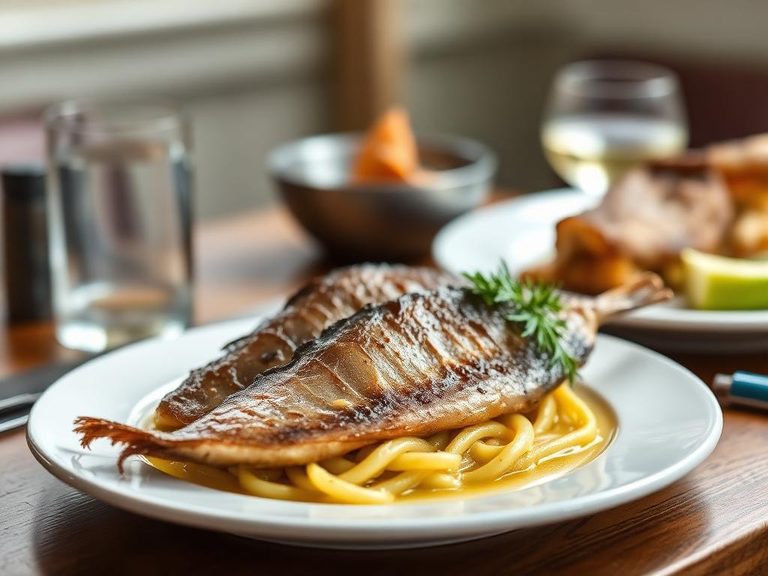
Kippered herring is a traditional method of preserving Atlantic herring by splitting, salting, and hot-smoking the fish, resulting in a rich, oily, and deeply savory fillet. The texture is tender and flaky, with a pronounced smoky flavor that intensifies the natural umami of the fish. It is a nutrient-dense food, providing a substantial 24.58g of protein and 12.37g of healthy fats per 100g, with zero carbohydrates.
Calorie split: 47% protein · 0% carbs · 53% fat
↓ Full nutrition💚 Why it's loved
People love kippered herring for its intense, smoky flavor and satisfying, meaty texture that makes it a standout on breakfast plates or as a savory snack. Its convenience as a ready-to-eat, shelf-stable protein source has made it a cultural staple, particularly in British and Northern European cuisine.
⚠️ Watch-outs & how to enjoy it better
The strong, smoky taste can be overpowering for those who prefer milder fish, and the traditional curing process results in a high sodium content. To mitigate the salt, you can soak the fillets in cold water or milk for 10-15 minutes before eating, or pair them with low-sodium sides like fresh greens or unsalted potatoes. As a common fish allergen, it should be avoided by those with specific fish sensitivities.
Key benefits
- Excellent source of high-quality protein for muscle maintenance.
- Rich in omega-3 fatty acids, which support heart and brain health.
- Provides significant amounts of Vitamin D and Vitamin B12.
- Naturally low in carbohydrates and sugar.
- A good source of selenium and iodine.
🍽️ Popular dishes


🌍 Where it's eaten
💡 Did you know?
The word 'kipper' originally referred to a male salmon in its spawning season, but by the 16th century, it became the term for herring that had been split, salted, and smoked to preserve it.
Full nutrition (USDA data · scales with serving)
| Water | 59.7 g |
| Energy | 217 kcal |
| Energy | 908 kj |
| Protein | 24.6 g |
| Total lipid (fat) | 12.4 g |
| Ash | 1.9 g |
| Carbohydrate, by difference | 0.00 g |
| Fiber, total dietary | 0.00 g |
| Total Sugars | 0.00 g |
| Calcium, Ca | 84.0 mg |
| Iron, Fe | 1.5 mg |
| Magnesium, Mg | 46.0 mg |
| Phosphorus, P | 325 mg |
| Potassium, K | 447 mg |
| Sodium, Na | 918 mg |
| Zinc, Zn | 1.4 mg |
| Copper, Cu | 0.14 mg |
| Manganese, Mn | 0.05 mg |
| Selenium, Se | 52.6 ug |
| Vitamin C, total ascorbic acid | 1.0 mg |
| Thiamin | 0.13 mg |
| Riboflavin | 0.32 mg |
| Niacin | 4.4 mg |
| Pantothenic acid | 0.88 mg |
| Vitamin B-6 | 0.41 mg |
| Folate, total | 14.0 ug |
| Folic acid | 0.00 ug |
| Folate, food | 14.0 ug |
| Folate, DFE | 14.0 ug |
| Choline, total | 95.0 mg |
| Vitamin B-12 | 18.7 ug |
| Vitamin B-12, added | 0.00 ug |
| Vitamin A, RAE | 40.0 ug |
| Retinol | 40.0 ug |
| Carotene, beta | 0.00 ug |
| Carotene, alpha | 0.00 ug |
| Cryptoxanthin, beta | 0.00 ug |
| Vitamin A, IU | 135 iu |
| Lycopene | 0.00 ug |
| Lutein + zeaxanthin | 0.00 ug |
| Vitamin E (alpha-tocopherol) | 1.5 mg |
| Vitamin E, added | 0.00 mg |
| Vitamin D (D2 + D3), International Units | 86.0 iu |
| Vitamin D (D2 + D3) | 2.2 ug |
| Vitamin D3 (cholecalciferol) | 2.2 ug |
| Vitamin K (phylloquinone) | 0.10 ug |
| Alcohol, ethyl | 0.00 g |
| Caffeine | 0.00 mg |
| Theobromine | 0.00 mg |
Fat & fatty acid profile (per 100g)
| Fatty acids, total saturated | 2.8 g |
| SFA 4:0 | 0.00 g |
| SFA 6:0 | 0.00 g |
| SFA 8:0 | 0.00 g |
| SFA 10:0 | 0.00 g |
| SFA 12:0 | 0.02 g |
| SFA 14:0 | 0.76 g |
| SFA 16:0 | 1.9 g |
| SFA 18:0 | 0.15 g |
| Fatty acids, total monounsaturated | 5.1 g |
| MUFA 16:1 | 0.85 g |
| MUFA 18:1 | 2.1 g |
| MUFA 20:1 | 0.99 g |
| MUFA 22:1 | 1.1 g |
| Fatty acids, total polyunsaturated | 2.9 g |
| PUFA 18:2 | 0.18 g |
| PUFA 18:3 | 0.14 g |
| PUFA 18:4 | 0.29 g |
| PUFA 20:4 | 0.08 g |
| PUFA 20:5 n-3 (EPA) | 0.97 g |
| PUFA 22:5 n-3 (DPA) | 0.07 g |
| PUFA 22:6 n-3 (DHA) | 1.2 g |
| Cholesterol | 82.0 mg |
Amino acid profile (per 100g)
| Tryptophan | 0.28 g |
| Threonine | 1.1 g |
| Isoleucine | 1.1 g |
| Leucine | 2.0 g |
| Lysine | 2.3 g |
| Methionine | 0.73 g |
| Cystine | 0.26 g |
| Phenylalanine | 0.96 g |
| Tyrosine | 0.83 g |
| Valine | 1.3 g |
| Arginine | 1.5 g |
| Histidine | 0.72 g |
| Alanine | 1.5 g |
| Aspartic acid | 2.5 g |
| Glutamic acid | 3.7 g |
| Glycine | 1.2 g |
| Proline | 0.87 g |
| Serine | 1.0 g |
FAQ
What is the difference between kippered and smoked herring?
Kippered herring is a specific type of smoked herring where the fish is split, gutted, salted, and then hot-smoked. Traditional smoked herring might be cold-smoked, resulting in a different texture and flavor profile.
Is kippered herring healthy?
Yes, it is highly nutritious, providing excellent protein, omega-3 fatty acids, and vitamins like D and B12. However, it is high in sodium, so it should be consumed in moderation, especially by those watching their salt intake.
How should I store kippered herring?
Unopened, it can be stored in a cool, dark place. Once opened, it should be refrigerated in an airtight container and consumed within a few days. It can also be frozen for longer storage.
Nutrient density (calculated · NRF9.3)
Nutrient Rich Foods index: beneficial nutrients (protein, fiber, vitamins, minerals) minus saturated fat, added sugar & sodium, per 100 kcal.
NRF9.3 index — Fulgoni, Keast & Drewnowski, 2009. Computed from USDA nutrients.
Weight-loss friendliness (composite index)
Energy density 2.17 kcal/g · 45% calories from protein · 0.0 g fiber · 0.0 g sugar per 100 g.
Composite of energy density (Rolls et al., 1999), protein & fiber satiety, minus sugar. A calculated heuristic — ranks satiety-per-calorie, not a clinical measure.
Dietary load (calculated from USDA values)
Potential renal acid load. Positive = acid-forming, negative = alkaline-forming.
Sodium-to-potassium ratio: 2.05 (lower is better — aim for ≤ 1)
Sodium:potassium per WHO potassium guidance. Computed from USDA nutrients.