

Fast foods, hamburger; single, regular patty; double decker bun with condiments and special sauce
Whole food · Fast Foods
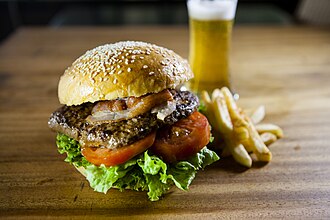
Photo: Wikipedia
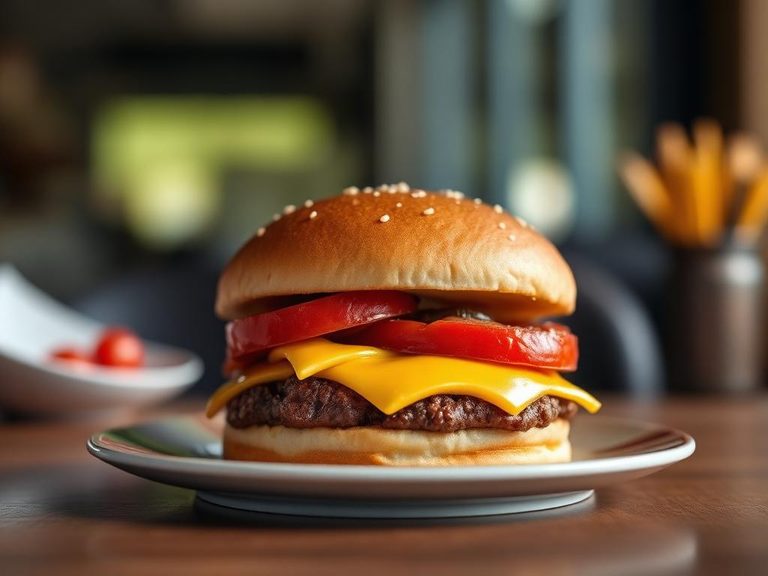
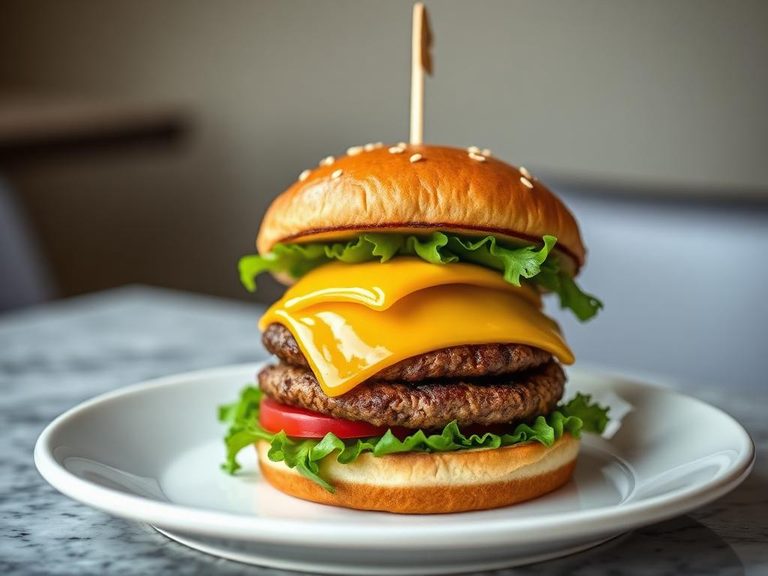
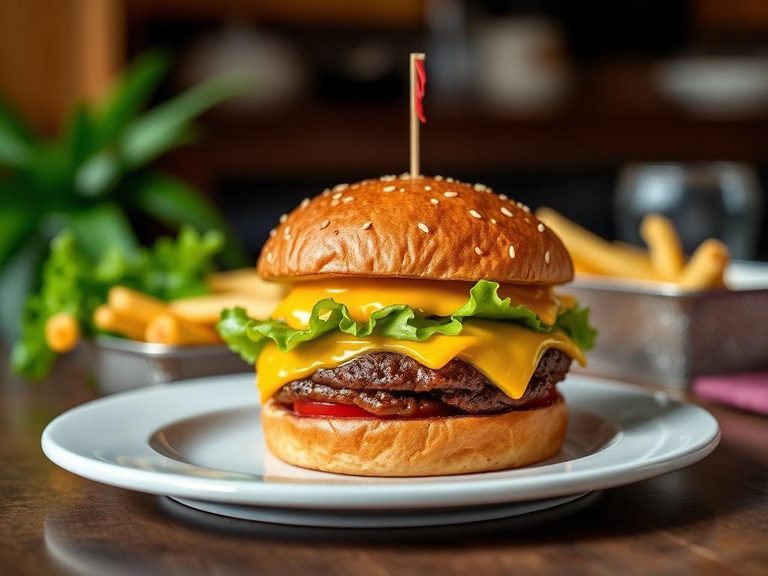
This is the iconic double-decker hamburger, a layered masterpiece of two beef patties, melted cheese, lettuce, pickles, onions, and a signature tangy sauce nestled between a soft sesame seed bun. Each bite delivers a satisfying crunch from fresh vegetables against the savory, juicy beef and creamy sauce. Nutritionally, it offers a substantial protein boost but is notably dense in calories and fats for its size.
Calorie split: 19% protein · 35% carbs · 46% fat
↓ Full nutrition💚 Why it's loved
People adore it for the perfect harmony of savory, salty, tangy, and creamy flavors in every bite. It's a cultural icon of convenience and comfort, representing a classic American fast-food experience.
⚠️ Watch-outs & how to enjoy it better
The high sodium and saturated fat content can contribute to water retention and may not suit low-sodium or heart-healthy diets. The refined bun and sugary sauce can cause rapid blood-sugar spikes. Counteract this by pairing with a side salad or water, choosing a lettuce wrap if available, or simply enjoying it as an occasional treat rather than a regular meal.
Key benefits
- High-quality protein source (12.17g per 100g)
- Provides quick energy from carbohydrates
- Contains calcium from cheese and beef
- Offers dietary fiber from lettuce and pickles
- Convenient, calorie-dense meal for active needs
🍽️ Popular dishes
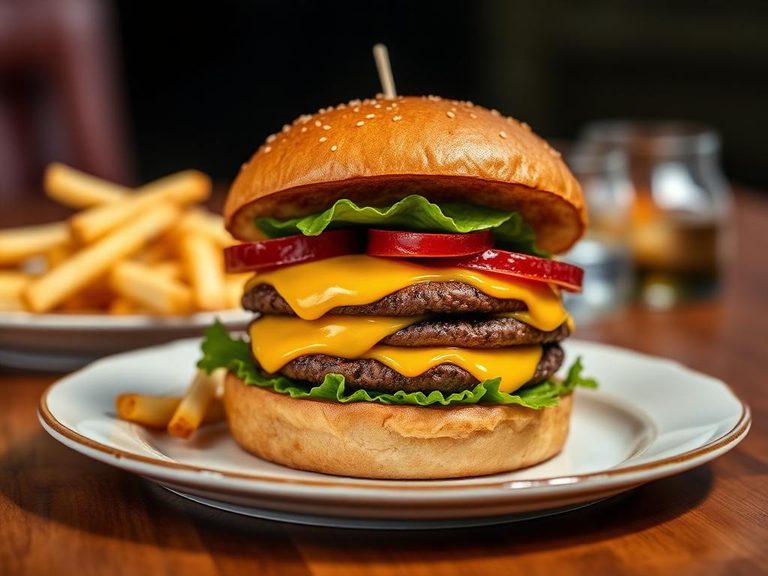
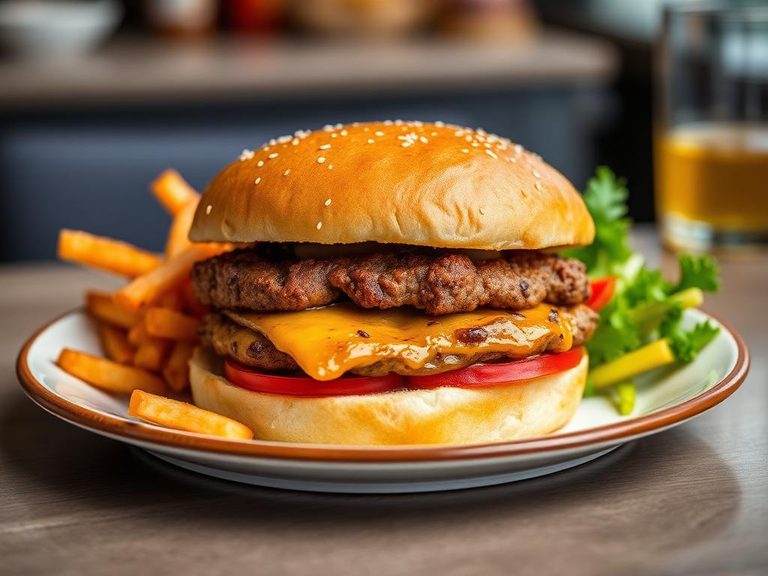
🌍 Where it's eaten
💡 Did you know?
The 'special sauce' on the most famous version of this burger is essentially a Thousand Island dressing variant, and its exact recipe was a closely guarded trade secret for decades.
Full nutrition (USDA data · scales with serving)
| Water | 50.3 g |
| Energy | 259 kcal |
| Energy | 1084 kj |
| Protein | 12.2 g |
| Total lipid (fat) | 13.3 g |
| Ash | 1.5 g |
| Carbohydrate, by difference | 22.7 g |
| Fiber, total dietary | 1.4 g |
| Sucrose | 0.15 g |
| Glucose | 1.3 g |
| Fructose | 1.4 g |
| Lactose | 0.15 g |
| Maltose | 0.39 g |
| Starch | 16.1 g |
| Calcium, Ca | 103 mg |
| Iron, Fe | 2.1 mg |
| Magnesium, Mg | 24.0 mg |
| Phosphorus, P | 112 mg |
| Potassium, K | 194 mg |
| Sodium, Na | 386 mg |
| Zinc, Zn | 2.4 mg |
| Copper, Cu | 0.10 mg |
| Manganese, Mn | 0.23 mg |
| Selenium, Se | 25.3 ug |
| Vitamin C, total ascorbic acid | 0.30 mg |
| Thiamin | 0.23 mg |
| Riboflavin | 0.23 mg |
| Niacin | 3.9 mg |
| Pantothenic acid | 0.46 mg |
| Vitamin B-6 | 0.08 mg |
| Folate, total | 22.0 ug |
| Folic acid | 17.0 ug |
| Folate, food | 5.0 ug |
| Folate, DFE | 34.0 ug |
| Vitamin B-12 | 1.2 ug |
| Vitamin E (alpha-tocopherol) | 0.09 mg |
| Tocopherol, beta | 0.00 mg |
| Tocopherol, gamma | 1.6 mg |
| Tocopherol, delta | 0.83 mg |
| Tocotrienol, beta | 0.00 mg |
| Tocotrienol, gamma | 0.00 mg |
| Tocotrienol, delta | 0.00 mg |
| Vitamin K (phylloquinone) | 23.4 ug |
| Vitamin K (Dihydrophylloquinone) | 0.00 ug |
Fat & fatty acid profile (per 100g)
| Fatty acids, total saturated | 4.2 g |
| SFA 8:0 | 0.00 g |
| SFA 10:0 | 0.00 g |
| SFA 12:0 | 0.00 g |
| SFA 14:0 | 0.24 g |
| SFA 15:0 | 0.04 g |
| SFA 16:0 | 2.5 g |
| SFA 17:0 | 0.09 g |
| SFA 18:0 | 1.3 g |
| SFA 20:0 | 0.03 g |
| SFA 22:0 | 0.03 g |
| SFA 24:0 | 0.00 g |
| Fatty acids, total monounsaturated | 4.8 g |
| MUFA 14:1 | 0.06 g |
| MUFA 15:1 | 0.00 g |
| MUFA 17:1 | 0.00 g |
| MUFA 18:1 | 4.7 g |
| MUFA 20:1 | 0.05 g |
| MUFA 22:1 | 0.02 g |
| Fatty acids, total polyunsaturated | 4.1 g |
| PUFA 18:2 | 3.6 g |
| PUFA 18:3 | 0.48 g |
| PUFA 18:4 | 0.04 g |
| PUFA 20:2 n-6 c,c | 0.00 g |
| PUFA 20:3 | 0.00 g |
| PUFA 20:4 | 0.02 g |
| PUFA 20:5 n-3 (EPA) | 0.00 g |
| PUFA 22:5 n-3 (DPA) | 0.00 g |
| PUFA 22:6 n-3 (DHA) | 0.00 g |
| Cholesterol | 32.0 mg |
Amino acid profile (per 100g)
| Tryptophan | 0.11 g |
| Threonine | 0.39 g |
| Isoleucine | 0.43 g |
| Leucine | 0.77 g |
| Lysine | 0.64 g |
| Methionine | 0.21 g |
| Cystine | 0.15 g |
| Phenylalanine | 0.44 g |
| Tyrosine | 0.22 g |
| Valine | 0.50 g |
| Arginine | 0.59 g |
| Histidine | 0.28 g |
| Alanine | 0.64 g |
| Aspartic acid | 0.74 g |
| Glutamic acid | 2.4 g |
| Glycine | 0.75 g |
| Proline | 0.81 g |
| Serine | 0.42 g |
FAQ
How much protein is in a typical serving?
A standard 215g burger contains about 26g of protein, primarily from the beef patties and cheese.
Is this a good post-workout meal?
It can be effective due to its high protein and calorie content for muscle recovery and glycogen replenishment, but the high fat and sodium are less ideal than leaner options.
What makes the 'special sauce' unique?
It's a creamy, tangy blend typically containing mayonnaise, pickle relish, mustard, vinegar, and spices, creating a signature flavor distinct from plain ketchup or mustard.
Nutrient density (calculated · NRF9.3)
Nutrient Rich Foods index: beneficial nutrients (protein, fiber, vitamins, minerals) minus saturated fat, added sugar & sodium, per 100 kcal.
NRF9.3 index — Fulgoni, Keast & Drewnowski, 2009. Computed from USDA nutrients.
Weight-loss friendliness (composite index)
Energy density 2.59 kcal/g · 19% calories from protein · 1.4 g fiber · 0.0 g sugar per 100 g.
Composite of energy density (Rolls et al., 1999), protein & fiber satiety, minus sugar. A calculated heuristic — ranks satiety-per-calorie, not a clinical measure.
Dietary load (calculated from USDA values)
Potential renal acid load. Positive = acid-forming, negative = alkaline-forming.
Sodium-to-potassium ratio: 1.99 (lower is better — aim for ≤ 1)
Sodium:potassium per WHO potassium guidance. Computed from USDA nutrients.