

Buckwheat flour, whole-groat
Whole food · Cereal Grains and Pasta

Photo: Wikipedia
Whole-groat buckwheat flour is a robust, earthy flour milled from the entire buckwheat seed, offering a deep, nutty flavor and a slightly gritty, hearty texture. Unlike refined flours, it retains the bran and germ, making it a powerhouse of fiber and plant-based protein. Its distinctive, rustic character is the foundation for many traditional pancakes and noodles across the globe.
Calorie split: 14% protein · 78% carbs · 8% fat
↓ Full nutrition💚 Why it's loved
People love it for its deep, earthy, and nutty flavor that adds a distinctive, rustic character to baked goods and pancakes. Its versatility allows it to be used in both sweet and savory dishes, from Japanese soba noodles to French galettes.
⚠️ Watch-outs & how to enjoy it better
The strong, earthy taste can be overpowering for some palates, and its dense texture may not appeal to everyone. To mitigate potential blood-sugar spikes due to its carb content, pair it with protein or healthy fats (e.g., eggs, cheese, nuts) and practice portion control. As a gluten-free flour, it can be crumbly; mixing with other flours or adding binders like eggs can improve texture.
Key benefits
- Rich in fiber (10g per 100g) for digestive health
- Good source of plant-based protein (12.62g per 100g)
- Naturally gluten-free, suitable for celiac diets
- Contains essential minerals like magnesium and iron
- Low in sugar (2.6g per 100g)
🍽️ Popular dishes


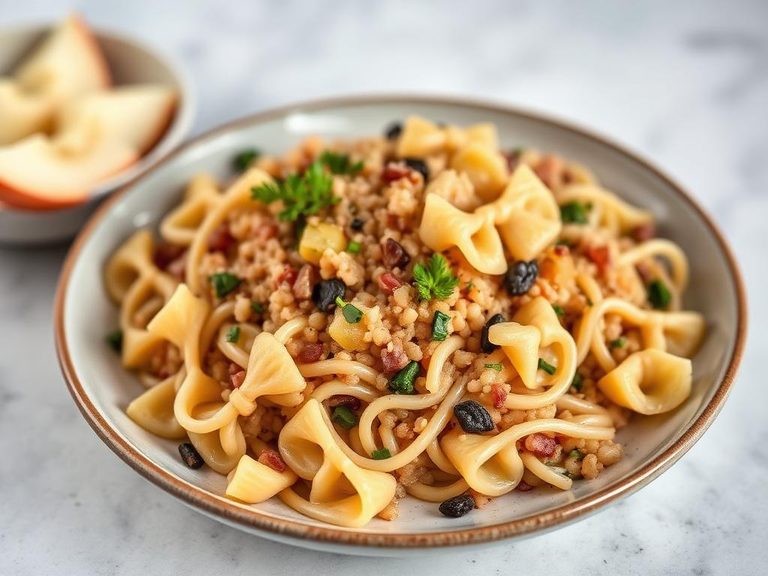


🌍 Where it's eaten
💡 Did you know?
Despite its name, buckwheat is not a type of wheat but a pseudocereal, related to rhubarb and sorrel.
Full nutrition (USDA data · scales with serving)
| Water | 11.2 g |
| Energy | 335 kcal |
| Energy | 1402 kj |
| Protein | 12.6 g |
| Total lipid (fat) | 3.1 g |
| Ash | 2.5 g |
| Carbohydrate, by difference | 70.6 g |
| Fiber, total dietary | 10.0 g |
| Total Sugars | 2.6 g |
| Sucrose | 1.7 g |
| Calcium, Ca | 41.0 mg |
| Iron, Fe | 4.1 mg |
| Magnesium, Mg | 251 mg |
| Phosphorus, P | 337 mg |
| Potassium, K | 577 mg |
| Sodium, Na | 11.0 mg |
| Zinc, Zn | 3.1 mg |
| Copper, Cu | 0.52 mg |
| Manganese, Mn | 2.0 mg |
| Selenium, Se | 5.7 ug |
| Vitamin C, total ascorbic acid | 0.00 mg |
| Thiamin | 0.42 mg |
| Riboflavin | 0.19 mg |
| Niacin | 6.2 mg |
| Pantothenic acid | 0.44 mg |
| Vitamin B-6 | 0.58 mg |
| Folate, total | 54.0 ug |
| Folic acid | 0.00 ug |
| Folate, food | 54.0 ug |
| Folate, DFE | 54.0 ug |
| Choline, total | 54.2 mg |
| Vitamin B-12 | 0.00 ug |
| Vitamin B-12, added | 0.00 ug |
| Vitamin A, RAE | 0.00 ug |
| Retinol | 0.00 ug |
| Carotene, beta | 0.00 ug |
| Carotene, alpha | 0.00 ug |
| Cryptoxanthin, beta | 0.00 ug |
| Vitamin A, IU | 0.00 iu |
| Lycopene | 0.00 ug |
| Lutein + zeaxanthin | 220 ug |
| Vitamin E (alpha-tocopherol) | 0.32 mg |
| Vitamin E, added | 0.00 mg |
| Tocopherol, gamma | 7.1 mg |
| Tocopherol, delta | 0.45 mg |
| Vitamin D (D2 + D3), International Units | 0.00 iu |
| Vitamin D (D2 + D3) | 0.00 ug |
| Vitamin K (phylloquinone) | 7.0 ug |
| Alcohol, ethyl | 0.00 g |
| Caffeine | 0.00 mg |
| Theobromine | 0.00 mg |
Fat & fatty acid profile (per 100g)
| Fatty acids, total saturated | 0.68 g |
| SFA 4:0 | 0.00 g |
| SFA 6:0 | 0.00 g |
| SFA 8:0 | 0.03 g |
| SFA 10:0 | 0.02 g |
| SFA 12:0 | 0.01 g |
| SFA 14:0 | 0.02 g |
| SFA 16:0 | 0.41 g |
| SFA 18:0 | 0.04 g |
| Fatty acids, total monounsaturated | 0.95 g |
| MUFA 16:1 | 0.02 g |
| MUFA 18:1 | 0.90 g |
| MUFA 20:1 | 0.00 g |
| MUFA 22:1 | 0.01 g |
| Fatty acids, total polyunsaturated | 0.95 g |
| PUFA 18:2 | 0.88 g |
| PUFA 18:3 | 0.07 g |
| PUFA 18:4 | 0.00 g |
| PUFA 20:4 | 0.00 g |
| PUFA 20:5 n-3 (EPA) | 0.00 g |
| PUFA 22:5 n-3 (DPA) | 0.00 g |
| PUFA 22:6 n-3 (DHA) | 0.00 g |
| Cholesterol | 0.00 mg |
Amino acid profile (per 100g)
| Tryptophan | 0.18 g |
| Threonine | 0.48 g |
| Isoleucine | 0.47 g |
| Leucine | 0.79 g |
| Lysine | 0.64 g |
| Methionine | 0.16 g |
| Cystine | 0.22 g |
| Phenylalanine | 0.49 g |
| Tyrosine | 0.23 g |
| Valine | 0.65 g |
| Arginine | 0.94 g |
| Histidine | 0.29 g |
| Alanine | 0.71 g |
| Aspartic acid | 1.1 g |
| Glutamic acid | 1.9 g |
| Glycine | 0.98 g |
| Proline | 0.48 g |
| Serine | 0.65 g |
FAQ
Is buckwheat flour gluten-free?
Yes, buckwheat is naturally gluten-free, making it a safe choice for those with celiac disease or gluten sensitivity. However, cross-contamination can occur during processing, so look for certified gluten-free products.
How does whole-groat buckwheat flour differ from regular buckwheat flour?
Whole-groat buckwheat flour is milled from the entire buckwheat seed, including the bran and germ, which gives it more fiber, protein, and nutrients compared to refined buckwheat flour. It also has a darker color and stronger, earthier flavor.
Can I use buckwheat flour as a 1:1 substitute for wheat flour?
Not always. Buckwheat flour lacks gluten, so it may not provide the same structure in baking. It's often best used in combination with other flours or in recipes specifically designed for it, like pancakes or soba noodles.
Nutrient density (calculated · NRF9.3)
Nutrient Rich Foods index: beneficial nutrients (protein, fiber, vitamins, minerals) minus saturated fat, added sugar & sodium, per 100 kcal.
NRF9.3 index — Fulgoni, Keast & Drewnowski, 2009. Computed from USDA nutrients.
Weight-loss friendliness (composite index)
Energy density 3.35 kcal/g · 15% calories from protein · 10.0 g fiber · 2.6 g sugar per 100 g.
Composite of energy density (Rolls et al., 1999), protein & fiber satiety, minus sugar. A calculated heuristic — ranks satiety-per-calorie, not a clinical measure.
Dietary load (calculated from USDA values)
Potential renal acid load. Positive = acid-forming, negative = alkaline-forming.
Sodium-to-potassium ratio: 0.02 (lower is better — aim for ≤ 1)
Sodium:potassium per WHO potassium guidance. Computed from USDA nutrients.