

Beans, white, mature seeds, cooked, boiled, without salt
Whole food · Legumes and Legume Products

Photo: Wikipedia
Mature white beans, boiled until tender, offer a mild, creamy flavor and a smooth, velvety texture that readily absorbs surrounding seasonings. They are a nutritional powerhouse, providing a substantial 9.73 grams of plant-based protein and an impressive 6.3 grams of dietary fiber per 100g serving. With virtually no fat and a low glycemic index, they are a staple for sustained energy and digestive health.
Calorie split: 27% protein · 70% carbs · 2% fat
↓ Full nutrition💚 Why it's loved
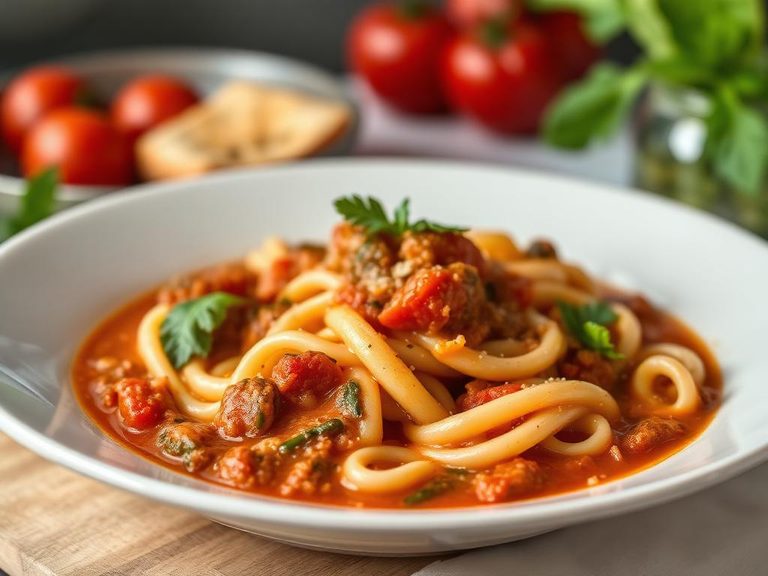
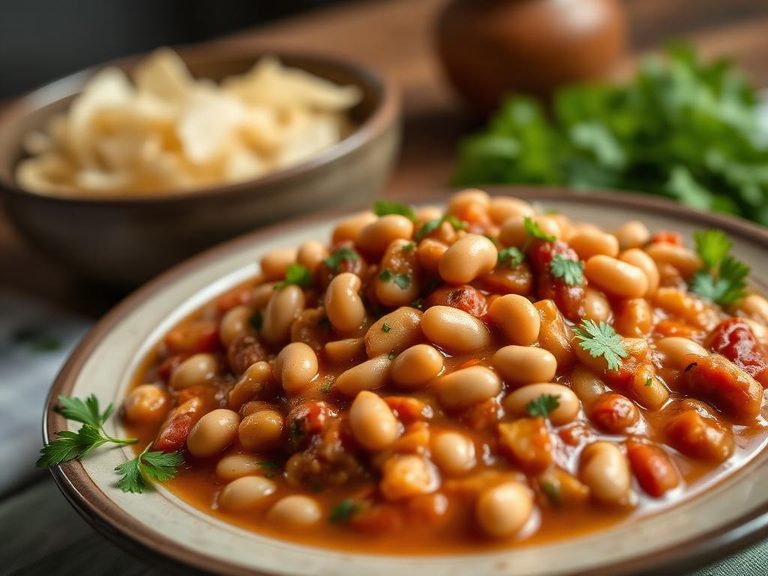
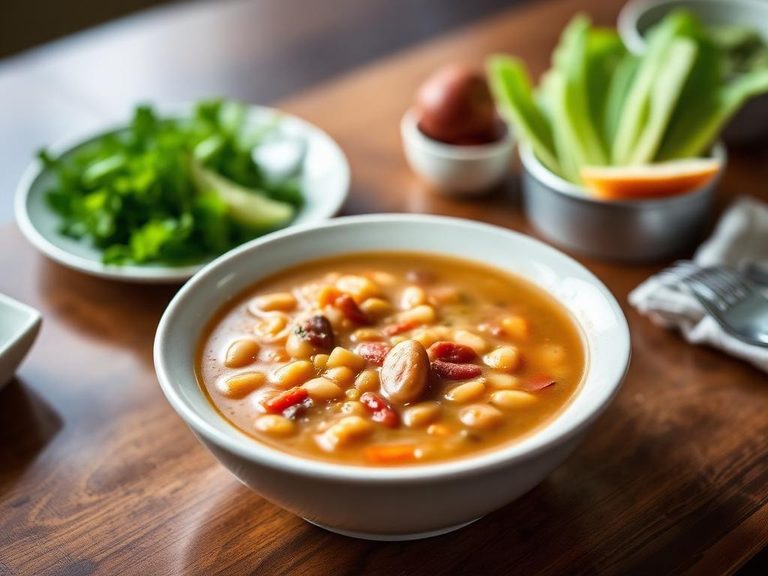
People love white beans for their incredible versatility and comforting, mild canvas that soaks up herbs, garlic, and broth. They are a cornerstone of countless hearty, soul-warming dishes across global cuisines, from Italian pasta e fagioli to American Senate bean soup.
⚠️ Watch-outs & how to enjoy it better
Their high fiber and oligosaccharide content can cause gas and bloating in some individuals, especially when introduced to the diet quickly. To counteract this, start with smaller portions, ensure they are thoroughly cooked, and consider soaking dried beans overnight and discarding the soak water. They are also a common allergen, and those managing blood sugar should pair them with non-starchy vegetables or a healthy fat to moderate the glycemic response.
Key benefits
- Excellent source of plant-based protein for muscle maintenance.
- High in soluble fiber, which supports healthy cholesterol levels.
- Provides slow-release carbohydrates for steady energy.
- Rich in essential minerals like iron, magnesium, and folate.
- Naturally low in fat and sodium (when cooked without salt).
🍽️ Popular dishes
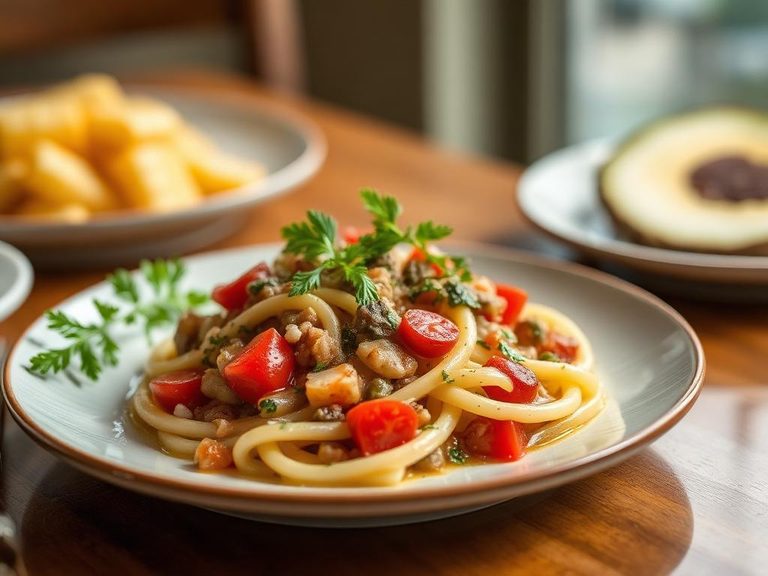
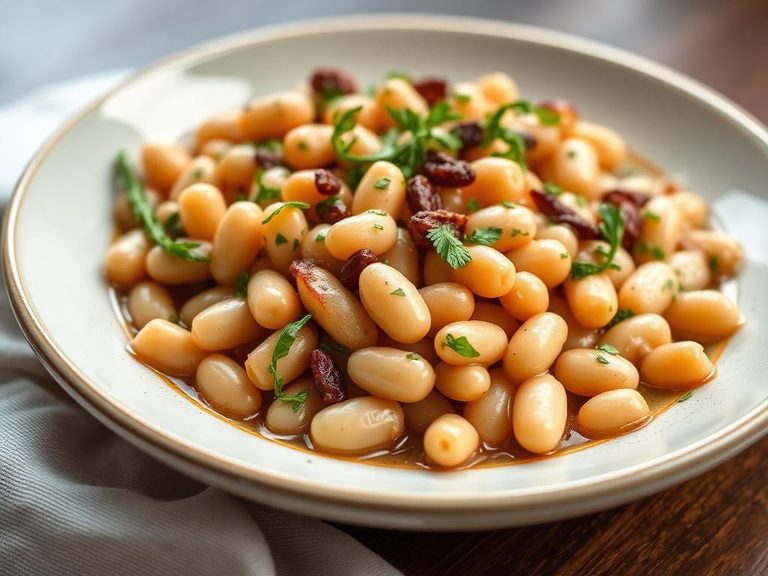
🌍 Where it's eaten
💡 Did you know?
The world record for eating baked beans (a related product) is over 50 pounds in 10 minutes, but a more practical fact is that one cup of cooked white beans provides about 24% of the daily recommended intake for folate, a B-vitamin crucial for cell growth.
Full nutrition (USDA data · scales with serving)
| Water | 63.1 g |
| Energy | 139 kcal |
| Energy | 581 kj |
| Protein | 9.7 g |
| Total lipid (fat) | 0.35 g |
| Ash | 1.8 g |
| Carbohydrate, by difference | 25.1 g |
| Fiber, total dietary | 6.3 g |
| Total Sugars | 0.34 g |
| Calcium, Ca | 90.0 mg |
| Iron, Fe | 3.7 mg |
| Magnesium, Mg | 63.0 mg |
| Phosphorus, P | 113 mg |
| Potassium, K | 561 mg |
| Sodium, Na | 6.0 mg |
| Zinc, Zn | 1.4 mg |
| Copper, Cu | 0.29 mg |
| Manganese, Mn | 0.64 mg |
| Selenium, Se | 1.3 ug |
| Vitamin C, total ascorbic acid | 0.00 mg |
| Thiamin | 0.12 mg |
| Riboflavin | 0.05 mg |
| Niacin | 0.14 mg |
| Pantothenic acid | 0.23 mg |
| Vitamin B-6 | 0.09 mg |
| Folate, total | 81.0 ug |
| Folic acid | 0.00 ug |
| Folate, food | 81.0 ug |
| Folate, DFE | 81.0 ug |
| Choline, total | 35.1 mg |
| Vitamin B-12 | 0.00 ug |
| Vitamin B-12, added | 0.00 ug |
| Vitamin A, RAE | 0.00 ug |
| Retinol | 0.00 ug |
| Carotene, beta | 0.00 ug |
| Carotene, alpha | 0.00 ug |
| Cryptoxanthin, beta | 0.00 ug |
| Vitamin A, IU | 0.00 iu |
| Lycopene | 0.00 ug |
| Lutein + zeaxanthin | 0.00 ug |
| Vitamin E (alpha-tocopherol) | 0.94 mg |
| Vitamin E, added | 0.00 mg |
| Vitamin D (D2 + D3), International Units | 0.00 iu |
| Vitamin D (D2 + D3) | 0.00 ug |
| Vitamin K (phylloquinone) | 3.5 ug |
| Alcohol, ethyl | 0.00 g |
| Caffeine | 0.00 mg |
| Theobromine | 0.00 mg |
Fat & fatty acid profile (per 100g)
| Fatty acids, total saturated | 0.09 g |
| SFA 4:0 | 0.00 g |
| SFA 6:0 | 0.00 g |
| SFA 8:0 | 0.00 g |
| SFA 10:0 | 0.00 g |
| SFA 12:0 | 0.00 g |
| SFA 14:0 | 0.00 g |
| SFA 16:0 | 0.09 g |
| SFA 18:0 | 0.01 g |
| Fatty acids, total monounsaturated | 0.03 g |
| MUFA 16:1 | 0.00 g |
| MUFA 18:1 | 0.03 g |
| MUFA 20:1 | 0.00 g |
| MUFA 22:1 | 0.00 g |
| Fatty acids, total polyunsaturated | 0.15 g |
| PUFA 18:2 | 0.08 g |
| PUFA 18:3 | 0.07 g |
| PUFA 18:4 | 0.00 g |
| PUFA 20:4 | 0.00 g |
| PUFA 20:5 n-3 (EPA) | 0.00 g |
| PUFA 22:5 n-3 (DPA) | 0.00 g |
| PUFA 22:6 n-3 (DHA) | 0.00 g |
| Fatty acids, total trans | 0.00 g |
| Cholesterol | 0.00 mg |
Amino acid profile (per 100g)
| Tryptophan | 0.12 g |
| Threonine | 0.41 g |
| Isoleucine | 0.43 g |
| Leucine | 0.78 g |
| Lysine | 0.67 g |
| Methionine | 0.15 g |
| Cystine | 0.11 g |
| Phenylalanine | 0.53 g |
| Tyrosine | 0.27 g |
| Valine | 0.51 g |
| Arginine | 0.60 g |
| Histidine | 0.27 g |
| Alanine | 0.41 g |
| Aspartic acid | 1.2 g |
| Glutamic acid | 1.5 g |
| Glycine | 0.38 g |
| Proline | 0.41 g |
| Serine | 0.53 g |
FAQ
Do I need to soak dried white beans before cooking?
Soaking overnight (or for at least 8 hours) is highly recommended. It softens the beans, reduces cooking time significantly, and helps break down the oligosaccharides that can cause digestive discomfort. For a quick soak, cover beans with water, bring to a boil for 2 minutes, then let them stand covered for an hour before cooking.
Are canned white beans as nutritious as dried?
Yes, nutritionally they are very similar. Canning involves high-heat processing which may slightly reduce some heat-sensitive vitamins, but it also makes the beans immediately usable. The main difference is often sodium content; choose 'no salt added' canned beans or rinse them thoroughly under water to reduce sodium by up to 40%.
Why do my white beans sometimes have a tough skin or remain hard in the center?
This is often due to age of the beans, hard water, or the presence of acid (like tomatoes or salt) added too early in cooking. Always add acidic ingredients and salt towards the end of the cooking time. Using fresh beans and ensuring a gentle, consistent simmer after the soak will help achieve a uniformly creamy texture.
Nutrient density (calculated · NRF9.3)
Nutrient Rich Foods index: beneficial nutrients (protein, fiber, vitamins, minerals) minus saturated fat, added sugar & sodium, per 100 kcal.
NRF9.3 index — Fulgoni, Keast & Drewnowski, 2009. Computed from USDA nutrients.
Weight-loss friendliness (composite index)
Energy density 1.39 kcal/g · 28% calories from protein · 6.3 g fiber · 0.3 g sugar per 100 g.
Composite of energy density (Rolls et al., 1999), protein & fiber satiety, minus sugar. A calculated heuristic — ranks satiety-per-calorie, not a clinical measure.
Dietary load (calculated from USDA values)
Potential renal acid load. Positive = acid-forming, negative = alkaline-forming.
Sodium-to-potassium ratio: 0.01 (lower is better — aim for ≤ 1)
Sodium:potassium per WHO potassium guidance. Computed from USDA nutrients.