

Babyfood, vegetables, carrots, strained
Whole food · Baby Foods

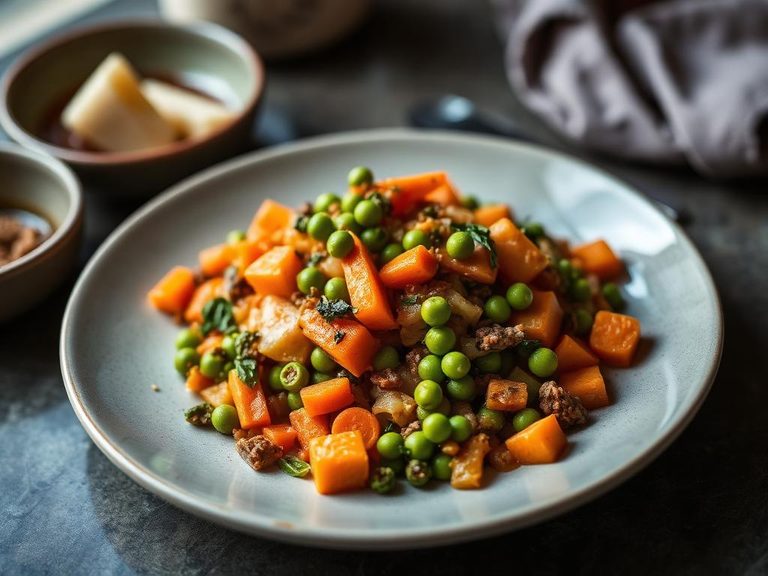
Photo: Wikipedia
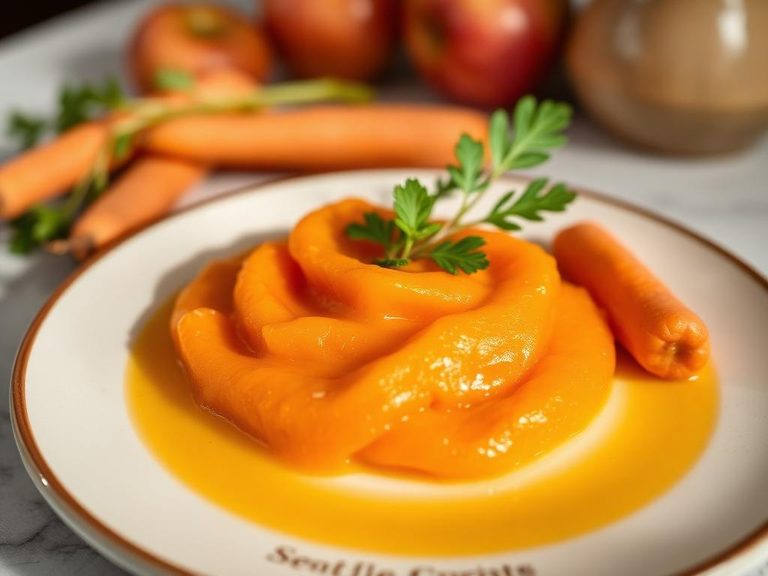
This is a smooth, velvety purée of cooked and strained carrots, designed as a first food for infants. It has a naturally sweet, earthy flavor and a texture so fine it coats a spoon. Nutritionally, it's a low-calorie, fiber-rich source of beta-carotene, which the body converts to vitamin A.
Calorie split: 11% protein · 85% carbs · 3% fat
↓ Full nutrition💚 Why it's loved
Parents love it for its natural sweetness that babies readily accept, and its smooth texture makes it a safe, nutritious introduction to vegetables. It's a versatile base that can be mixed with other purées or grains.
⚠️ Watch-outs & how to enjoy it better
The high natural sugar content (3.64g per 100g) can contribute to blood sugar spikes if served in large, unbalanced portions. To counteract this, always pair it with a protein or healthy fat source, like a swirl of plain yogurt or a sprinkle of ground flaxseed, to slow sugar absorption.
Key benefits
- Excellent source of beta-carotene for vitamin A.
- High in dietary fiber for digestive health.
- Naturally low in fat and sodium.
- Provides antioxidants like lutein and lycopene.
- Gentle, easily digestible first food.
🍽️ Popular dishes
🌍 Where it's eaten
💡 Did you know?
Strained carrots were among the very first commercially produced baby foods in the United States, popularized by Gerber in the 1920s.
Full nutrition (USDA data · scales with serving)
| Water | 92.3 g |
| Energy | 26.0 kcal |
| Energy | 109 kj |
| Protein | 0.80 g |
| Total lipid (fat) | 0.10 g |
| Ash | 0.80 g |
| Carbohydrate, by difference | 6.0 g |
| Fiber, total dietary | 1.7 g |
| Total Sugars | 3.6 g |
| Calcium, Ca | 22.0 mg |
| Iron, Fe | 0.37 mg |
| Magnesium, Mg | 9.0 mg |
| Phosphorus, P | 20.0 mg |
| Potassium, K | 196 mg |
| Sodium, Na | 69.0 mg |
| Zinc, Zn | 0.15 mg |
| Copper, Cu | 0.04 mg |
| Selenium, Se | 0.20 ug |
| Fluoride, F | 1.0 ug |
| Vitamin C, total ascorbic acid | 5.7 mg |
| Thiamin | 0.02 mg |
| Riboflavin | 0.04 mg |
| Niacin | 0.46 mg |
| Pantothenic acid | 0.24 mg |
| Vitamin B-6 | 0.07 mg |
| Folate, total | 15.0 ug |
| Folic acid | 0.00 ug |
| Folate, food | 15.0 ug |
| Folate, DFE | 15.0 ug |
| Choline, total | 6.9 mg |
| Vitamin B-12 | 0.00 ug |
| Vitamin B-12, added | 0.00 ug |
| Vitamin A, RAE | 573 ug |
| Retinol | 0.00 ug |
| Carotene, beta | 5575 ug |
| Carotene, alpha | 2602 ug |
| Cryptoxanthin, beta | 0.00 ug |
| Vitamin A, IU | 11461 iu |
| Lycopene | 0.00 ug |
| Lutein + zeaxanthin | 0.00 ug |
| Vitamin E (alpha-tocopherol) | 0.52 mg |
| Vitamin E, added | 0.00 mg |
| Vitamin D (D2 + D3), International Units | 0.00 iu |
| Vitamin D (D2 + D3) | 0.00 ug |
| Vitamin K (phylloquinone) | 14.4 ug |
| Alcohol, ethyl | 0.00 g |
| Caffeine | 0.00 mg |
| Theobromine | 0.00 mg |
Fat & fatty acid profile (per 100g)
| Fatty acids, total saturated | 0.02 g |
| SFA 4:0 | 0.00 g |
| SFA 6:0 | 0.00 g |
| SFA 8:0 | 0.00 g |
| SFA 10:0 | 0.00 g |
| SFA 12:0 | 0.00 g |
| SFA 14:0 | 0.00 g |
| SFA 16:0 | 0.01 g |
| SFA 18:0 | 0.00 g |
| Fatty acids, total monounsaturated | 0.00 g |
| MUFA 16:1 | 0.00 g |
| MUFA 18:1 | 0.00 g |
| MUFA 20:1 | 0.00 g |
| MUFA 22:1 | 0.00 g |
| Fatty acids, total polyunsaturated | 0.05 g |
| PUFA 18:2 | 0.04 g |
| PUFA 18:3 | 0.01 g |
| PUFA 18:4 | 0.00 g |
| PUFA 20:4 | 0.00 g |
| PUFA 20:5 n-3 (EPA) | 0.00 g |
| PUFA 22:5 n-3 (DPA) | 0.00 g |
| PUFA 22:6 n-3 (DHA) | 0.00 g |
| Cholesterol | 0.00 mg |
Amino acid profile (per 100g)
| Tryptophan | 0.01 g |
| Threonine | 0.02 g |
| Isoleucine | 0.02 g |
| Leucine | 0.03 g |
| Lysine | 0.02 g |
| Methionine | 0.01 g |
| Cystine | 0.01 g |
| Phenylalanine | 0.02 g |
| Tyrosine | 0.02 g |
| Valine | 0.03 g |
| Arginine | 0.05 g |
| Histidine | 0.01 g |
| Alanine | 0.04 g |
| Aspartic acid | 0.12 g |
| Glutamic acid | 0.22 g |
| Glycine | 0.02 g |
| Proline | 0.02 g |
| Serine | 0.02 g |
FAQ
Is this the same as carrot juice?
No. Strained baby food is a thick purée made from cooked, mashed, and sieved carrots, retaining the fiber. Carrot juice is the extracted liquid with most of the pulp and fiber removed.
Can I use this as an ingredient in my own cooking?
Absolutely. It's a convenient, smooth carrot purée that can be stirred into soups, stews, pasta sauces, or baked goods to add moisture, natural sweetness, and nutrients without altering texture.
Why is the sugar content listed if it's just vegetables?
Carrots are naturally rich in sugars like sucrose, glucose, and fructose. This is intrinsic plant sugar, not added sugar, and comes packaged with fiber and nutrients.
Nutrient density (calculated · NRF9.3)
Nutrient Rich Foods index: beneficial nutrients (protein, fiber, vitamins, minerals) minus saturated fat, added sugar & sodium, per 100 kcal.
NRF9.3 index — Fulgoni, Keast & Drewnowski, 2009. Computed from USDA nutrients.
Weight-loss friendliness (composite index)
Energy density 0.26 kcal/g · 12% calories from protein · 1.7 g fiber · 3.6 g sugar per 100 g.
Composite of energy density (Rolls et al., 1999), protein & fiber satiety, minus sugar. A calculated heuristic — ranks satiety-per-calorie, not a clinical measure.
Dietary load (calculated from USDA values)
Potential renal acid load. Positive = acid-forming, negative = alkaline-forming.
Sodium-to-potassium ratio: 0.35 (lower is better — aim for ≤ 1)
Sodium:potassium per WHO potassium guidance. Computed from USDA nutrients.