

Babyfood, fruit and vegetable, apple and sweet potato
Whole food · Baby Foods

Photo: Wikipedia
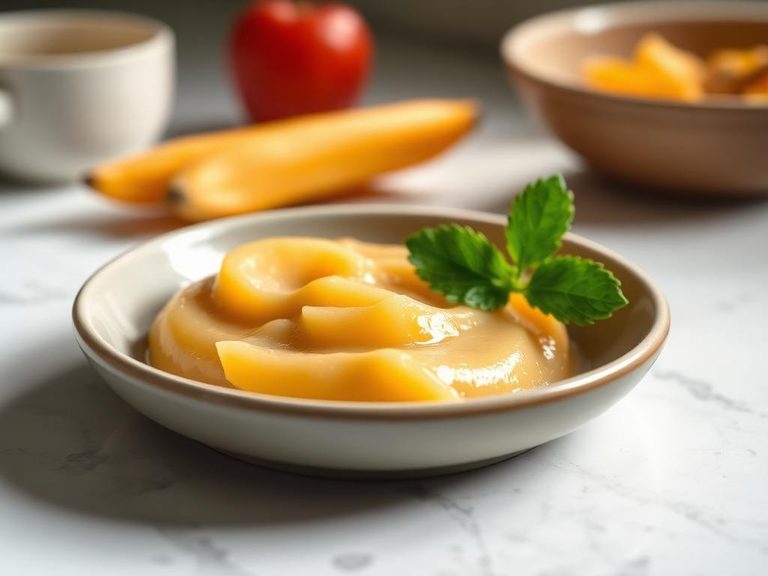
A smooth, velvety puree that blends the gentle sweetness of ripe apples with the earthy, creamy notes of sweet potato. Its naturally vibrant orange hue signals a wealth of beta-carotene, while its mild, familiar flavor makes it a foundational first food for infants. The texture is typically silky and uniform, designed for easy swallowing.
Calorie split: 2% protein · 95% carbs · 3% fat
↓ Full nutrition💚 Why it's loved
Parents and caregivers love it for its reliable, crowd-pleasing sweetness and smooth consistency that babies accept readily. It's a trusted, convenient staple in the journey of introducing solid foods, often evoking a sense of wholesome, homemade care.
⚠️ Watch-outs & how to enjoy it better
The high natural sugar content (11.6g per 100g) can contribute to rapid blood sugar spikes if served frequently or in large portions. To counteract this, serve it as part of a balanced meal alongside a protein or fat source (like a little plain yogurt or avocado) to slow sugar absorption, and practice portion control.
Key benefits
- Excellent source of beta-carotene (vitamin A precursor) for vision and immune health
- Provides gentle, soluble fiber to support digestive regularity
- Naturally sweet without added sugars, appealing to developing palates
- Contains vitamin C from apples to aid iron absorption
- Hypoallergenic and low in common food allergens
🍽️ Popular dishes
🌍 Where it's eaten
💡 Did you know?
This specific combination is often one of the first 'mixed' flavors introduced to infants, strategically pairing a universally accepted fruit (apple) with a nutrient-dense vegetable (sweet potato) to expand taste preferences.
Full nutrition (USDA data · scales with serving)
| Water | 84.0 g |
| Energy | 64.0 kcal |
| Energy | 269 kj |
| Protein | 0.30 g |
| Total lipid (fat) | 0.22 g |
| Ash | 0.30 g |
| Carbohydrate, by difference | 15.3 g |
| Fiber, total dietary | 1.4 g |
| Total Sugars | 11.6 g |
| Sucrose | 0.65 g |
| Glucose | 3.1 g |
| Fructose | 7.1 g |
| Maltose | 0.78 g |
| Calcium, Ca | 8.0 mg |
| Iron, Fe | 0.20 mg |
| Magnesium, Mg | 6.0 mg |
| Phosphorus, P | 17.0 mg |
| Potassium, K | 149 mg |
| Sodium, Na | 3.0 mg |
| Zinc, Zn | 0.10 mg |
| Copper, Cu | 0.09 mg |
| Manganese, Mn | 0.06 mg |
| Selenium, Se | 0.30 ug |
| Vitamin C, total ascorbic acid | 6.4 mg |
| Thiamin | 0.01 mg |
| Riboflavin | 0.02 mg |
| Niacin | 0.10 mg |
| Pantothenic acid | 0.10 mg |
| Vitamin B-6 | 0.05 mg |
| Folate, total | 2.0 ug |
| Folic acid | 0.00 ug |
| Folate, food | 2.0 ug |
| Folate, DFE | 2.0 ug |
| Choline, total | 4.4 mg |
| Vitamin B-12 | 0.00 ug |
| Vitamin B-12, added | 0.00 ug |
| Vitamin A, RAE | 103 ug |
| Retinol | 0.00 ug |
| Carotene, beta | 1225 ug |
| Carotene, alpha | 0.00 ug |
| Cryptoxanthin, beta | 9.0 ug |
| Vitamin A, IU | 2050 iu |
| Lycopene | 0.00 ug |
| Lutein + zeaxanthin | 13.0 ug |
| Vitamin E (alpha-tocopherol) | 0.16 mg |
| Vitamin E, added | 0.00 mg |
| Vitamin D (D2 + D3), International Units | 0.00 iu |
| Vitamin D (D2 + D3) | 0.00 ug |
| Vitamin K (phylloquinone) | 0.80 ug |
| Alcohol, ethyl | 0.00 g |
| Caffeine | 0.00 mg |
| Theobromine | 0.00 mg |
Fat & fatty acid profile (per 100g)
| Fatty acids, total saturated | 0.04 g |
| SFA 4:0 | 0.00 g |
| SFA 6:0 | 0.00 g |
| SFA 8:0 | 0.00 g |
| SFA 10:0 | 0.00 g |
| SFA 12:0 | 0.00 g |
| SFA 14:0 | 0.00 g |
| SFA 16:0 | 0.04 g |
| SFA 18:0 | 0.00 g |
| Fatty acids, total monounsaturated | 0.01 g |
| MUFA 16:1 | 0.00 g |
| MUFA 18:1 | 0.01 g |
| MUFA 20:1 | 0.00 g |
| MUFA 22:1 | 0.00 g |
| Fatty acids, total polyunsaturated | 0.08 g |
| PUFA 18:2 | 0.07 g |
| PUFA 18:3 | 0.01 g |
| PUFA 18:4 | 0.00 g |
| PUFA 20:4 | 0.00 g |
| PUFA 20:5 n-3 (EPA) | 0.00 g |
| PUFA 22:5 n-3 (DPA) | 0.00 g |
| PUFA 22:6 n-3 (DHA) | 0.00 g |
| Cholesterol | 0.00 mg |
Amino acid profile (per 100g)
Estimated from Babyfood, grape juice, no sugar, canned — USDA does not publish this profile for Babyfood.
| Threonine | 0.02 g |
| Isoleucine | 0.01 g |
| Leucine | 0.02 g |
| Lysine | 0.02 g |
| Methionine | 0.03 g |
| Cystine | 0.01 g |
| Phenylalanine | 0.02 g |
| Tyrosine | 0.02 g |
| Valine | 0.02 g |
| Arginine | 0.06 g |
| Histidine | 0.03 g |
| Alanine | 0.04 g |
| Aspartic acid | 0.10 g |
| Glutamic acid | 0.18 g |
| Glycine | 0.03 g |
| Proline | 0.03 g |
| Serine | 0.04 g |
FAQ
Is this puree a complete meal for my baby?
No, it's a complementary food. For babies over 6 months, it should be part of a varied diet that includes iron-rich foods (like fortified cereal or meat), healthy fats, and eventually protein sources to meet all nutritional needs.
Can I mix this with other foods?
Absolutely. It's a versatile base. You can stir in a spoonful of plain whole-milk yogurt for protein and fat, blend in a bit of oatmeal for texture, or mix with other pureed vegetables like peas or carrots for new flavor combinations.
How should I store homemade versions?
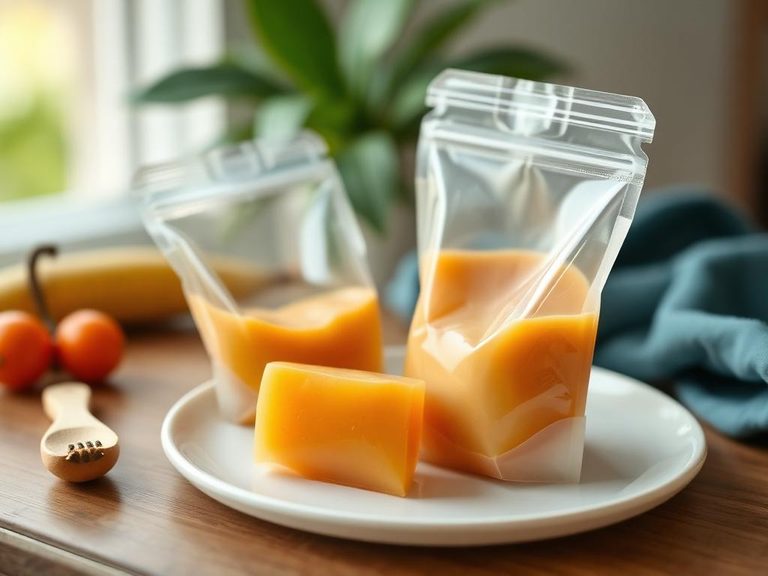
Store in airtight containers in the refrigerator for up to 48 hours, or freeze in ice cube trays or small portions for up to 3 months. Thaw in the refrigerator or a warm water bath, and always test the temperature before serving.
Nutrient density (calculated · NRF9.3)
Nutrient Rich Foods index: beneficial nutrients (protein, fiber, vitamins, minerals) minus saturated fat, added sugar & sodium, per 100 kcal.
NRF9.3 index — Fulgoni, Keast & Drewnowski, 2009. Computed from USDA nutrients.
Weight-loss friendliness (composite index)
Energy density 0.64 kcal/g · 2% calories from protein · 1.4 g fiber · 11.6 g sugar per 100 g.
Composite of energy density (Rolls et al., 1999), protein & fiber satiety, minus sugar. A calculated heuristic — ranks satiety-per-calorie, not a clinical measure.
Dietary load (calculated from USDA values)
Potential renal acid load. Positive = acid-forming, negative = alkaline-forming.
Sodium-to-potassium ratio: 0.02 (lower is better — aim for ≤ 1)
Sodium:potassium per WHO potassium guidance. Computed from USDA nutrients.