

Wheat flour, white, all-purpose, unenriched
Whole food · Cereal Grains and Pasta
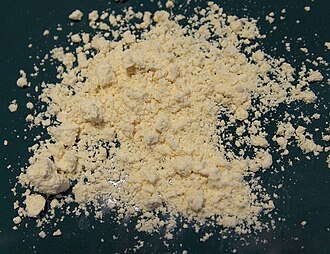
Photo: Wikipedia
White all-purpose flour is the workhorse of global kitchens, a finely milled powder made from the endosperm of wheat kernels. It has a neutral, slightly sweet taste and a soft, powdery texture that, when mixed with liquid and kneaded, creates a smooth, elastic dough. Nutritionally, it's a dense source of energy, primarily from carbohydrates, with a modest protein content that helps provide structure in baked goods.
Calorie split: 12% protein · 86% carbs · 2% fat
↓ Full nutrition💚 Why it's loved
People love it for its incredible versatility and reliability; it's the foundation for everything from fluffy pancakes and tender biscuits to chewy bread and delicate pastries. Its mild flavor allows other ingredients like spices, fruits, and fats to shine, making it a cultural staple in cuisines worldwide.
⚠️ Watch-outs & how to enjoy it better
As a refined carbohydrate, it can cause rapid blood sugar spikes, making it less ideal for those managing diabetes or insulin resistance. It is also a common allergen (gluten) and lacks the fiber and nutrients of whole wheat. To counteract blood sugar spikes, pair it with protein (like eggs or cheese) or healthy fats (like avocado or nuts), and consider using it in smaller portions alongside whole grains.
Key benefits
- Provides quick energy from its high carbohydrate content.
- A good source of plant-based protein for muscle and tissue maintenance.
- Its neutral flavor makes it a versatile base for countless recipes.
- The fine texture allows for a light, tender crumb in cakes and pastries.
- Can be enriched with vitamins and minerals to combat deficiencies.
🍽️ Popular dishes





🌍 Where it's eaten
💡 Did you know?
The term 'all-purpose' was popularized in the early 20th century by American mills to market a single flour that could be used for both bread and cake, simplifying the pantry for home bakers.
Full nutrition (USDA data · scales with serving)
| Water | 11.9 g |
| Energy | 364 kcal |
| Energy | 1523 kj |
| Protein | 10.3 g |
| Total lipid (fat) | 0.98 g |
| Ash | 0.47 g |
| Carbohydrate, by difference | 76.3 g |
| Fiber, total dietary | 2.7 g |
| Total Sugars | 0.27 g |
| Calcium, Ca | 15.0 mg |
| Iron, Fe | 1.2 mg |
| Magnesium, Mg | 22.0 mg |
| Phosphorus, P | 108 mg |
| Potassium, K | 107 mg |
| Sodium, Na | 2.0 mg |
| Zinc, Zn | 0.70 mg |
| Copper, Cu | 0.14 mg |
| Manganese, Mn | 0.68 mg |
| Selenium, Se | 33.9 ug |
| Vitamin C, total ascorbic acid | 0.00 mg |
| Thiamin | 0.12 mg |
| Riboflavin | 0.04 mg |
| Niacin | 1.3 mg |
| Pantothenic acid | 0.44 mg |
| Vitamin B-6 | 0.04 mg |
| Folate, total | 26.0 ug |
| Folic acid | 0.00 ug |
| Folate, food | 26.0 ug |
| Folate, DFE | 26.0 ug |
| Choline, total | 10.4 mg |
| Vitamin B-12 | 0.00 ug |
| Vitamin B-12, added | 0.00 ug |
| Vitamin A, RAE | 0.00 ug |
| Retinol | 0.00 ug |
| Carotene, beta | 0.00 ug |
| Carotene, alpha | 0.00 ug |
| Cryptoxanthin, beta | 0.00 ug |
| Vitamin A, IU | 0.00 iu |
| Lycopene | 0.00 ug |
| Lutein + zeaxanthin | 18.0 ug |
| Vitamin E (alpha-tocopherol) | 0.06 mg |
| Vitamin E, added | 0.00 mg |
| Vitamin D (D2 + D3), International Units | 0.00 iu |
| Vitamin D (D2 + D3) | 0.00 ug |
| Vitamin K (phylloquinone) | 0.30 ug |
| Alcohol, ethyl | 0.00 g |
| Caffeine | 0.00 mg |
| Theobromine | 0.00 mg |
Fat & fatty acid profile (per 100g)
| Fatty acids, total saturated | 0.15 g |
| SFA 4:0 | 0.00 g |
| SFA 6:0 | 0.00 g |
| SFA 8:0 | 0.00 g |
| SFA 10:0 | 0.00 g |
| SFA 12:0 | 0.00 g |
| SFA 14:0 | 0.00 g |
| SFA 16:0 | 0.15 g |
| SFA 18:0 | 0.01 g |
| Fatty acids, total monounsaturated | 0.09 g |
| MUFA 16:1 | 0.00 g |
| MUFA 18:1 | 0.09 g |
| MUFA 20:1 | 0.00 g |
| MUFA 22:1 | 0.00 g |
| Fatty acids, total polyunsaturated | 0.41 g |
| PUFA 18:2 | 0.39 g |
| PUFA 18:3 | 0.02 g |
| PUFA 18:4 | 0.00 g |
| PUFA 20:4 | 0.00 g |
| PUFA 20:5 n-3 (EPA) | 0.00 g |
| PUFA 22:5 n-3 (DPA) | 0.00 g |
| PUFA 22:6 n-3 (DHA) | 0.00 g |
| Cholesterol | 0.00 mg |
Amino acid profile (per 100g)
| Tryptophan | 0.13 g |
| Threonine | 0.28 g |
| Isoleucine | 0.36 g |
| Leucine | 0.71 g |
| Lysine | 0.23 g |
| Methionine | 0.18 g |
| Cystine | 0.22 g |
| Phenylalanine | 0.52 g |
| Tyrosine | 0.31 g |
| Valine | 0.41 g |
| Arginine | 0.42 g |
| Histidine | 0.23 g |
| Alanine | 0.33 g |
| Aspartic acid | 0.43 g |
| Glutamic acid | 3.5 g |
| Glycine | 0.37 g |
| Proline | 1.2 g |
| Serine | 0.52 g |
FAQ
What's the difference between all-purpose flour and bread flour?
All-purpose flour has a moderate protein content (around 10-12%), suitable for most baking. Bread flour has a higher protein content (12-14%), which creates more gluten, resulting in a chewier, more structured loaf of bread.
Can I substitute all-purpose flour for whole wheat flour?
You can, but it will change the texture and nutrition. Whole wheat flour is denser and has more fiber. A common approach is to substitute 50% of the all-purpose flour with whole wheat flour to maintain some lightness while adding nutrition.
Why is my flour clumpy?
Clumping can occur if the flour has been exposed to moisture. To fix it, sift the flour through a fine-mesh sieve to break up the clumps and aerate it, which is especially important for light baked goods like cakes.
Nutrient density (calculated · NRF9.3)
Nutrient Rich Foods index: beneficial nutrients (protein, fiber, vitamins, minerals) minus saturated fat, added sugar & sodium, per 100 kcal.
NRF9.3 index — Fulgoni, Keast & Drewnowski, 2009. Computed from USDA nutrients.
Weight-loss friendliness (composite index)
Energy density 3.64 kcal/g · 11% calories from protein · 2.7 g fiber · 0.3 g sugar per 100 g.
Composite of energy density (Rolls et al., 1999), protein & fiber satiety, minus sugar. A calculated heuristic — ranks satiety-per-calorie, not a clinical measure.
Dietary load (calculated from USDA values)
Potential renal acid load. Positive = acid-forming, negative = alkaline-forming.
Sodium-to-potassium ratio: 0.02 (lower is better — aim for ≤ 1)
Sodium:potassium per WHO potassium guidance. Computed from USDA nutrients.