

Sausage, meatless
Whole food · Legumes and Legume Products

Photo: Wikipedia
Meatless sausage is a plant-based protein designed to mimic the savory, smoky, and often spiced profile of traditional meat sausage. It typically has a firm, slightly chewy texture and can be grilled, pan-fried, or crumbled, offering a satisfying alternative for those seeking to reduce meat consumption. With a notable 20.28g of protein per 100g and a moderate fat content, it serves as a substantial protein source in a meat-free diet.
Calorie split: 29% protein · 12% carbs · 59% fat
↓ Full nutrition💚 Why it's loved
People love meatless sausage for its ability to deliver a familiar, savory umami flavor and satisfying texture without animal products, making it a staple in plant-based cooking. Its versatility allows it to be used in everything from breakfast scrambles to hearty stews, appealing to both vegetarians and flexitarians.
⚠️ Watch-outs & how to enjoy it better
Some meatless sausages can be high in sodium, which may be a concern for those monitoring blood pressure, and they often contain common allergens like soy or wheat. To counteract high sodium, pair with potassium-rich foods like leafy greens or bananas, and choose low-sodium varieties. For allergens, always check labels and consider homemade versions using legumes or grains.
Key benefits
- High in protein (20.28g per 100g), supporting muscle maintenance and satiety.
- Cholesterol-free, unlike animal-based sausages.
- Contains dietary fiber (2.8g per 100g), aiding digestion.
- Offers a convenient, versatile protein source for quick meals.
- Often fortified with vitamins and minerals like B12 and iron.
🍽️ Popular dishes
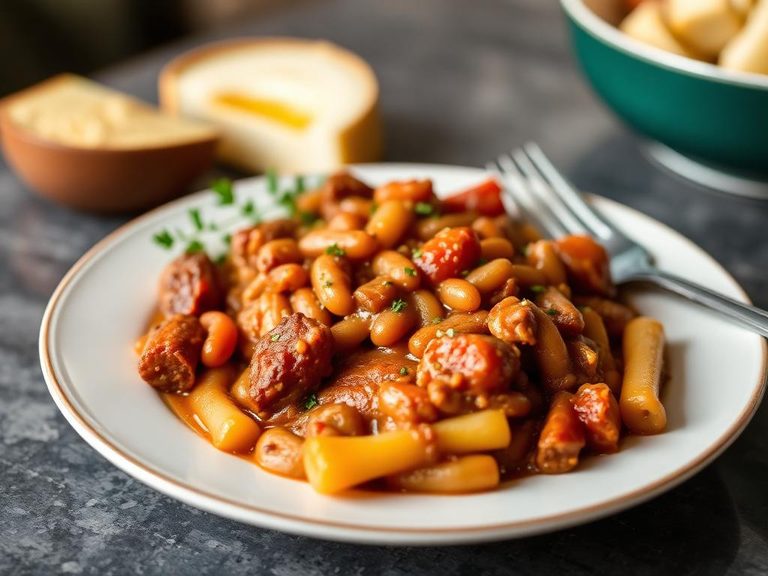
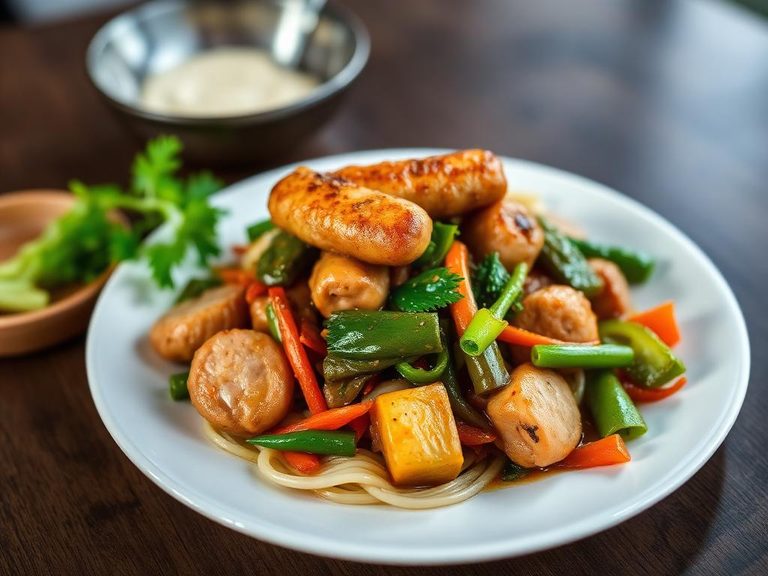
🌍 Where it's eaten
💡 Did you know?
The first commercially successful meatless sausage, the 'Veggie Sausage,' was introduced in the UK in the 1980s, inspired by traditional British bangers but made from textured vegetable protein.
Full nutrition (USDA data · scales with serving)
| Water | 50.4 g |
| Energy | 255 kcal |
| Energy | 1069 kj |
| Protein | 20.3 g |
| Total lipid (fat) | 18.2 g |
| Ash | 3.1 g |
| Carbohydrate, by difference | 8.1 g |
| Fiber, total dietary | 2.8 g |
| Total Sugars | 0.00 g |
| Calcium, Ca | 63.0 mg |
| Iron, Fe | 3.7 mg |
| Magnesium, Mg | 36.0 mg |
| Phosphorus, P | 225 mg |
| Potassium, K | 231 mg |
| Sodium, Na | 888 mg |
| Zinc, Zn | 1.5 mg |
| Copper, Cu | 0.25 mg |
| Manganese, Mn | 0.72 mg |
| Selenium, Se | 7.4 ug |
| Vitamin C, total ascorbic acid | 0.00 mg |
| Thiamin | 2.3 mg |
| Riboflavin | 0.40 mg |
| Niacin | 11.2 mg |
| Pantothenic acid | 0.32 mg |
| Vitamin B-6 | 0.83 mg |
| Folate, total | 26.0 ug |
| Folic acid | 0.00 ug |
| Folate, food | 26.0 ug |
| Folate, DFE | 26.0 ug |
| Choline, total | 69.7 mg |
| Vitamin B-12 | 0.00 ug |
| Vitamin B-12, added | 0.00 ug |
| Vitamin A, RAE | 0.00 ug |
| Retinol | 0.00 ug |
| Carotene, beta | 0.00 ug |
| Carotene, alpha | 0.00 ug |
| Cryptoxanthin, beta | 0.00 ug |
| Vitamin A, IU | 0.00 iu |
| Lycopene | 0.00 ug |
| Lutein + zeaxanthin | 0.00 ug |
| Vitamin E (alpha-tocopherol) | 2.1 mg |
| Vitamin E, added | 0.00 mg |
| Vitamin D (D2 + D3), International Units | 0.00 iu |
| Vitamin D (D2 + D3) | 0.00 ug |
| Vitamin K (phylloquinone) | 0.00 ug |
| Alcohol, ethyl | 0.00 g |
| Caffeine | 0.00 mg |
| Theobromine | 0.00 mg |
Fat & fatty acid profile (per 100g)
| Fatty acids, total saturated | 2.9 g |
| SFA 4:0 | 0.00 g |
| SFA 6:0 | 0.00 g |
| SFA 8:0 | 0.00 g |
| SFA 10:0 | 0.00 g |
| SFA 12:0 | 0.22 g |
| SFA 14:0 | 0.07 g |
| SFA 16:0 | 1.9 g |
| SFA 18:0 | 0.79 g |
| Fatty acids, total monounsaturated | 4.5 g |
| MUFA 16:1 | 0.00 g |
| MUFA 18:1 | 4.5 g |
| MUFA 20:1 | 0.00 g |
| MUFA 22:1 | 0.00 g |
| Fatty acids, total polyunsaturated | 9.3 g |
| PUFA 18:2 | 8.2 g |
| PUFA 18:3 | 1.1 g |
| PUFA 18:4 | 0.00 g |
| PUFA 20:4 | 0.00 g |
| PUFA 20:5 n-3 (EPA) | 0.00 g |
| PUFA 22:5 n-3 (DPA) | 0.00 g |
| PUFA 22:6 n-3 (DHA) | 0.00 g |
| Fatty acids, total trans | 0.00 g |
| Cholesterol | 0.00 mg |
Amino acid profile (per 100g)
| Tryptophan | 0.28 g |
| Threonine | 0.79 g |
| Isoleucine | 0.97 g |
| Leucine | 1.6 g |
| Lysine | 1.3 g |
| Methionine | 0.25 g |
| Cystine | 0.30 g |
| Phenylalanine | 1.1 g |
| Tyrosine | 0.69 g |
| Valine | 1.0 g |
| Arginine | 1.5 g |
| Histidine | 0.52 g |
| Alanine | 0.85 g |
| Aspartic acid | 2.3 g |
| Glutamic acid | 4.2 g |
| Glycine | 0.82 g |
| Proline | 1.1 g |
| Serine | 1.1 g |
FAQ
Is meatless sausage a good source of protein?
Yes, with 20.28g of protein per 100g, it provides a substantial amount comparable to many meat-based sausages, making it an excellent protein source for plant-based diets.
How can I reduce the sodium in meatless sausage?
Choose low-sodium varieties, rinse the sausage before cooking, and pair it with potassium-rich foods like sweet potatoes or spinach to help balance sodium intake.
What are common allergens in meatless sausage?
Common allergens include soy, wheat (gluten), and sometimes nuts or seeds. Always check the ingredient list if you have allergies or sensitivities.
Nutrient density (calculated · NRF9.3)
Nutrient Rich Foods index: beneficial nutrients (protein, fiber, vitamins, minerals) minus saturated fat, added sugar & sodium, per 100 kcal.
NRF9.3 index — Fulgoni, Keast & Drewnowski, 2009. Computed from USDA nutrients.
Weight-loss friendliness (composite index)
Energy density 2.55 kcal/g · 32% calories from protein · 2.8 g fiber · 0.0 g sugar per 100 g.
Composite of energy density (Rolls et al., 1999), protein & fiber satiety, minus sugar. A calculated heuristic — ranks satiety-per-calorie, not a clinical measure.
Dietary load (calculated from USDA values)
Potential renal acid load. Positive = acid-forming, negative = alkaline-forming.
Sodium-to-potassium ratio: 3.84 (lower is better — aim for ≤ 1)
Sodium:potassium per WHO potassium guidance. Computed from USDA nutrients.