

Plums, canned, purple, heavy syrup pack, solids and liquids
Whole food · Fruits and Fruit Juices

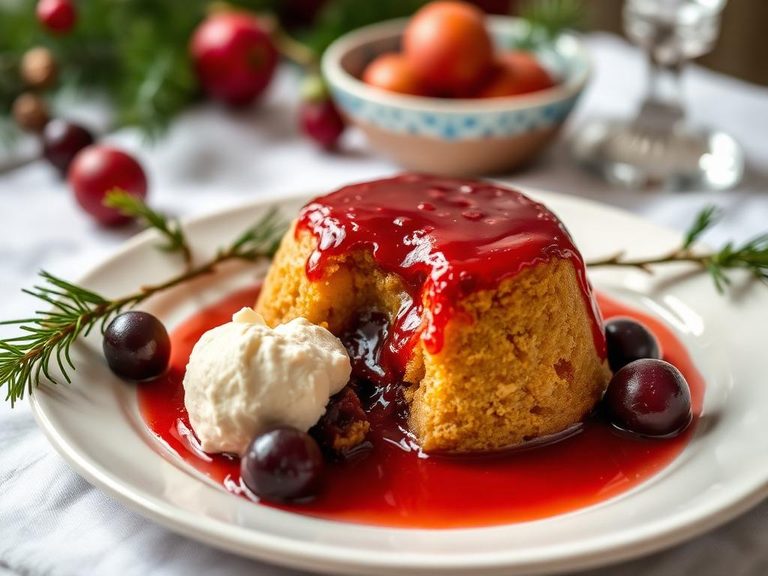
Photo: Wikipedia
This is the classic preserved plum: tender, jewel-toned halves swimming in a thick, sweet syrup. The texture is soft and yielding, offering a burst of concentrated, sugary plum flavor that's distinctly different from fresh fruit. Nutritionally, it's a high-energy, high-carb treat, with over 22g of sugar per 100g, making it a quick source of calories.
Calorie split: 2% protein · 98% carbs · 1% fat
↓ Full nutrition💚 Why it's loved
People love the nostalgic, intensely sweet and tangy flavor that's perfect for desserts and cocktails. It's a versatile ingredient that adds a pop of color and fruity depth to everything from yogurt parfaits to holiday compotes.
⚠️ Watch-outs & how to enjoy it better
The primary downside is the very high sugar content from the heavy syrup, which can cause rapid blood-sugar spikes. To counteract this, practice strict portion control (use a few slices as a garnish, not a main component) and pair it with protein or healthy fats, like adding a few slices to plain Greek yogurt or cottage cheese.
Key benefits
- Provides a quick source of energy from carbohydrates.
- Contains some dietary fiber, which aids digestion.
- Offers a small amount of antioxidants like anthocyanins.
- A convenient, shelf-stable fruit option year-round.
- The heavy syrup helps preserve the fruit's soft texture.
🍽️ Popular dishes


🌍 Where it's eaten
💡 Did you know?
The heavy syrup used in canning is typically a very concentrated sugar solution, often with a Brix (sugar content) of 40% or higher, which acts as a natural preservative by drawing water out of microbial cells.
Full nutrition (USDA data · scales with serving)
| Water | 76.1 g |
| Energy | 89.0 kcal |
| Energy | 372 kj |
| Protein | 0.36 g |
| Total lipid (fat) | 0.10 g |
| Ash | 0.24 g |
| Carbohydrate, by difference | 23.2 g |
| Fiber, total dietary | 0.90 g |
| Total Sugars | 22.3 g |
| Calcium, Ca | 9.0 mg |
| Iron, Fe | 0.84 mg |
| Magnesium, Mg | 5.0 mg |
| Phosphorus, P | 13.0 mg |
| Potassium, K | 91.0 mg |
| Sodium, Na | 19.0 mg |
| Zinc, Zn | 0.07 mg |
| Copper, Cu | 0.04 mg |
| Manganese, Mn | 0.03 mg |
| Selenium, Se | 0.00 ug |
| Vitamin C, total ascorbic acid | 0.40 mg |
| Thiamin | 0.02 mg |
| Riboflavin | 0.04 mg |
| Niacin | 0.29 mg |
| Pantothenic acid | 0.07 mg |
| Vitamin B-6 | 0.03 mg |
| Folate, total | 3.0 ug |
| Folic acid | 0.00 ug |
| Folate, food | 3.0 ug |
| Folate, DFE | 3.0 ug |
| Choline, total | 1.3 mg |
| Vitamin B-12 | 0.00 ug |
| Vitamin B-12, added | 0.00 ug |
| Vitamin A, RAE | 13.0 ug |
| Retinol | 0.00 ug |
| Carotene, beta | 142 ug |
| Carotene, alpha | 0.00 ug |
| Cryptoxanthin, beta | 26.0 ug |
| Vitamin A, IU | 259 iu |
| Lycopene | 0.00 ug |
| Lutein + zeaxanthin | 49.0 ug |
| Vitamin E (alpha-tocopherol) | 0.18 mg |
| Vitamin E, added | 0.00 mg |
| Vitamin D (D2 + D3), International Units | 0.00 iu |
| Vitamin D (D2 + D3) | 0.00 ug |
| Vitamin K (phylloquinone) | 4.3 ug |
| Alcohol, ethyl | 0.00 g |
| Caffeine | 0.00 mg |
| Theobromine | 0.00 mg |
Fat & fatty acid profile (per 100g)
| Fatty acids, total saturated | 0.01 g |
| SFA 4:0 | 0.00 g |
| SFA 6:0 | 0.00 g |
| SFA 8:0 | 0.00 g |
| SFA 10:0 | 0.00 g |
| SFA 12:0 | 0.00 g |
| SFA 14:0 | 0.00 g |
| SFA 16:0 | 0.01 g |
| SFA 18:0 | 0.00 g |
| Fatty acids, total monounsaturated | 0.07 g |
| MUFA 16:1 | 0.00 g |
| MUFA 18:1 | 0.07 g |
| MUFA 20:1 | 0.00 g |
| MUFA 22:1 | 0.00 g |
| Fatty acids, total polyunsaturated | 0.02 g |
| PUFA 18:2 | 0.02 g |
| PUFA 18:3 | 0.00 g |
| PUFA 18:4 | 0.00 g |
| PUFA 20:4 | 0.00 g |
| PUFA 20:5 n-3 (EPA) | 0.00 g |
| PUFA 22:5 n-3 (DPA) | 0.00 g |
| PUFA 22:6 n-3 (DHA) | 0.00 g |
| Fatty acids, total trans | 0.00 g |
| Cholesterol | 0.00 mg |
Amino acid profile (per 100g)
| Threonine | 0.01 g |
| Isoleucine | 0.01 g |
| Leucine | 0.01 g |
| Lysine | 0.01 g |
| Methionine | 0.00 g |
| Cystine | 0.00 g |
| Phenylalanine | 0.01 g |
| Tyrosine | 0.00 g |
| Valine | 0.01 g |
| Arginine | 0.01 g |
| Histidine | 0.01 g |
| Alanine | 0.01 g |
| Aspartic acid | 0.11 g |
| Glutamic acid | 0.02 g |
| Glycine | 0.01 g |
| Proline | 0.02 g |
| Serine | 0.01 g |
FAQ
How does the nutrition differ from fresh plums?
Canned plums in heavy syrup have significantly more sugar and calories than fresh plums. Fresh plums have about 46 kcal and 10g sugar per 100g, while the canned version in syrup has 89 kcal and 22g sugar per 100g.
Can I use the syrup in the can?
Yes, the syrup is edible and often used in recipes for glazes, cocktails, or to sweeten other dishes. However, it is very high in added sugar, so use it sparingly.
Is this a good source of vitamins?
While it retains some of the plum's original vitamins like vitamin C and K, the canning process and heat treatment can reduce their levels. It is not considered a significant source of these nutrients compared to fresh fruit.
Nutrient density (calculated · NRF9.3)
Nutrient Rich Foods index: beneficial nutrients (protein, fiber, vitamins, minerals) minus saturated fat, added sugar & sodium, per 100 kcal.
NRF9.3 index — Fulgoni, Keast & Drewnowski, 2009. Computed from USDA nutrients.
Weight-loss friendliness (composite index)
Energy density 0.89 kcal/g · 2% calories from protein · 0.9 g fiber · 22.3 g sugar per 100 g.
Composite of energy density (Rolls et al., 1999), protein & fiber satiety, minus sugar. A calculated heuristic — ranks satiety-per-calorie, not a clinical measure.
Dietary load (calculated from USDA values)
Potential renal acid load. Positive = acid-forming, negative = alkaline-forming.
Sodium-to-potassium ratio: 0.21 (lower is better — aim for ≤ 1)
Sodium:potassium per WHO potassium guidance. Computed from USDA nutrients.