

Pie, apple, commercially prepared, enriched flour
Whole food · Baked Products
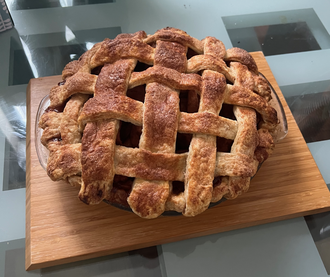
Photo: Wikipedia
This is the classic, comforting slice of apple pie you'd find in a diner or supermarket bakery, featuring tender, cooked apple slices encased in a flaky, golden-brown enriched-flour crust. The filling is sweet and warmly spiced, while the crust offers a buttery, slightly chewy texture. Nutritionally, it's a calorie-dense treat where the majority of energy comes from carbohydrates, specifically added sugars.
Calorie split: 3% protein · 56% carbs · 41% fat
↓ Full nutrition💚 Why it's loved
People love it for the nostalgic, homestyle flavor of sweet-tart apples and warm spices like cinnamon, wrapped in a satisfying, flaky pastry. It's a versatile dessert, equally at home à la mode, with a slice of sharp cheddar cheese, or as a standalone treat with coffee.
⚠️ Watch-outs & how to enjoy it better
The high sugar and refined carbohydrate content can lead to rapid blood-sugar spikes, making it a concern for individuals managing diabetes. The enriched flour crust offers minimal fiber, and the dish is calorie-dense. To mitigate, enjoy a smaller portion paired with a source of protein (like Greek yogurt) or healthy fat (like a handful of nuts) to slow sugar absorption.
Key benefits
- Provides quick energy from carbohydrates
- Contains small amounts of dietary fiber from the apple filling
- Offers a source of fat, which aids in satiety
- Can serve as a morale-boosting comfort food
🍽️ Popular dishes




🌍 Where it's eaten
💡 Did you know?
While apple pie is an iconic symbol of American culture, the first recorded recipe for a pie containing apples was actually published in a 1381 English cookbook.
Full nutrition (USDA data · scales with serving)
| Water | 52.2 g |
| Energy | 237 kcal |
| Energy | 992 kj |
| Protein | 1.9 g |
| Total lipid (fat) | 11.0 g |
| Ash | 0.90 g |
| Carbohydrate, by difference | 34.0 g |
| Fiber, total dietary | 1.6 g |
| Total Sugars | 15.7 g |
| Calcium, Ca | 11.0 mg |
| Iron, Fe | 0.45 mg |
| Magnesium, Mg | 7.0 mg |
| Phosphorus, P | 24.0 mg |
| Potassium, K | 65.0 mg |
| Sodium, Na | 201 mg |
| Zinc, Zn | 0.16 mg |
| Copper, Cu | 0.05 mg |
| Manganese, Mn | 0.18 mg |
| Selenium, Se | 1.0 ug |
| Vitamin C, total ascorbic acid | 3.2 mg |
| Thiamin | 0.03 mg |
| Riboflavin | 0.03 mg |
| Niacin | 0.26 mg |
| Pantothenic acid | 0.12 mg |
| Vitamin B-6 | 0.04 mg |
| Folate, total | 27.0 ug |
| Folic acid | 23.0 ug |
| Folate, food | 4.0 ug |
| Folate, DFE | 43.0 ug |
| Choline, total | 7.2 mg |
| Betaine | 16.4 mg |
| Vitamin B-12 | 0.01 ug |
| Vitamin B-12, added | 0.00 ug |
| Vitamin A, RAE | 32.0 ug |
| Retinol | 31.0 ug |
| Carotene, beta | 9.0 ug |
| Carotene, alpha | 0.00 ug |
| Cryptoxanthin, beta | 6.0 ug |
| Vitamin A, IU | 124 iu |
| Lycopene | 0.00 ug |
| Lutein + zeaxanthin | 9.0 ug |
| Vitamin E (alpha-tocopherol) | 1.5 mg |
| Vitamin E, added | 0.00 mg |
| Vitamin D (D2 + D3), International Units | 0.00 iu |
| Vitamin D (D2 + D3) | 0.00 ug |
| Vitamin K (phylloquinone) | 3.5 ug |
| Alcohol, ethyl | 0.00 g |
| Caffeine | 0.00 mg |
| Theobromine | 0.00 mg |
Fat & fatty acid profile (per 100g)
| Fatty acids, total saturated | 3.8 g |
| SFA 4:0 | 0.00 g |
| SFA 6:0 | 0.00 g |
| SFA 8:0 | 0.00 g |
| SFA 10:0 | 0.00 g |
| SFA 12:0 | 0.02 g |
| SFA 14:0 | 0.13 g |
| SFA 16:0 | 2.1 g |
| SFA 18:0 | 1.5 g |
| Fatty acids, total monounsaturated | 4.4 g |
| MUFA 16:1 | 0.15 g |
| MUFA 18:1 | 4.1 g |
| MUFA 20:1 | 0.00 g |
| MUFA 22:1 | 0.00 g |
| Fatty acids, total polyunsaturated | 2.2 g |
| PUFA 18:2 | 2.1 g |
| PUFA 18:3 | 0.12 g |
| PUFA 18:4 | 0.00 g |
| PUFA 20:4 | 0.00 g |
| PUFA 20:5 n-3 (EPA) | 0.00 g |
| PUFA 22:5 n-3 (DPA) | 0.00 g |
| PUFA 22:6 n-3 (DHA) | 0.00 g |
| Cholesterol | 0.00 mg |
Amino acid profile (per 100g)
| Tryptophan | 0.03 g |
| Threonine | 0.05 g |
| Isoleucine | 0.07 g |
| Leucine | 0.13 g |
| Lysine | 0.07 g |
| Methionine | 0.03 g |
| Cystine | 0.04 g |
| Phenylalanine | 0.09 g |
| Tyrosine | 0.05 g |
| Valine | 0.08 g |
| Arginine | 0.07 g |
| Histidine | 0.04 g |
| Alanine | 0.06 g |
| Aspartic acid | 0.10 g |
| Glutamic acid | 0.59 g |
| Glycine | 0.07 g |
| Proline | 0.20 g |
| Serine | 0.10 g |
FAQ
Is the apple filling the main source of sugar?
No. In a commercially prepared pie, the majority of the sugar is added directly to the filling during cooking, far exceeding the natural sugar from the apples themselves.
Why is it made with enriched flour?
Enriched flour is refined wheat flour with added back nutrients like iron and B vitamins. It's used for its consistent, fine texture and long shelf life, which are ideal for commercial baking.
Can I make a healthier version at home?
Absolutely. You can reduce added sugar in the filling, use a whole-wheat or oat-based crust for more fiber, and load up on the apples to increase the fruit-to-pastry ratio.
Nutrient density (calculated · NRF9.3)
Nutrient Rich Foods index: beneficial nutrients (protein, fiber, vitamins, minerals) minus saturated fat, added sugar & sodium, per 100 kcal.
NRF9.3 index — Fulgoni, Keast & Drewnowski, 2009. Computed from USDA nutrients.
Weight-loss friendliness (composite index)
Energy density 2.37 kcal/g · 3% calories from protein · 1.6 g fiber · 15.7 g sugar per 100 g.
Composite of energy density (Rolls et al., 1999), protein & fiber satiety, minus sugar. A calculated heuristic — ranks satiety-per-calorie, not a clinical measure.
Dietary load (calculated from USDA values)
Potential renal acid load. Positive = acid-forming, negative = alkaline-forming.
Sodium-to-potassium ratio: 3.09 (lower is better — aim for ≤ 1)
Sodium:potassium per WHO potassium guidance. Computed from USDA nutrients.