

Peaches, spiced, canned, heavy syrup pack, solids and liquids
Whole food · Fruits and Fruit Juices

Photo: Wikipedia
These are peach halves or slices preserved in a sweet, spiced syrup, offering a tender, juicy texture with a warm, aromatic flavor profile. Nutritionally, they are a concentrated source of quick energy from carbohydrates, primarily in the form of added sugars.
Calorie split: 2% protein · 97% carbs · 1% fat
↓ Full nutrition💚 Why it's loved
People love them for their comforting, nostalgic sweetness and the warm notes of spices like cinnamon or nutmeg, making them a versatile ingredient in both sweet and savory dishes. They are a staple in many home pantries for quick desserts and baking.
⚠️ Watch-outs & how to enjoy it better
The high sugar content from the heavy syrup can cause rapid blood-sugar spikes, making them less suitable for those managing diabetes or watching sugar intake. To mitigate this, pair a small portion with a source of protein or fat (like yogurt or nuts) to slow sugar absorption, and consider draining and rinsing the slices to reduce excess syrup.
Key benefits
- Provides a quick source of energy from carbohydrates
- Contains dietary fiber for digestive support
- Offers a convenient, long-shelf-life fruit option
- Source of antioxidants like vitamin C
- Spiced syrup can add a unique flavor dimension
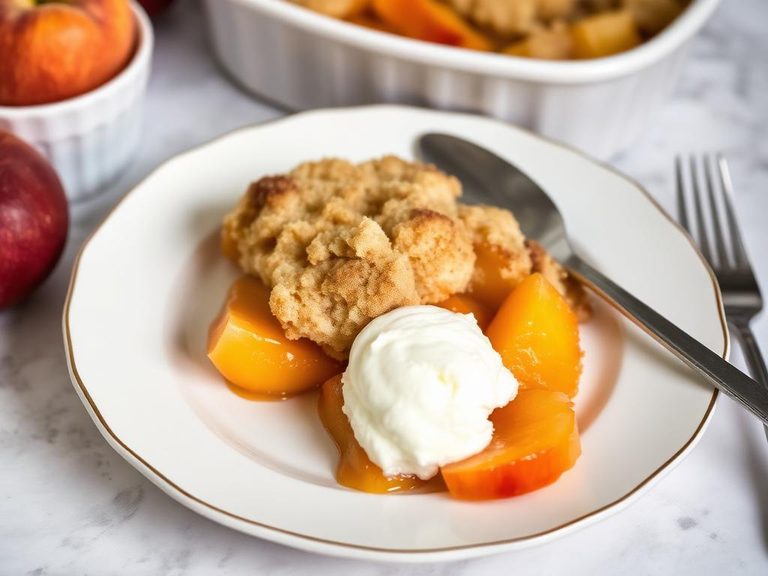
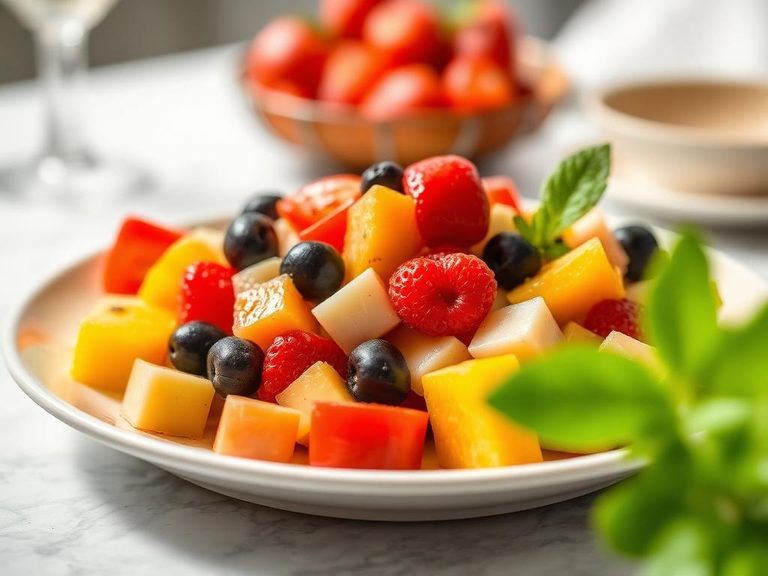
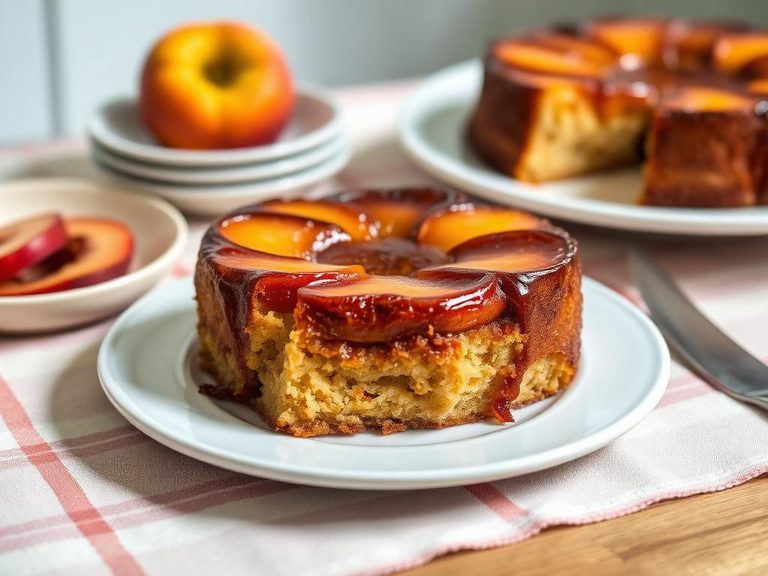
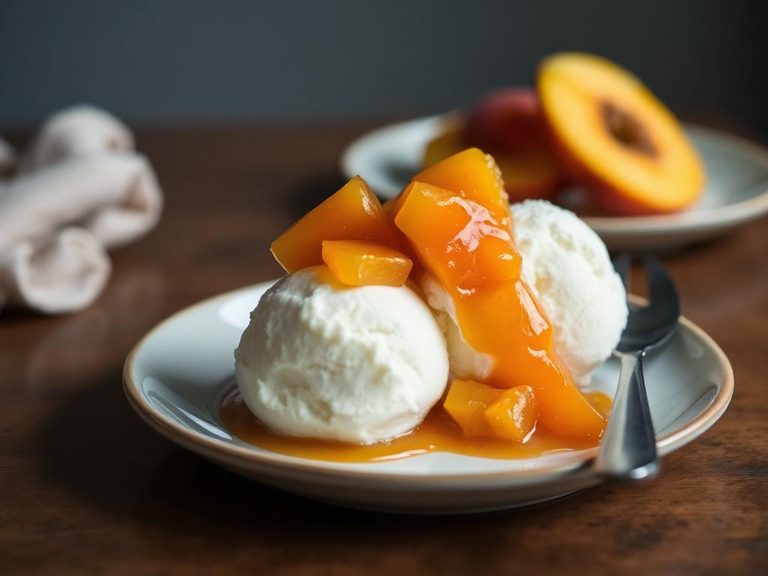
🍽️ Popular dishes

🌍 Where it's eaten
💡 Did you know?
The practice of canning peaches was popularized in the 19th century, and the 'heavy syrup' pack typically contains a sugar concentration of about 40-50%, which acts as a preservative and significantly alters the fruit's texture.
Full nutrition (USDA data · scales with serving)
| Water | 79.2 g |
| Energy | 75.0 kcal |
| Energy | 314 kj |
| Protein | 0.41 g |
| Total lipid (fat) | 0.10 g |
| Ash | 0.21 g |
| Carbohydrate, by difference | 20.1 g |
| Fiber, total dietary | 1.3 g |
| Total Sugars | 18.8 g |
| Calcium, Ca | 6.0 mg |
| Iron, Fe | 0.28 mg |
| Magnesium, Mg | 7.0 mg |
| Phosphorus, P | 9.0 mg |
| Potassium, K | 85.0 mg |
| Sodium, Na | 4.0 mg |
| Zinc, Zn | 0.08 mg |
| Copper, Cu | 0.10 mg |
| Selenium, Se | 0.30 ug |
| Vitamin C, total ascorbic acid | 5.3 mg |
| Thiamin | 0.01 mg |
| Riboflavin | 0.04 mg |
| Niacin | 0.54 mg |
| Pantothenic acid | 0.05 mg |
| Vitamin B-6 | 0.02 mg |
| Folate, total | 3.0 ug |
| Folic acid | 0.00 ug |
| Folate, food | 3.0 ug |
| Folate, DFE | 3.0 ug |
| Choline, total | 4.1 mg |
| Vitamin B-12 | 0.00 ug |
| Vitamin B-12, added | 0.00 ug |
| Vitamin A, RAE | 16.0 ug |
| Retinol | 0.00 ug |
| Carotene, beta | 157 ug |
| Carotene, alpha | 0.00 ug |
| Cryptoxanthin, beta | 65.0 ug |
| Vitamin A, IU | 317 iu |
| Lycopene | 0.00 ug |
| Lutein + zeaxanthin | 61.0 ug |
| Vitamin E (alpha-tocopherol) | 0.49 mg |
| Vitamin E, added | 0.00 mg |
| Vitamin D (D2 + D3), International Units | 0.00 iu |
| Vitamin D (D2 + D3) | 0.00 ug |
| Vitamin K (phylloquinone) | 1.7 ug |
| Alcohol, ethyl | 0.00 g |
| Caffeine | 0.00 mg |
| Theobromine | 0.00 mg |
Fat & fatty acid profile (per 100g)
| Fatty acids, total saturated | 0.01 g |
| SFA 4:0 | 0.00 g |
| SFA 6:0 | 0.00 g |
| SFA 8:0 | 0.00 g |
| SFA 10:0 | 0.00 g |
| SFA 12:0 | 0.00 g |
| SFA 14:0 | 0.00 g |
| SFA 16:0 | 0.01 g |
| SFA 18:0 | 0.00 g |
| Fatty acids, total monounsaturated | 0.04 g |
| MUFA 16:1 | 0.00 g |
| MUFA 18:1 | 0.04 g |
| MUFA 20:1 | 0.00 g |
| MUFA 22:1 | 0.00 g |
| Fatty acids, total polyunsaturated | 0.05 g |
| PUFA 18:2 | 0.05 g |
| PUFA 18:3 | 0.00 g |
| PUFA 18:4 | 0.00 g |
| PUFA 20:4 | 0.00 g |
| PUFA 20:5 n-3 (EPA) | 0.00 g |
| PUFA 22:5 n-3 (DPA) | 0.00 g |
| PUFA 22:6 n-3 (DHA) | 0.00 g |
| Fatty acids, total trans | 0.00 g |
| Cholesterol | 0.00 mg |
Amino acid profile (per 100g)
| Tryptophan | 0.00 g |
| Threonine | 0.02 g |
| Isoleucine | 0.01 g |
| Leucine | 0.02 g |
| Lysine | 0.01 g |
| Methionine | 0.01 g |
| Cystine | 0.00 g |
| Phenylalanine | 0.01 g |
| Tyrosine | 0.01 g |
| Valine | 0.02 g |
| Arginine | 0.01 g |
| Histidine | 0.01 g |
| Alanine | 0.03 g |
| Aspartic acid | 0.07 g |
| Glutamic acid | 0.06 g |
| Glycine | 0.01 g |
| Proline | 0.02 g |
| Serine | 0.02 g |
FAQ
How are spiced canned peaches different from regular ones?
Spiced versions are canned with added whole or ground spices like cinnamon, cloves, star anise, or nutmeg infused into the syrup, giving them a warmer, more complex flavor profile than plain canned peaches.
Can I use the syrup from the can?
Yes, the spiced syrup is flavorful and can be used as a sweetener in cocktails, to glaze meats, or reduced into a sauce for desserts. However, it is very high in sugar.
Are they a good source of vitamins?
While peaches naturally contain vitamins like vitamin C and A, the canning process can reduce some heat-sensitive nutrients. They are more notable for their fiber and carbohydrate content than as a primary vitamin source.
Nutrient density (calculated · NRF9.3)
Nutrient Rich Foods index: beneficial nutrients (protein, fiber, vitamins, minerals) minus saturated fat, added sugar & sodium, per 100 kcal.
NRF9.3 index — Fulgoni, Keast & Drewnowski, 2009. Computed from USDA nutrients.
Weight-loss friendliness (composite index)
Energy density 0.75 kcal/g · 2% calories from protein · 1.3 g fiber · 18.8 g sugar per 100 g.
Composite of energy density (Rolls et al., 1999), protein & fiber satiety, minus sugar. A calculated heuristic — ranks satiety-per-calorie, not a clinical measure.
Dietary load (calculated from USDA values)
Potential renal acid load. Positive = acid-forming, negative = alkaline-forming.
Sodium-to-potassium ratio: 0.05 (lower is better — aim for ≤ 1)
Sodium:potassium per WHO potassium guidance. Computed from USDA nutrients.