

Jams and preserves, apricot
Whole food · Sweets
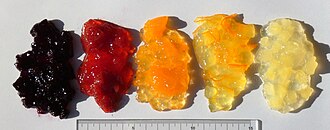
Photo: Wikipedia
Apricot jam is a vibrant, amber-hued preserve made from cooked apricots and sugar, offering a luscious, sweet-tart flavor with a smooth, spreadable texture. Nutritionally, it is a concentrated source of quick energy, providing 242 kcal and 43.4g of sugar per 100g, with minimal fat and protein. Its bright, fruity taste makes it a staple for breakfasts and baking, embodying the essence of summer fruit preserved for year-round enjoyment.
Calorie split: 1% protein · 98% carbs · 1% fat
↓ Full nutrition💚 Why it's loved
People love apricot jam for its perfect balance of sweetness and tanginess, which complements both savory and sweet dishes. Its cultural significance in European and Middle Eastern cuisines, often served with bread, pastries, or cheeses, adds to its enduring appeal.
⚠️ Watch-outs & how to enjoy it better
The high sugar content (43.4g per 100g) can cause blood-sugar spikes, making it less suitable for those with diabetes or insulin resistance. To counteract this, pair it with protein or fat (e.g., on whole-grain toast with nuts) and practice portion control, using just a teaspoon per serving.
Key benefits
- Provides quick energy from natural and added sugars.
- Contains small amounts of vitamin A and potassium from apricots.
- Offers a convenient way to add fruit flavor to meals.
- Has a long shelf life when properly sealed.
- Can be used as a natural sweetener in various recipes.
🍽️ Popular dishes




🌍 Where it's eaten
💡 Did you know?
Apricot jam was historically used as a medicinal remedy for sore throats in 19th-century England, believed to coat and soothe the throat due to its thick, sticky consistency.
Full nutrition (USDA data · scales with serving)
| Water | 34.5 g |
| Energy | 242 kcal |
| Energy | 1014 kj |
| Protein | 0.70 g |
| Total lipid (fat) | 0.20 g |
| Ash | 0.20 g |
| Carbohydrate, by difference | 64.4 g |
| Fiber, total dietary | 0.30 g |
| Total Sugars | 43.4 g |
| Calcium, Ca | 20.0 mg |
| Iron, Fe | 0.49 mg |
| Magnesium, Mg | 4.0 mg |
| Phosphorus, P | 3.0 mg |
| Potassium, K | 77.0 mg |
| Sodium, Na | 40.0 mg |
| Zinc, Zn | 0.06 mg |
| Copper, Cu | 0.10 mg |
| Manganese, Mn | 0.04 mg |
| Selenium, Se | 2.0 ug |
| Vitamin C, total ascorbic acid | 8.8 mg |
| Thiamin | 0.00 mg |
| Riboflavin | 0.02 mg |
| Niacin | 0.04 mg |
| Pantothenic acid | 0.02 mg |
| Vitamin B-6 | 0.02 mg |
| Folate, total | 1.0 ug |
| Folic acid | 0.00 ug |
| Folate, food | 1.0 ug |
| Folate, DFE | 1.0 ug |
| Choline, total | 0.40 mg |
| Vitamin B-12 | 0.00 ug |
| Vitamin B-12, added | 0.00 ug |
| Vitamin A, RAE | 10.0 ug |
| Retinol | 0.00 ug |
| Carotene, beta | 116 ug |
| Carotene, alpha | 2.0 ug |
| Cryptoxanthin, beta | 11.0 ug |
| Vitamin A, IU | 205 iu |
| Lycopene | 0.00 ug |
| Lutein + zeaxanthin | 9.0 ug |
| Vitamin E (alpha-tocopherol) | 0.13 mg |
| Vitamin E, added | 0.00 mg |
| Vitamin D (D2 + D3), International Units | 0.00 iu |
| Vitamin D (D2 + D3) | 0.00 ug |
| Vitamin K (phylloquinone) | 0.00 ug |
| Alcohol, ethyl | 0.00 g |
| Caffeine | 0.00 mg |
| Theobromine | 0.00 mg |
Fat & fatty acid profile (per 100g)
| Fatty acids, total saturated | 0.01 g |
| SFA 4:0 | 0.00 g |
| SFA 6:0 | 0.00 g |
| SFA 8:0 | 0.00 g |
| SFA 10:0 | 0.00 g |
| SFA 12:0 | 0.00 g |
| SFA 14:0 | 0.00 g |
| SFA 16:0 | 0.00 g |
| SFA 18:0 | 0.00 g |
| Fatty acids, total monounsaturated | 0.00 g |
| MUFA 16:1 | 0.00 g |
| MUFA 18:1 | 0.00 g |
| MUFA 20:1 | 0.00 g |
| MUFA 22:1 | 0.00 g |
| Fatty acids, total polyunsaturated | 0.00 g |
| PUFA 18:2 | 0.00 g |
| PUFA 18:3 | 0.00 g |
| PUFA 18:4 | 0.00 g |
| PUFA 20:4 | 0.00 g |
| PUFA 20:5 n-3 (EPA) | 0.00 g |
| PUFA 22:5 n-3 (DPA) | 0.00 g |
| PUFA 22:6 n-3 (DHA) | 0.00 g |
| Cholesterol | 0.00 mg |
Amino acid profile (per 100g)
Estimated from Jams and preserves — USDA does not publish this profile for Jams and preserves.
| Tryptophan | 0.01 g |
| Threonine | 0.02 g |
| Isoleucine | 0.02 g |
| Leucine | 0.04 g |
| Lysine | 0.03 g |
| Methionine | 0.00 g |
| Cystine | 0.01 g |
| Phenylalanine | 0.02 g |
| Tyrosine | 0.03 g |
| Valine | 0.02 g |
| Arginine | 0.03 g |
| Histidine | 0.01 g |
| Alanine | 0.04 g |
| Aspartic acid | 0.17 g |
| Glutamic acid | 0.11 g |
| Glycine | 0.03 g |
| Proline | 0.02 g |
| Serine | 0.03 g |
FAQ
Is apricot jam healthy?
Apricot jam is high in sugar and calories, so it should be consumed in moderation. It does offer some vitamins from the fruit, but it's not a significant source of nutrients compared to whole fruit.
How long does apricot jam last?
Unopened, it can last for up to a year in a cool, dark place. Once opened, it should be refrigerated and consumed within 1-2 months for best quality.
Can I make apricot jam without added sugar?
Yes, you can make sugar-free apricot jam using natural sweeteners like honey or by relying on the fruit's natural sugars, though the texture and shelf life may differ.
Nutrient density (calculated · NRF9.3)
Nutrient Rich Foods index: beneficial nutrients (protein, fiber, vitamins, minerals) minus saturated fat, added sugar & sodium, per 100 kcal.
NRF9.3 index — Fulgoni, Keast & Drewnowski, 2009. Computed from USDA nutrients.
Weight-loss friendliness (composite index)
Energy density 2.42 kcal/g · 1% calories from protein · 0.3 g fiber · 43.4 g sugar per 100 g.
Composite of energy density (Rolls et al., 1999), protein & fiber satiety, minus sugar. A calculated heuristic — ranks satiety-per-calorie, not a clinical measure.
Dietary load (calculated from USDA values)
Potential renal acid load. Positive = acid-forming, negative = alkaline-forming.
Sodium-to-potassium ratio: 0.52 (lower is better — aim for ≤ 1)
Sodium:potassium per WHO potassium guidance. Computed from USDA nutrients.