

Grapefruit juice, white, canned, sweetened
Whole food · Fruits and Fruit Juices

Photo: Wikipedia
Canned white grapefruit juice is a sweetened, shelf-stable beverage with a bright, tart citrus flavor that's mellowed by added sugar. It has a thin, watery texture and a pale yellow color. Nutritionally, it's a low-calorie source of vitamin C but is primarily composed of simple sugars.
Calorie split: 5% protein · 93% carbs · 2% fat
↓ Full nutrition💚 Why it's loved
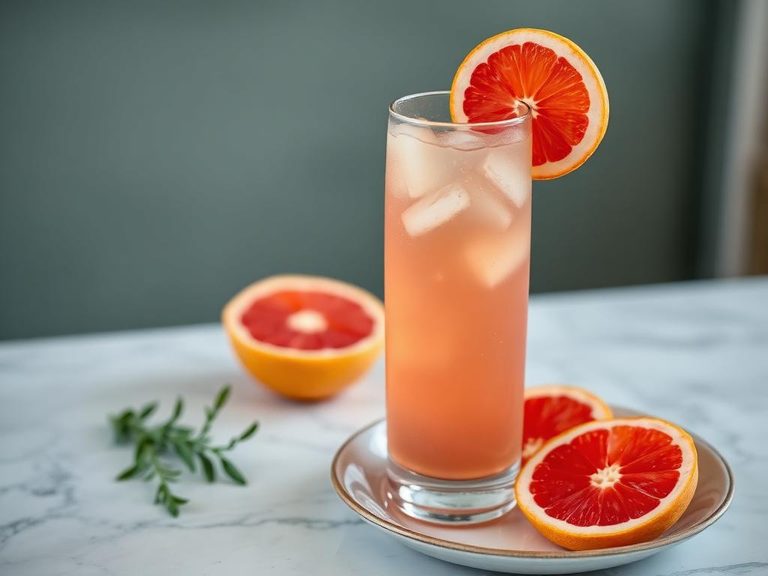
People love its refreshing, sweet-tart taste that's perfect for breakfast or as a mixer. Its versatility makes it a staple in cocktails, smoothies, and marinades.
⚠️ Watch-outs & how to enjoy it better
The added sugar can cause blood-sugar spikes, making it less ideal for those managing diabetes. The high acidity can also erode tooth enamel or trigger heartburn in sensitive individuals. To counteract, pair it with protein or fat (like nuts or yogurt) to slow sugar absorption, practice portion control (e.g., 4-6 oz), and rinse your mouth with water after drinking.
Key benefits
- Provides a quick source of energy from carbohydrates.
- Contains vitamin C, an antioxidant that supports immune function.
- Offers hydration with a flavorful, low-fat profile.
- Convenient and shelf-stable for long-term storage.
🍽️ Popular dishes


🌍 Where it's eaten
💡 Did you know?
Grapefruit juice can interfere with the metabolism of many common medications, including some statins and blood pressure drugs, by inhibiting a key enzyme in the gut.
Full nutrition (USDA data · scales with serving)
| Water | 87.4 g |
| Energy | 46.0 kcal |
| Energy | 192 kj |
| Protein | 0.58 g |
| Total lipid (fat) | 0.09 g |
| Ash | 0.82 g |
| Carbohydrate, by difference | 11.1 g |
| Fiber, total dietary | 0.10 g |
| Total Sugars | 11.0 g |
| Calcium, Ca | 8.0 mg |
| Iron, Fe | 0.36 mg |
| Magnesium, Mg | 10.0 mg |
| Phosphorus, P | 11.0 mg |
| Potassium, K | 162 mg |
| Sodium, Na | 2.0 mg |
| Zinc, Zn | 0.06 mg |
| Copper, Cu | 0.05 mg |
| Manganese, Mn | 0.02 mg |
| Selenium, Se | 0.10 ug |
| Vitamin C, total ascorbic acid | 26.9 mg |
| Thiamin | 0.04 mg |
| Riboflavin | 0.02 mg |
| Niacin | 0.32 mg |
| Pantothenic acid | 0.13 mg |
| Vitamin B-6 | 0.02 mg |
| Folate, total | 10.0 ug |
| Folic acid | 0.00 ug |
| Folate, food | 10.0 ug |
| Folate, DFE | 10.0 ug |
| Vitamin B-12 | 0.00 ug |
| Vitamin B-12, added | 0.00 ug |
| Vitamin A, RAE | 0.00 ug |
| Retinol | 0.00 ug |
| Carotene, beta | 3.0 ug |
| Carotene, alpha | 2.0 ug |
| Cryptoxanthin, beta | 1.0 ug |
| Vitamin A, IU | 7.0 iu |
| Lycopene | 0.00 ug |
| Lutein + zeaxanthin | 10.0 ug |
| Vitamin E (alpha-tocopherol) | 0.04 mg |
| Vitamin E, added | 0.00 mg |
| Vitamin D (D2 + D3), International Units | 0.00 iu |
| Vitamin D (D2 + D3) | 0.00 ug |
| Vitamin K (phylloquinone) | 0.00 ug |
| Alcohol, ethyl | 0.00 g |
| Caffeine | 0.00 mg |
| Theobromine | 0.00 mg |
Fat & fatty acid profile (per 100g)
| Fatty acids, total saturated | 0.01 g |
| SFA 4:0 | 0.00 g |
| SFA 6:0 | 0.00 g |
| SFA 8:0 | 0.00 g |
| SFA 10:0 | 0.00 g |
| SFA 12:0 | 0.00 g |
| SFA 14:0 | 0.00 g |
| SFA 16:0 | 0.01 g |
| SFA 18:0 | 0.00 g |
| Fatty acids, total monounsaturated | 0.01 g |
| MUFA 16:1 | 0.00 g |
| MUFA 18:1 | 0.01 g |
| MUFA 20:1 | 0.00 g |
| MUFA 22:1 | 0.00 g |
| Fatty acids, total polyunsaturated | 0.02 g |
| PUFA 18:2 | 0.02 g |
| PUFA 18:3 | 0.00 g |
| PUFA 18:4 | 0.00 g |
| PUFA 20:4 | 0.00 g |
| PUFA 20:5 n-3 (EPA) | 0.00 g |
| PUFA 22:5 n-3 (DPA) | 0.00 g |
| PUFA 22:6 n-3 (DHA) | 0.00 g |
| Fatty acids, total trans | 0.00 g |
| Cholesterol | 0.00 mg |
Amino acid profile (per 100g)
Estimated from Grapefruit, sections, canned, juice pack, solids and liquids — USDA does not publish this profile for Grapefruit juice.
| Tryptophan | 0.01 g |
| Threonine | 0.01 g |
| Isoleucine | 0.01 g |
| Leucine | 0.01 g |
| Lysine | 0.02 g |
| Methionine | 0.01 g |
| Cystine | 0.01 g |
| Phenylalanine | 0.04 g |
| Tyrosine | 0.01 g |
| Valine | 0.01 g |
| Arginine | 0.08 g |
| Histidine | 0.01 g |
| Alanine | 0.02 g |
| Aspartic acid | 0.13 g |
| Glutamic acid | 0.18 g |
| Glycine | 0.01 g |
| Proline | 0.06 g |
| Serine | 0.03 g |
FAQ
Is canned grapefruit juice as healthy as fresh?
Not exactly. Canned juice often contains added sugar and may have less vitamin C than freshly squeezed juice due to processing and storage.
Can I drink grapefruit juice if I'm on medication?
You should consult your doctor or pharmacist. Grapefruit juice can interact with many drugs, altering their effectiveness or causing side effects.
How does the sugar content compare to other juices?
At 11g per 100g, it's similar to orange juice but may be higher in added sugars if sweetened, making it less ideal for low-sugar diets.
Nutrient density (calculated · NRF9.3)
Nutrient Rich Foods index: beneficial nutrients (protein, fiber, vitamins, minerals) minus saturated fat, added sugar & sodium, per 100 kcal.
NRF9.3 index — Fulgoni, Keast & Drewnowski, 2009. Computed from USDA nutrients.
Weight-loss friendliness (composite index)
Energy density 0.46 kcal/g · 5% calories from protein · 0.1 g fiber · 11.0 g sugar per 100 g.
Composite of energy density (Rolls et al., 1999), protein & fiber satiety, minus sugar. A calculated heuristic — ranks satiety-per-calorie, not a clinical measure.
Dietary load (calculated from USDA values)
Potential renal acid load. Positive = acid-forming, negative = alkaline-forming.
Sodium-to-potassium ratio: 0.01 (lower is better — aim for ≤ 1)
Sodium:potassium per WHO potassium guidance. Computed from USDA nutrients.