

Croissants, butter
Whole food · Baked Products
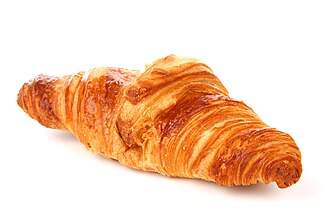
Photo: Wikipedia
A butter croissant is a crescent-shaped, flaky pastry made from laminated dough, where layers of butter are folded into yeast-leavened dough. When baked, it puffs into a delicate, golden shell with a shattering crust and a soft, airy, honeycomb interior. Nutritionally, it's a dense source of energy, primarily from refined carbohydrates and fat, with a modest amount of protein.
Calorie split: 8% protein · 45% carbs · 47% fat
↓ Full nutrition💚 Why it's loved
People adore the butter croissant for its intoxicating aroma and the satisfying contrast between its crisp, shattering layers and its tender, melt-in-your-mouth interior. It's a versatile staple, enjoyed plain, with jam, or as the foundation for sweet and savory sandwiches, deeply embedded in French café culture.
⚠️ Watch-outs & how to enjoy it better
The high calorie, refined carb, and saturated fat content can cause blood-sugar spikes and may not suit those monitoring calorie or fat intake. It is also a common allergen (contains wheat/gluten, dairy) and is often high in sodium. To counteract, pair it with protein (like eggs or Greek yogurt) and fiber (like berries or a side salad) to slow digestion, practice strict portion control (e.g., sharing one), or opt for a mini-croissant.
Key benefits
- Provides quick energy from carbohydrates
- Contains some protein from wheat flour and dairy butter
- Source of dietary fat, which aids in the absorption of fat-soluble vitamins
- Offers a small amount of dietary fiber
- Can be a source of calcium and vitamin A from the butter
🍽️ Popular dishes

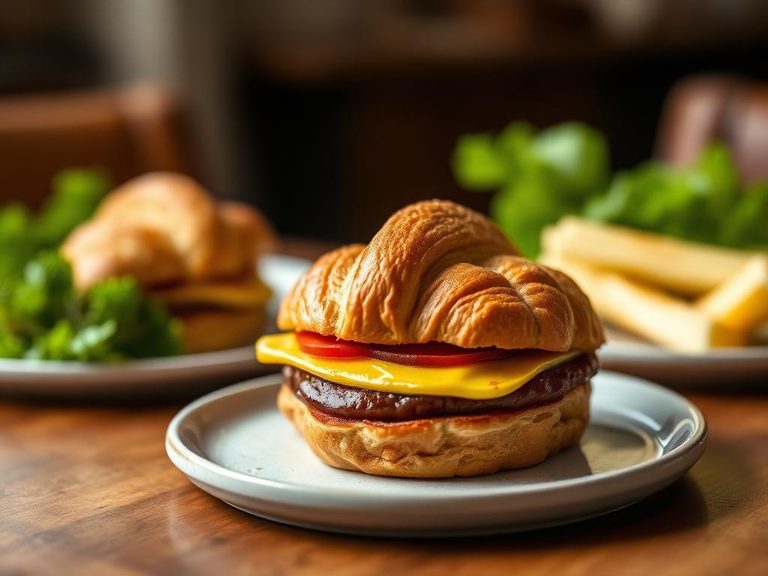
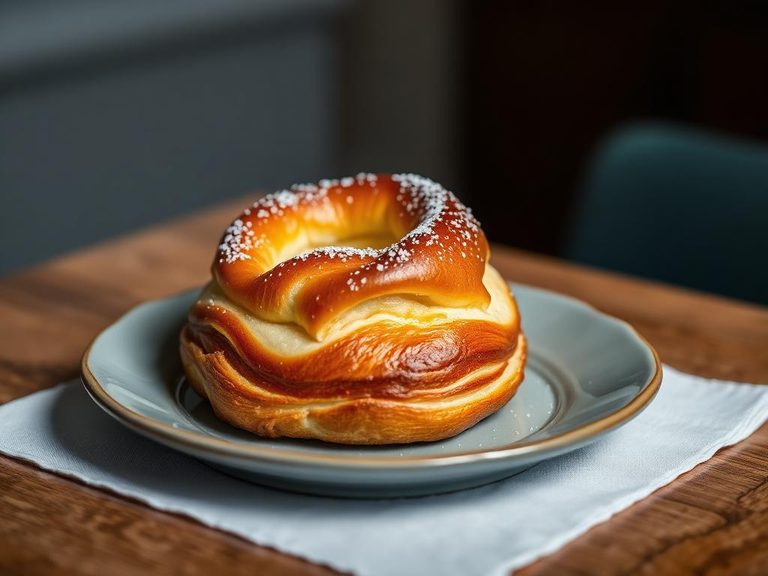
🌍 Where it's eaten
💡 Did you know?
Despite its iconic French association, the croissant's ancestor, the kipferl, is Austrian; the modern laminated, flaky version was perfected in Paris in the early 20th century.
Full nutrition (USDA data · scales with serving)
| Water | 23.2 g |
| Energy | 406 kcal |
| Energy | 1699 kj |
| Protein | 8.2 g |
| Total lipid (fat) | 21.0 g |
| Ash | 1.6 g |
| Carbohydrate, by difference | 45.8 g |
| Fiber, total dietary | 2.6 g |
| Total Sugars | 11.3 g |
| Calcium, Ca | 37.0 mg |
| Iron, Fe | 2.0 mg |
| Magnesium, Mg | 16.0 mg |
| Phosphorus, P | 105 mg |
| Potassium, K | 118 mg |
| Sodium, Na | 384 mg |
| Zinc, Zn | 0.75 mg |
| Copper, Cu | 0.08 mg |
| Manganese, Mn | 0.33 mg |
| Selenium, Se | 22.7 ug |
| Vitamin C, total ascorbic acid | 0.20 mg |
| Thiamin | 0.39 mg |
| Riboflavin | 0.24 mg |
| Niacin | 2.2 mg |
| Pantothenic acid | 0.86 mg |
| Vitamin B-6 | 0.06 mg |
| Folate, total | 88.0 ug |
| Folic acid | 60.0 ug |
| Folate, food | 28.0 ug |
| Folate, DFE | 130 ug |
| Choline, total | 38.8 mg |
| Vitamin B-12 | 0.16 ug |
| Vitamin B-12, added | 0.00 ug |
| Vitamin A, RAE | 206 ug |
| Retinol | 202 ug |
| Carotene, beta | 38.0 ug |
| Carotene, alpha | 0.00 ug |
| Cryptoxanthin, beta | 1.0 ug |
| Vitamin A, IU | 740 iu |
| Lycopene | 0.00 ug |
| Lutein + zeaxanthin | 74.0 ug |
| Vitamin E (alpha-tocopherol) | 0.84 mg |
| Vitamin E, added | 0.00 mg |
| Vitamin D (D2 + D3), International Units | 0.00 iu |
| Vitamin D (D2 + D3) | 0.00 ug |
| Vitamin K (phylloquinone) | 1.8 ug |
| Alcohol, ethyl | 0.00 g |
| Caffeine | 0.00 mg |
| Theobromine | 0.00 mg |
Fat & fatty acid profile (per 100g)
| Fatty acids, total saturated | 11.7 g |
| SFA 4:0 | 0.59 g |
| SFA 6:0 | 0.35 g |
| SFA 8:0 | 0.20 g |
| SFA 10:0 | 0.46 g |
| SFA 12:0 | 0.51 g |
| SFA 14:0 | 1.8 g |
| SFA 16:0 | 5.0 g |
| SFA 18:0 | 2.3 g |
| Fatty acids, total monounsaturated | 5.5 g |
| MUFA 16:1 | 0.43 g |
| MUFA 18:1 | 4.8 g |
| MUFA 20:1 | 0.00 g |
| MUFA 22:1 | 0.00 g |
| Fatty acids, total polyunsaturated | 1.1 g |
| PUFA 18:2 | 0.80 g |
| PUFA 18:3 | 0.29 g |
| PUFA 18:4 | 0.00 g |
| PUFA 20:4 | 0.01 g |
| PUFA 20:5 n-3 (EPA) | 0.00 g |
| PUFA 22:5 n-3 (DPA) | 0.00 g |
| PUFA 22:6 n-3 (DHA) | 0.00 g |
| Cholesterol | 67.0 mg |
Amino acid profile (per 100g)
| Tryptophan | 0.10 g |
| Threonine | 0.28 g |
| Isoleucine | 0.36 g |
| Leucine | 0.62 g |
| Lysine | 0.33 g |
| Methionine | 0.17 g |
| Cystine | 0.17 g |
| Phenylalanine | 0.42 g |
| Tyrosine | 0.27 g |
| Valine | 0.41 g |
| Arginine | 0.34 g |
| Histidine | 0.19 g |
| Alanine | 0.33 g |
| Aspartic acid | 0.50 g |
| Glutamic acid | 2.3 g |
| Glycine | 0.29 g |
| Proline | 0.78 g |
| Serine | 0.44 g |
FAQ
What's the difference between a croissant and a crescent roll?
A true croissant is made from laminated dough (layers of butter folded in), creating a flaky, airy texture. A crescent roll is typically made from a simpler, softer, non-laminated dough, resulting in a bread-like roll.
Why is my croissant not flaky?
The most common reasons are: the butter wasn't cold enough during lamination (causing it to melt into the dough), the dough wasn't rested enough between folds, or the oven wasn't hot enough to create steam and puff the layers.
Can I freeze croissants?
Yes, they freeze exceptionally well. Bake them from frozen at 375°F (190°C) for 5-10 minutes to re-crisp, or thaw at room temperature for a few hours before a quick reheat.
Nutrient density (calculated · NRF9.3)
Nutrient Rich Foods index: beneficial nutrients (protein, fiber, vitamins, minerals) minus saturated fat, added sugar & sodium, per 100 kcal.
NRF9.3 index — Fulgoni, Keast & Drewnowski, 2009. Computed from USDA nutrients.
Weight-loss friendliness (composite index)
Energy density 4.06 kcal/g · 8% calories from protein · 2.6 g fiber · 11.3 g sugar per 100 g.
Composite of energy density (Rolls et al., 1999), protein & fiber satiety, minus sugar. A calculated heuristic — ranks satiety-per-calorie, not a clinical measure.
Dietary load (calculated from USDA values)
Potential renal acid load. Positive = acid-forming, negative = alkaline-forming.
Sodium-to-potassium ratio: 3.25 (lower is better — aim for ≤ 1)
Sodium:potassium per WHO potassium guidance. Computed from USDA nutrients.