

Cookies, brownies, commercially prepared
Whole food · Baked Products
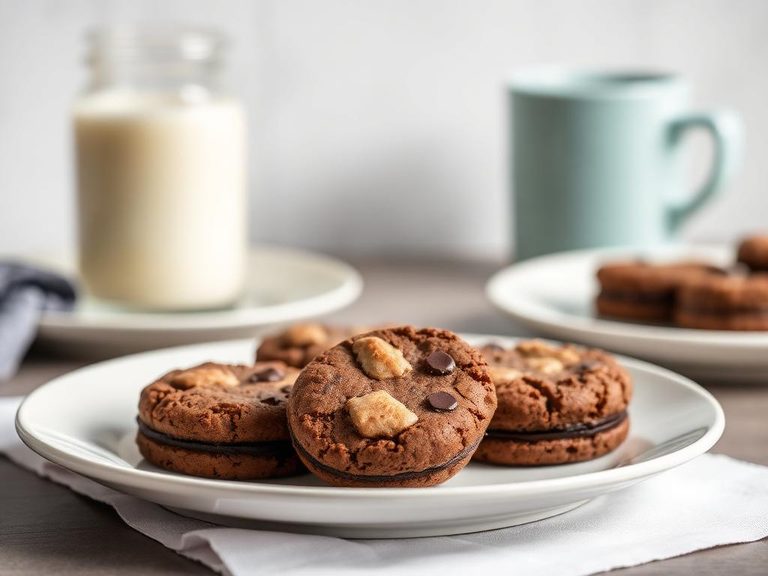
Commercially prepared brownies and cookies are dense, fudgy, or chewy baked confections, typically rich in chocolate or vanilla flavor with a sweet, indulgent taste. They are characterized by a soft, moist interior and a slightly crisp or chewy exterior, offering a satisfying textural contrast. Nutritionally, they are energy-dense, providing a significant amount of carbohydrates and fats in a small serving.
Calorie split: 5% protein · 61% carbs · 35% fat
↓ Full nutrition💚 Why it's loved
People love them for their comforting, nostalgic flavor and the immediate satisfaction of their rich, sweet, and often chocolatey profile. They are a versatile treat, enjoyed as a snack, dessert, or accompaniment to coffee or milk, and are deeply embedded in casual social and celebratory food culture.
⚠️ Watch-outs & how to enjoy it better
The high sugar and refined carbohydrate content can lead to rapid blood-sugar spikes and subsequent energy crashes, making them less suitable for those managing blood sugar levels. They are also calorie-dense, which can be a concern for weight management, and may contain common allergens like wheat, eggs, and dairy. To counteract this, pair a small portion with a source of protein or healthy fat (like a handful of nuts or a glass of milk) to slow sugar absorption, and practice strict portion control.
Key benefits
- Quick source of energy from carbohydrates and fats
- Provides a small amount of dietary fiber
- Convenient and widely available for a sweet treat
- Can satisfy sugar cravings in a controlled portion
- Often fortified with some minerals like iron from cocoa
🍽️ Popular dishes




🌍 Where it's eaten
💡 Did you know?
The brownie is believed to have been invented in the late 19th century at the Palmer House Hotel in Chicago, where it was created for the World's Columbian Exposition as a portable, individually wrapped dessert for ladies to carry in their lunchboxes.
Full nutrition (USDA data · scales with serving)
| Water | 13.6 g |
| Energy | 405 kcal |
| Energy | 1695 kj |
| Protein | 4.8 g |
| Total lipid (fat) | 16.3 g |
| Ash | 1.3 g |
| Carbohydrate, by difference | 63.9 g |
| Fiber, total dietary | 2.1 g |
| Total Sugars | 36.6 g |
| Calcium, Ca | 29.0 mg |
| Iron, Fe | 2.3 mg |
| Magnesium, Mg | 31.0 mg |
| Phosphorus, P | 101 mg |
| Potassium, K | 149 mg |
| Sodium, Na | 286 mg |
| Zinc, Zn | 0.72 mg |
| Copper, Cu | 0.22 mg |
| Manganese, Mn | 0.13 mg |
| Selenium, Se | 6.3 ug |
| Vitamin C, total ascorbic acid | 0.00 mg |
| Thiamin | 0.26 mg |
| Riboflavin | 0.21 mg |
| Niacin | 1.7 mg |
| Pantothenic acid | 0.55 mg |
| Vitamin B-6 | 0.04 mg |
| Folate, total | 47.0 ug |
| Folic acid | 35.0 ug |
| Folate, food | 12.0 ug |
| Folate, DFE | 72.0 ug |
| Choline, total | 10.0 mg |
| Vitamin B-12 | 0.07 ug |
| Vitamin B-12, added | 0.00 ug |
| Vitamin A, RAE | 20.0 ug |
| Retinol | 20.0 ug |
| Carotene, beta | 0.00 ug |
| Carotene, alpha | 0.00 ug |
| Cryptoxanthin, beta | 0.00 ug |
| Vitamin A, IU | 69.0 iu |
| Lycopene | 0.00 ug |
| Lutein + zeaxanthin | 6.0 ug |
| Vitamin E (alpha-tocopherol) | 0.15 mg |
| Vitamin E, added | 0.00 mg |
| Vitamin D (D2 + D3), International Units | 0.00 iu |
| Vitamin D (D2 + D3) | 0.00 ug |
| Vitamin K (phylloquinone) | 6.5 ug |
| Vitamin K (Dihydrophylloquinone) | 0.00 ug |
| Alcohol, ethyl | 0.00 g |
| Caffeine | 2.0 mg |
| Theobromine | 78.0 mg |
Fat & fatty acid profile (per 100g)
| Fatty acids, total saturated | 4.2 g |
| SFA 4:0 | 0.00 g |
| SFA 6:0 | 0.00 g |
| SFA 8:0 | 0.00 g |
| SFA 10:0 | 0.00 g |
| SFA 12:0 | 0.00 g |
| SFA 14:0 | 0.08 g |
| SFA 16:0 | 2.2 g |
| SFA 18:0 | 2.0 g |
| Fatty acids, total monounsaturated | 9.0 g |
| MUFA 16:1 | 0.01 g |
| MUFA 18:1 | 8.9 g |
| MUFA 20:1 | 0.01 g |
| MUFA 22:1 | 0.00 g |
| Fatty acids, total polyunsaturated | 2.3 g |
| PUFA 18:2 | 2.1 g |
| PUFA 18:3 | 0.16 g |
| PUFA 18:4 | 0.00 g |
| PUFA 20:4 | 0.00 g |
| PUFA 20:5 n-3 (EPA) | 0.00 g |
| PUFA 22:5 n-3 (DPA) | 0.00 g |
| PUFA 22:6 n-3 (DHA) | 0.00 g |
| Cholesterol | 17.0 mg |
Amino acid profile (per 100g)
| Tryptophan | 0.06 g |
| Threonine | 0.19 g |
| Isoleucine | 0.22 g |
| Leucine | 0.36 g |
| Lysine | 0.26 g |
| Methionine | 0.11 g |
| Cystine | 0.10 g |
| Phenylalanine | 0.24 g |
| Tyrosine | 0.17 g |
| Valine | 0.26 g |
| Arginine | 0.26 g |
| Histidine | 0.10 g |
| Alanine | 0.22 g |
| Aspartic acid | 0.39 g |
| Glutamic acid | 0.95 g |
| Glycine | 0.17 g |
| Proline | 0.30 g |
| Serine | 0.28 g |
FAQ
Are brownies and cookies considered a cake or a cookie?
They occupy a unique middle ground. A brownie is often classified as a 'bar cookie' due to its dense, fudgy texture, while a classic chocolate chip cookie is a drop cookie. Both are distinct from the lighter, airier texture of a cake.
Why do commercially prepared ones have a longer shelf life?
They often contain preservatives (like calcium propionate), stabilizers, and are packaged in modified atmosphere packaging to prevent staleness and microbial growth, allowing them to be stored at room temperature for weeks.
Can I make a healthier version at home?
Yes. You can substitute some flour with almond or oat flour, use applesauce or mashed banana to replace some fat, reduce sugar, and add mix-ins like nuts, seeds, or dark chocolate chips for added fiber and nutrients.
Nutrient density (calculated · NRF9.3)
Nutrient Rich Foods index: beneficial nutrients (protein, fiber, vitamins, minerals) minus saturated fat, added sugar & sodium, per 100 kcal.
NRF9.3 index — Fulgoni, Keast & Drewnowski, 2009. Computed from USDA nutrients.
Weight-loss friendliness (composite index)
Energy density 4.05 kcal/g · 5% calories from protein · 2.1 g fiber · 36.6 g sugar per 100 g.
Composite of energy density (Rolls et al., 1999), protein & fiber satiety, minus sugar. A calculated heuristic — ranks satiety-per-calorie, not a clinical measure.
Dietary load (calculated from USDA values)
Potential renal acid load. Positive = acid-forming, negative = alkaline-forming.
Sodium-to-potassium ratio: 1.92 (lower is better — aim for ≤ 1)
Sodium:potassium per WHO potassium guidance. Computed from USDA nutrients.