

Bread, rye
Whole food · Baked Products

Photo: Wikipedia
Rye bread is a dense, dark loaf with a robust, earthy flavor and a chewy, often seedy texture. Its deep, slightly sour profile comes from the rye grain itself, which gives it a distinctive character distinct from wheat bread. Nutritionally, it's a standout for its high fiber content (5.8g per 100g) and substantial protein (8.5g), making it a satisfying, nutrient-dense staple.
Calorie split: 13% protein · 75% carbs · 12% fat
↓ Full nutrition💚 Why it's loved
People adore rye bread for its complex, tangy flavor that stands up to strong ingredients like smoked fish, sharp cheeses, and pickled vegetables. It's a cultural cornerstone in many cuisines, especially for iconic sandwiches and as a hearty accompaniment to soups and stews.
⚠️ Watch-outs & how to enjoy it better
The dense texture and strong flavor can be polarizing, and some may find it heavy. Rye contains gluten (a common allergen) and can be high in sodium in commercial varieties. To counteract, pair it with healthy fats and proteins (like avocado or smoked salmon) to balance the meal, and check labels for lower-sodium options if needed.
Key benefits
- High in dietary fiber, promoting digestive health and satiety.
- Good source of plant-based protein (8.5g per 100g).
- Contains essential minerals like magnesium, iron, and zinc.
- Lower glycemic index than many white breads, aiding blood sugar management.
- Rich in antioxidants from whole grain rye.
🍽️ Popular dishes

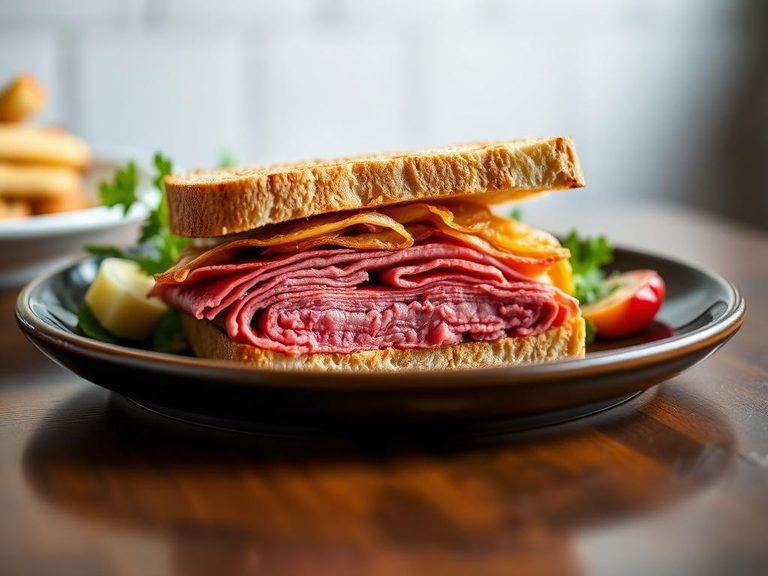
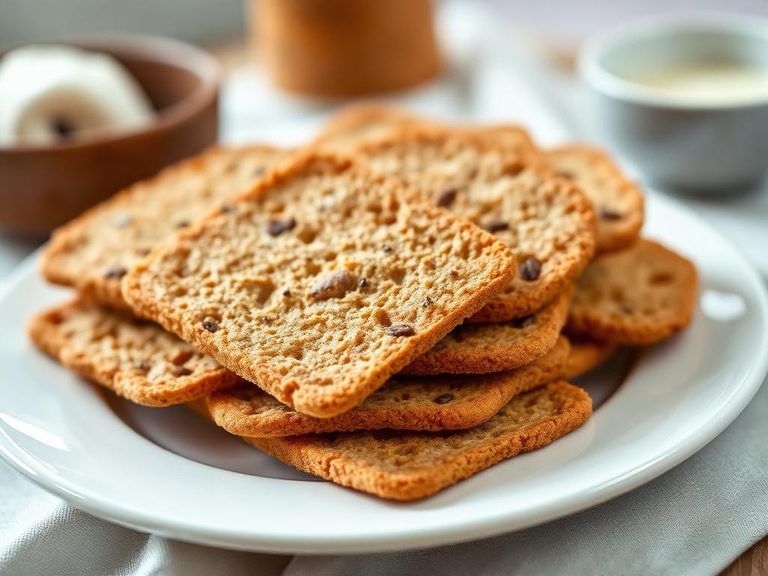
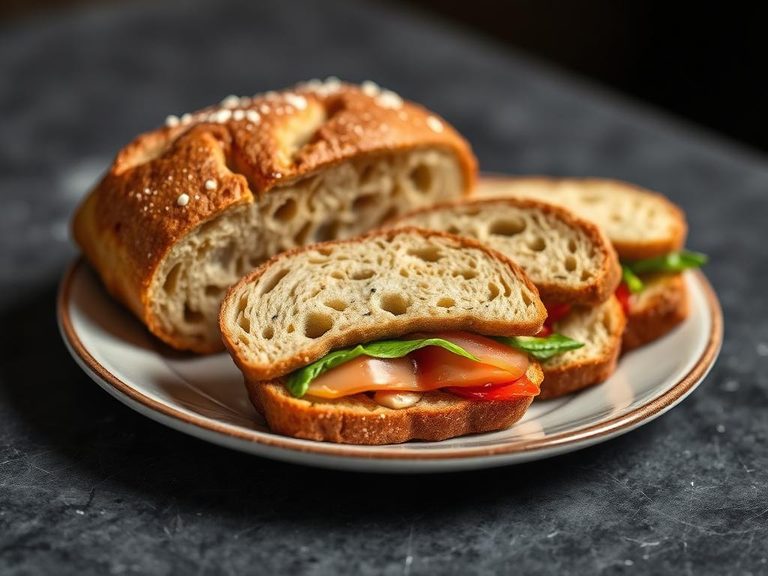
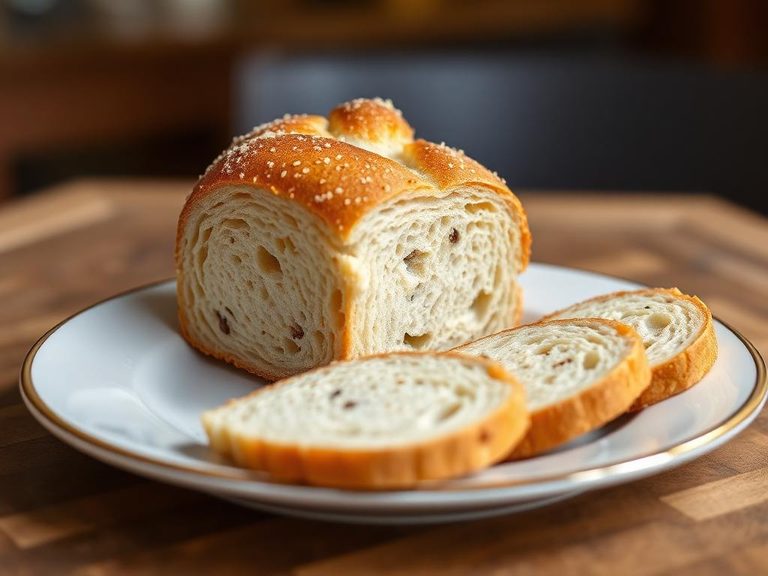
🌍 Where it's eaten
💡 Did you know?
The word 'rye' comes from the Old English 'ryge,' but the grain itself was originally a weed in wheat and barley fields; humans only began cultivating it intentionally around 500 BCE in what is now Turkey.
Full nutrition (USDA data · scales with serving)
| Water | 37.3 g |
| Energy | 259 kcal |
| Energy | 1084 kj |
| Protein | 8.5 g |
| Total lipid (fat) | 3.3 g |
| Ash | 2.5 g |
| Carbohydrate, by difference | 48.3 g |
| Fiber, total dietary | 5.8 g |
| Total Sugars | 3.9 g |
| Calcium, Ca | 73.0 mg |
| Iron, Fe | 2.8 mg |
| Magnesium, Mg | 40.0 mg |
| Phosphorus, P | 125 mg |
| Potassium, K | 166 mg |
| Sodium, Na | 603 mg |
| Zinc, Zn | 1.1 mg |
| Copper, Cu | 0.19 mg |
| Manganese, Mn | 0.82 mg |
| Selenium, Se | 30.9 ug |
| Fluoride, F | 51.0 ug |
| Vitamin C, total ascorbic acid | 0.40 mg |
| Thiamin | 0.43 mg |
| Riboflavin | 0.34 mg |
| Niacin | 3.8 mg |
| Pantothenic acid | 0.44 mg |
| Vitamin B-6 | 0.07 mg |
| Folate, total | 110 ug |
| Folic acid | 59.0 ug |
| Folate, food | 51.0 ug |
| Folate, DFE | 151 ug |
| Choline, total | 14.6 mg |
| Vitamin B-12 | 0.00 ug |
| Vitamin B-12, added | 0.00 ug |
| Vitamin A, RAE | 0.00 ug |
| Retinol | 0.00 ug |
| Carotene, beta | 4.0 ug |
| Carotene, alpha | 0.00 ug |
| Cryptoxanthin, beta | 1.0 ug |
| Vitamin A, IU | 7.0 iu |
| Lycopene | 0.00 ug |
| Lutein + zeaxanthin | 54.0 ug |
| Vitamin E (alpha-tocopherol) | 0.33 mg |
| Vitamin E, added | 0.00 mg |
| Vitamin D (D2 + D3), International Units | 0.00 iu |
| Vitamin D (D2 + D3) | 0.00 ug |
| Vitamin K (phylloquinone) | 1.2 ug |
| Alcohol, ethyl | 0.00 g |
| Caffeine | 0.00 mg |
| Theobromine | 0.00 mg |
Fat & fatty acid profile (per 100g)
| Fatty acids, total saturated | 0.63 g |
| SFA 4:0 | 0.00 g |
| SFA 6:0 | 0.00 g |
| SFA 8:0 | 0.00 g |
| SFA 10:0 | 0.00 g |
| SFA 12:0 | 0.00 g |
| SFA 14:0 | 0.01 g |
| SFA 16:0 | 0.39 g |
| SFA 18:0 | 0.23 g |
| Fatty acids, total monounsaturated | 1.3 g |
| MUFA 16:1 | 0.01 g |
| MUFA 18:1 | 1.3 g |
| MUFA 20:1 | 0.00 g |
| MUFA 22:1 | 0.00 g |
| Fatty acids, total polyunsaturated | 0.80 g |
| PUFA 18:2 | 0.74 g |
| PUFA 18:3 | 0.06 g |
| PUFA 18:4 | 0.00 g |
| PUFA 20:4 | 0.00 g |
| PUFA 20:5 n-3 (EPA) | 0.00 g |
| PUFA 22:5 n-3 (DPA) | 0.00 g |
| PUFA 22:6 n-3 (DHA) | 0.00 g |
| Cholesterol | 0.00 mg |
Amino acid profile (per 100g)
| Tryptophan | 0.10 g |
| Threonine | 0.26 g |
| Isoleucine | 0.32 g |
| Leucine | 0.58 g |
| Lysine | 0.23 g |
| Methionine | 0.14 g |
| Cystine | 0.17 g |
| Phenylalanine | 0.41 g |
| Tyrosine | 0.21 g |
| Valine | 0.38 g |
| Arginine | 0.33 g |
| Histidine | 0.18 g |
| Alanine | 0.30 g |
| Aspartic acid | 0.44 g |
| Glutamic acid | 2.6 g |
| Glycine | 0.30 g |
| Proline | 0.91 g |
| Serine | 0.42 g |
FAQ
Is rye bread gluten-free?
No. Rye bread contains gluten, which is found in rye, wheat, and barley. People with celiac disease or gluten sensitivity must avoid it.
Why is rye bread often darker than wheat bread?
The color comes from the rye grain itself, which has a darker flour, and often from added molasses or cocoa powder in some recipes. The long fermentation process in traditional recipes also contributes to a darker crust.
What's the difference between light and dark rye bread?
Light rye is made from rye flour that has had the bran and germ removed, while dark rye uses the whole grain, including the bran, giving it more fiber, nutrients, and a stronger flavor.
Nutrient density (calculated · NRF9.3)
Nutrient Rich Foods index: beneficial nutrients (protein, fiber, vitamins, minerals) minus saturated fat, added sugar & sodium, per 100 kcal.
NRF9.3 index — Fulgoni, Keast & Drewnowski, 2009. Computed from USDA nutrients.
Weight-loss friendliness (composite index)
Energy density 2.59 kcal/g · 13% calories from protein · 5.8 g fiber · 3.9 g sugar per 100 g.
Composite of energy density (Rolls et al., 1999), protein & fiber satiety, minus sugar. A calculated heuristic — ranks satiety-per-calorie, not a clinical measure.
Dietary load (calculated from USDA values)
Potential renal acid load. Positive = acid-forming, negative = alkaline-forming.
Sodium-to-potassium ratio: 3.63 (lower is better — aim for ≤ 1)
Sodium:potassium per WHO potassium guidance. Computed from USDA nutrients.