

Bread, 100% whole wheat, commercial
Whole food · Baked Products
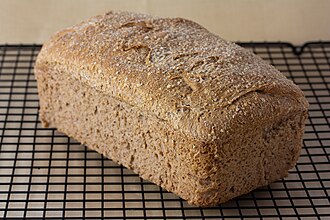
Photo: Wikipedia
Commercial 100% whole wheat bread is a dense, hearty loaf made from the entire wheat kernel, offering a nutty, slightly earthy flavor and a chewy, fibrous texture. Unlike refined white bread, its bran and germ remain intact, providing a robust nutritional profile rich in fiber, B vitamins, and minerals like iron and magnesium. It is a staple for those seeking sustained energy and digestive health from a simple, everyday food.
💚 Why it's loved
People love it for its satisfying, chewy texture and deep, nutty flavor that stands up to bold toppings and fillings. It's a versatile staple that fits seamlessly into everything from classic sandwiches to hearty toast, embodying a sense of wholesome, everyday comfort.
⚠️ Watch-outs & how to enjoy it better
Some find its dense texture and strong wheat flavor less appealing than lighter white bread, and its high fiber content can cause digestive discomfort (bloating or gas) for those not accustomed to it. To counteract this, start with smaller portions and gradually increase intake; pairing it with a protein or healthy fat (like avocado or peanut butter) can also slow digestion and improve tolerance.
Key benefits
- High in dietary fiber for digestive health and satiety
- Rich in B vitamins (thiamine, niacin) for energy metabolism
- Good source of minerals like iron, magnesium, and selenium
- Contains phytonutrients and antioxidants from the whole grain
- May help moderate blood sugar response compared to refined grains
🍽️ Popular dishes





🌍 Where it's eaten
💡 Did you know?
The USDA requires that for bread to be labeled '100% whole wheat,' it must be made entirely from whole wheat flour, but commercial versions often add vital wheat gluten to improve texture and rise, which is a concentrated form of the protein found in wheat.
Full nutrition (USDA data · scales with serving)
| Water | 37.0 g |
| Ash | 2.1 g |
| Calcium, Ca | 132 mg |
| Iron, Fe | 2.8 mg |
| Magnesium, Mg | 72.9 mg |
| Phosphorus, P | 198 mg |
| Potassium, K | 203 mg |
| Sodium, Na | 408 mg |
| Zinc, Zn | 1.7 mg |
| Copper, Cu | 0.25 mg |
| Manganese, Mn | 1.8 mg |
| Thiamin | 0.28 mg |
| Riboflavin | 0.16 mg |
| Niacin | 5.2 mg |
| Biotin | 4.9 ug |
| Folate, total | 58.2 ug |
Fat & fatty acid profile (per 100g)
Estimated from Bread, salvadoran sweet cheese (quesadilla salvadorena) — USDA does not publish this profile for Bread.
| Fatty acids, total saturated | 4.6 g |
| SFA 4:0 | 0.16 g |
| SFA 6:0 | 0.03 g |
| SFA 8:0 | 0.02 g |
| SFA 10:0 | 0.06 g |
| SFA 12:0 | 0.05 g |
| SFA 14:0 | 0.17 g |
| SFA 15:0 | 0.02 g |
| SFA 16:0 | 2.4 g |
| SFA 17:0 | 0.03 g |
| SFA 18:0 | 1.6 g |
| SFA 20:0 | 0.05 g |
| SFA 22:0 | 0.04 g |
| SFA 24:0 | 0.01 g |
| Fatty acids, total monounsaturated | 6.8 g |
| MUFA 14:1 | 0.01 g |
| MUFA 15:1 | 0.00 g |
| MUFA 16:1 | 0.10 g |
| MUFA 16:1 c | 0.09 g |
| MUFA 17:1 | 0.01 g |
| MUFA 18:1 | 6.6 g |
| MUFA 18:1 c | 4.7 g |
| MUFA 20:1 | 0.06 g |
| MUFA 22:1 | 0.00 g |
| MUFA 22:1 c | 0.00 g |
| MUFA 24:1 c | 0.00 g |
| Fatty acids, total polyunsaturated | 4.4 g |
| PUFA 18:2 | 3.8 g |
| PUFA 18:2 n-6 c,c | 3.6 g |
| PUFA 18:2 CLAs | 0.02 g |
| PUFA 18:3 | 0.53 g |
| PUFA 18:3 n-3 c,c,c (ALA) | 0.49 g |
| PUFA 18:3 n-6 c,c,c | 0.04 g |
| PUFA 18:4 | 0.00 g |
| PUFA 20:2 n-6 c,c | 0.01 g |
| PUFA 20:3 | 0.01 g |
| PUFA 20:3 n-3 | 0.00 g |
| PUFA 20:3 n-6 | 0.01 g |
| PUFA 20:4 | 0.05 g |
| PUFA 20:5 n-3 (EPA) | 0.00 g |
| PUFA 22:4 | 0.01 g |
| PUFA 22:5 n-3 (DPA) | 0.00 g |
| PUFA 22:6 n-3 (DHA) | 0.01 g |
| Fatty acids, total trans | 2.0 g |
| Fatty acids, total trans-monoenoic | 1.9 g |
| TFA 16:1 t | 0.01 g |
| TFA 18:1 t | 1.9 g |
| TFA 22:1 t | 0.00 g |
| TFA 18:2 t not further defined | 0.15 g |
| Fatty acids, total trans-polyenoic | 0.15 g |
| Cholesterol | 59.0 mg |
Amino acid profile (per 100g)
Estimated from Bread, salvadoran sweet cheese (quesadilla salvadorena) — USDA does not publish this profile for Bread.
| Tryptophan | 0.07 g |
| Threonine | 0.21 g |
| Isoleucine | 0.30 g |
| Leucine | 0.65 g |
| Lysine | 0.50 g |
| Methionine | 0.28 g |
| Cystine | 0.06 g |
| Phenylalanine | 0.37 g |
| Tyrosine | 0.23 g |
| Valine | 0.43 g |
| Arginine | 0.25 g |
| Histidine | 0.15 g |
| Alanine | 0.36 g |
| Aspartic acid | 0.59 g |
| Glutamic acid | 1.3 g |
| Glycine | 0.20 g |
| Proline | 0.83 g |
| Serine | 0.45 g |
| Hydroxyproline | 0.00 g |
FAQ
Is 100% whole wheat bread healthier than white bread?
Yes, generally. It retains the bran and germ, providing more fiber, vitamins, and minerals, which can support better digestion and sustained energy levels compared to refined white bread.
Why does my whole wheat bread sometimes taste bitter?
The bitterness can come from the natural phenolic compounds in the bran and germ, or from over-toasting. Soaking the bread in a liquid (like milk for French toast) or toasting it lightly can mellow the flavor.
Can I freeze whole wheat bread to keep it fresh?
Absolutely. Freezing slices or the whole loaf in an airtight bag preserves freshness for up to 3 months. Toast directly from frozen for the best texture.
Dietary load (calculated from USDA values)
Sodium-to-potassium ratio: 2.01 (lower is better — aim for ≤ 1)
Sodium:potassium per WHO potassium guidance. Computed from USDA nutrients.