

BURGER KING, CROISSAN'WICH with Sausage and Cheese
Whole food · Fast Foods

Photo: Wikipedia
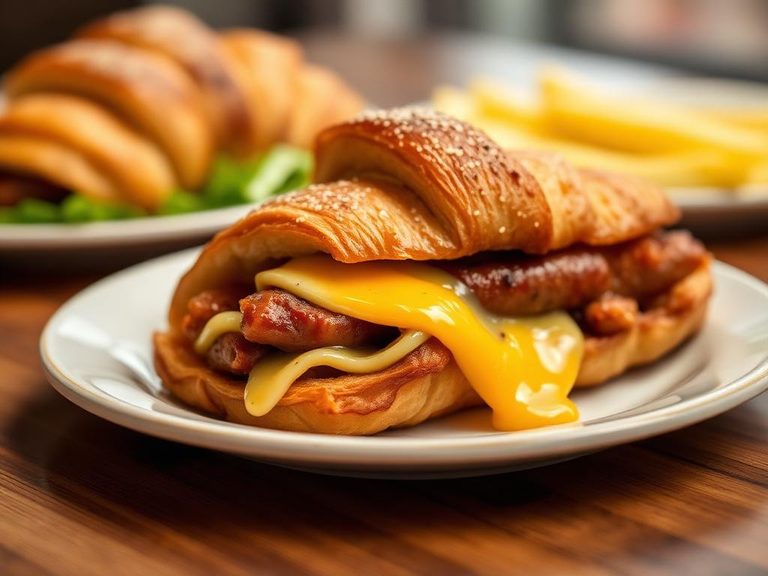
This is a flaky, buttery croissant sandwich filled with savory sausage and melted American cheese, offering a satisfying contrast of textures. The golden, laminated pastry gives way to a soft, seasoned meat patty, creating a rich, indulgent bite. Nutritionally, it's a calorie-dense option where fat is the primary energy source, with a modest protein contribution.
Calorie split: 15% protein · 24% carbs · 61% fat
↓ Full nutrition💚 Why it's loved
People love it for the ultimate savory breakfast indulgence—the salty, umami-rich sausage and gooey cheese perfectly complement the buttery, slightly sweet croissant. It's a beloved, convenient staple that feels like a treat.
⚠️ Watch-outs & how to enjoy it better
The high fat and refined carbohydrate content can lead to a blood-sugar spike and subsequent crash, making it a poor choice for sustained energy. To counteract this, pair it with a side of fiber-rich fruit or vegetables, and consider eating only half to manage portion size.
Key benefits
- Provides a quick, high-energy meal for busy mornings
- The sausage and cheese offer a significant protein boost
- The croissant's fat content promotes a feeling of satiety
- Offers a familiar, comforting flavor profile
🍽️ Popular dishes


🌍 Where it's eaten
💡 Did you know?
The 'Croissan'wich' is a trademarked portmanteau of 'croissant' and 'sandwich' created by Burger King in 1983.
Full nutrition (USDA data · scales with serving)
| Water | 35.1 g |
| Energy | 376 kcal |
| Energy | 1573 kj |
| Protein | 13.7 g |
| Total lipid (fat) | 25.4 g |
| Ash | 2.8 g |
| Carbohydrate, by difference | 23.0 g |
| Fiber, total dietary | 0.70 g |
| Total Sugars | 3.4 g |
| Sucrose | 0.00 g |
| Glucose | 0.75 g |
| Fructose | 0.93 g |
| Lactose | 0.89 g |
| Maltose | 0.79 g |
| Galactose | 0.00 g |
| Starch | 17.7 g |
| Calcium, Ca | 107 mg |
| Iron, Fe | 1.9 mg |
| Magnesium, Mg | 19.0 mg |
| Phosphorus, P | 158 mg |
| Potassium, K | 205 mg |
| Sodium, Na | 782 mg |
| Zinc, Zn | 1.4 mg |
| Copper, Cu | 0.07 mg |
| Manganese, Mn | 0.26 mg |
| Selenium, Se | 20.9 ug |
| Vitamin C, total ascorbic acid | 0.00 mg |
| Thiamin | 0.33 mg |
| Riboflavin | 0.32 mg |
| Niacin | 4.1 mg |
| Pantothenic acid | 0.65 mg |
| Vitamin B-6 | 0.18 mg |
| Vitamin B-12 | 0.55 ug |
| Vitamin E (alpha-tocopherol) | 0.98 mg |
| Tocopherol, beta | 0.05 mg |
| Tocopherol, gamma | 3.4 mg |
| Tocopherol, delta | 1.4 mg |
| Tocotrienol, alpha | 0.00 mg |
| Tocotrienol, beta | 0.00 mg |
| Tocotrienol, gamma | 0.00 mg |
| Tocotrienol, delta | 0.00 mg |
| Vitamin K (phylloquinone) | 6.5 ug |
| Vitamin K (Dihydrophylloquinone) | 11.6 ug |
Fat & fatty acid profile (per 100g)
| Fatty acids, total saturated | 8.6 g |
| SFA 8:0 | 0.04 g |
| SFA 10:0 | 0.09 g |
| SFA 12:0 | 0.11 g |
| SFA 14:0 | 0.52 g |
| SFA 15:0 | 0.05 g |
| SFA 16:0 | 5.0 g |
| SFA 17:0 | 0.08 g |
| SFA 18:0 | 2.6 g |
| SFA 20:0 | 0.05 g |
| SFA 22:0 | 0.01 g |
| Fatty acids, total monounsaturated | 12.0 g |
| MUFA 14:1 | 0.01 g |
| MUFA 15:1 | 0.00 g |
| MUFA 16:1 | 0.44 g |
| MUFA 17:1 | 0.00 g |
| MUFA 18:1 | 11.4 g |
| MUFA 20:1 | 0.13 g |
| Fatty acids, total polyunsaturated | 3.1 g |
| PUFA 18:2 | 2.8 g |
| PUFA 18:3 | 0.15 g |
| PUFA 18:3 n-3 c,c,c (ALA) | 0.15 g |
| PUFA 18:3 n-6 c,c,c | 0.00 g |
| PUFA 20:2 n-6 c,c | 0.08 g |
| PUFA 20:3 | 0.00 g |
| PUFA 20:4 | 0.06 g |
| Cholesterol | 43.0 mg |
Amino acid profile (per 100g)
| Tryptophan | 0.11 g |
| Threonine | 0.48 g |
| Isoleucine | 0.58 g |
| Leucine | 1.0 g |
| Lysine | 0.82 g |
| Methionine | 0.26 g |
| Cystine | 0.18 g |
| Phenylalanine | 0.59 g |
| Tyrosine | 0.46 g |
| Valine | 0.69 g |
| Arginine | 0.68 g |
| Histidine | 0.41 g |
| Alanine | 0.65 g |
| Aspartic acid | 1.0 g |
| Glutamic acid | 3.1 g |
| Glycine | 0.68 g |
| Proline | 1.0 g |
| Serine | 0.64 g |
FAQ
How does the nutrition compare to a biscuit sandwich?
The croissant version is typically higher in fat and calories due to the butter-laminated dough, whereas a biscuit sandwich is higher in carbohydrates and often sodium.
Is the sausage pork or beef?
Burger King's standard sausage patty is primarily made from pork, seasoned with spices like sage and black pepper.
Can I make a healthier version at home?
Yes. Use a whole-grain croissant or English muffin, a lean turkey sausage patty, and add spinach or tomato to boost fiber and nutrient content.
Nutrient density (calculated · NRF9.3)
Nutrient Rich Foods index: beneficial nutrients (protein, fiber, vitamins, minerals) minus saturated fat, added sugar & sodium, per 100 kcal.
NRF9.3 index — Fulgoni, Keast & Drewnowski, 2009. Computed from USDA nutrients.
Weight-loss friendliness (composite index)
Energy density 3.76 kcal/g · 15% calories from protein · 0.7 g fiber · 3.4 g sugar per 100 g.
Composite of energy density (Rolls et al., 1999), protein & fiber satiety, minus sugar. A calculated heuristic — ranks satiety-per-calorie, not a clinical measure.
Dietary load (calculated from USDA values)
Potential renal acid load. Positive = acid-forming, negative = alkaline-forming.
Sodium-to-potassium ratio: 3.81 (lower is better — aim for ≤ 1)
Sodium:potassium per WHO potassium guidance. Computed from USDA nutrients.