

Turkey, light meat, skin not eaten
Common food
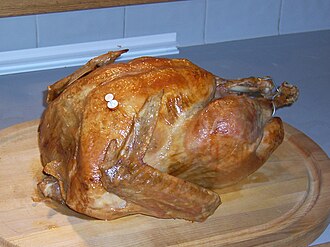
Photo: Wikipedia
Turkey light meat, with skin removed, is the lean, tender breast meat of the bird. It has a mild, subtly sweet flavor and a fine, dense texture that becomes juicy when cooked properly. Nutritionally, it's a powerhouse of high-quality protein with virtually no fat or carbohydrates.
Calorie split: 86% protein · 0% carbs · 14% fat
↓ Full nutrition💚 Why it's loved
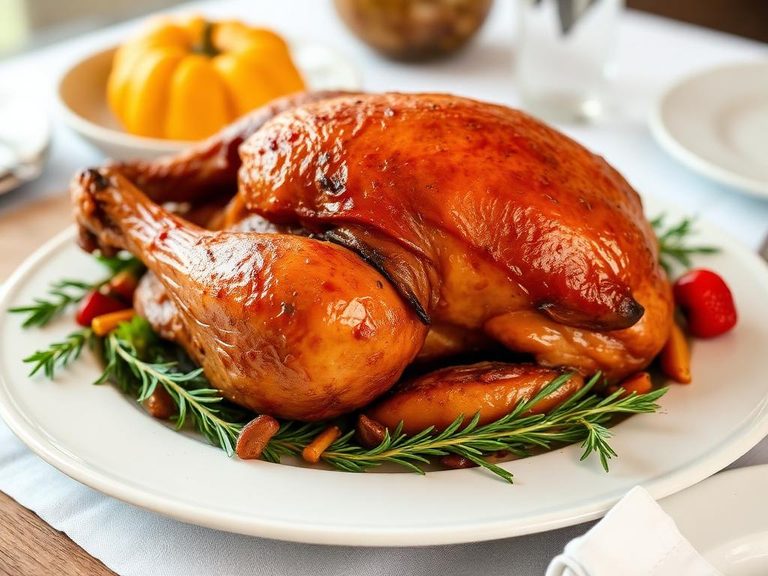
People love turkey breast for its incredible versatility—it's a blank canvas that absorbs marinades and seasonings beautifully, making it suitable for everything from holiday roasts to quick weeknight stir-fries. It's also the lean, protein-packed centerpiece of the classic Thanksgiving meal in the United States.
⚠️ Watch-outs & how to enjoy it better
The primary downside is its extreme leanness, which can lead to dry, tough meat if overcooked. To counteract this, brining (soaking in a saltwater solution) before cooking helps it retain moisture, and using a meat thermometer to avoid overcooking is essential. It is also a common poultry allergen for some individuals.
Key benefits
- Exceptionally high in lean protein for muscle maintenance and satiety.
- Very low in fat, especially saturated fat, supporting heart health.
- Zero carbohydrates, making it ideal for low-carb and ketogenic diets.
- A good source of B vitamins like niacin and B6 for energy metabolism.
🍽️ Popular dishes



🌍 Where it's eaten
💡 Did you know?
Wild turkeys can fly at speeds up to 55 mph for short bursts and run up to 25 mph on the ground.
Full nutrition (USDA data · scales with serving)
| Water | 68.1 g |
| Energy | 139 kcal |
| Protein | 28.8 g |
| Total lipid (fat) | 2.1 g |
| Carbohydrate, by difference | 0.00 g |
| Fiber, total dietary | 0.00 g |
| Total Sugars | 0.00 g |
| Calcium, Ca | 11.0 mg |
| Iron, Fe | 0.65 mg |
| Magnesium, Mg | 31.0 mg |
| Phosphorus, P | 237 mg |
| Potassium, K | 247 mg |
| Sodium, Na | 467 mg |
| Zinc, Zn | 1.6 mg |
| Copper, Cu | 0.06 mg |
| Selenium, Se | 29.9 ug |
| Vitamin C, total ascorbic acid | 0.00 mg |
| Thiamin | 0.04 mg |
| Riboflavin | 0.20 mg |
| Niacin | 11.7 mg |
| Vitamin B-6 | 0.76 mg |
| Folate, total | 10.0 ug |
| Folic acid | 0.00 ug |
| Folate, food | 10.0 ug |
| Folate, DFE | 10.0 ug |
| Choline, total | 78.1 mg |
| Vitamin B-12 | 0.82 ug |
| Vitamin B-12, added | 0.00 ug |
| Vitamin A, RAE | 3.0 ug |
| Retinol | 3.0 ug |
| Carotene, beta | 0.00 ug |
| Carotene, alpha | 0.00 ug |
| Cryptoxanthin, beta | 0.00 ug |
| Lycopene | 0.00 ug |
| Lutein + zeaxanthin | 0.00 ug |
| Vitamin E (alpha-tocopherol) | 0.06 mg |
| Vitamin E, added | 0.00 mg |
| Vitamin D (D2 + D3) | 0.30 ug |
| Vitamin K (phylloquinone) | 0.00 ug |
| Alcohol, ethyl | 0.00 g |
| Caffeine | 0.00 mg |
| Theobromine | 0.00 mg |
Fat & fatty acid profile (per 100g)
| Fatty acids, total saturated | 0.59 g |
| SFA 4:0 | 0.00 g |
| SFA 6:0 | 0.00 g |
| SFA 8:0 | 0.00 g |
| SFA 10:0 | 0.00 g |
| SFA 12:0 | 0.01 g |
| SFA 14:0 | 0.02 g |
| SFA 16:0 | 0.37 g |
| SFA 18:0 | 0.18 g |
| Fatty acids, total monounsaturated | 0.62 g |
| MUFA 16:1 | 0.06 g |
| MUFA 18:1 | 0.55 g |
| MUFA 20:1 | 0.01 g |
| MUFA 22:1 | 0.00 g |
| Fatty acids, total polyunsaturated | 0.52 g |
| PUFA 18:2 | 0.43 g |
| PUFA 18:3 | 0.02 g |
| PUFA 18:4 | 0.00 g |
| PUFA 20:4 | 0.04 g |
| PUFA 20:5 n-3 (EPA) | 0.00 g |
| PUFA 22:5 n-3 (DPA) | 0.01 g |
| PUFA 22:6 n-3 (DHA) | 0.00 g |
| Cholesterol | 76.0 mg |
Amino acid profile (per 100g)
Estimated from Turkey, mechanically deboned, from turkey frames, raw — USDA does not publish this profile for Turkey.
| Tryptophan | 0.11 g |
| Threonine | 0.64 g |
| Isoleucine | 0.50 g |
| Leucine | 1.1 g |
| Lysine | 1.2 g |
| Methionine | 0.37 g |
| Cystine | 0.10 g |
| Phenylalanine | 0.55 g |
| Tyrosine | 0.47 g |
| Valine | 0.54 g |
| Arginine | 0.87 g |
| Histidine | 0.50 g |
| Alanine | 0.87 g |
| Aspartic acid | 1.4 g |
| Glutamic acid | 2.2 g |
| Glycine | 0.78 g |
| Proline | 0.65 g |
| Serine | 0.62 g |
FAQ
How do I keep turkey breast from drying out?
The best methods are brining it before cooking, cooking it to an internal temperature of 165°F (74°C) and no more, and letting it rest for 10-15 minutes after cooking before slicing.
Is turkey breast healthier than chicken breast?
They are nutritionally very similar, both being excellent sources of lean protein. Turkey breast can be slightly lower in fat and calories per serving, but the difference is minimal.
What's the difference between turkey light and dark meat?
Light meat (breast) is leaner, milder in flavor, and cooks faster. Dark meat (legs and thighs) has more fat, a richer flavor, and is more forgiving and moist when cooked.
Nutrient density (calculated · NRF9.3)
Nutrient Rich Foods index: beneficial nutrients (protein, fiber, vitamins, minerals) minus saturated fat, added sugar & sodium, per 100 kcal.
NRF9.3 index — Fulgoni, Keast & Drewnowski, 2009. Computed from USDA nutrients.
Weight-loss friendliness (composite index)
Energy density 1.39 kcal/g · 83% calories from protein · 0.0 g fiber · 0.0 g sugar per 100 g.
Composite of energy density (Rolls et al., 1999), protein & fiber satiety, minus sugar. A calculated heuristic — ranks satiety-per-calorie, not a clinical measure.
Dietary load (calculated from USDA values)
Potential renal acid load. Positive = acid-forming, negative = alkaline-forming.
Sodium-to-potassium ratio: 1.89 (lower is better — aim for ≤ 1)
Sodium:potassium per WHO potassium guidance. Computed from USDA nutrients.