

Soymilk, original and vanilla, light, with added calcium, vitamins A and D
Whole food · Legumes and Legume Products

Photo: Wikipedia
This is a light, fortified soymilk, a plant-based beverage with a smooth, creamy texture and a mild, slightly beany flavor enhanced by subtle vanilla sweetness. Its standout nutritional feature is the significant fortification with calcium and vitamins A and D, making it a nutritionally dense, low-calorie option at just 30 kcal per 100g.
Calorie split: 31% protein · 46% carbs · 23% fat
↓ Full nutrition💚 Why it's loved
People love it as a versatile, dairy-free staple that seamlessly fits into smoothies, cereal, coffee, and baking while providing a familiar, comforting taste. Its light, vanilla-kissed profile makes it an easy, enjoyable swap for traditional milk in many diets.
⚠️ Watch-outs & how to enjoy it better
As a soy product, it is a common allergen and may not be suitable for those with soy sensitivities. The added sugars, while moderate, can contribute to blood sugar spikes if consumed in large quantities without other foods. To counteract this, pair it with a source of protein or healthy fat (like nuts or seeds) to slow sugar absorption, and be mindful of portion sizes if monitoring sugar intake.
Key benefits
- Excellent source of calcium and vitamin D for bone health
- Very low in calories and fat, suitable for weight management
- Provides plant-based protein (2.38g per 100g)
- Fortified with vitamin A for immune and vision support
- Naturally free of cholesterol and lactose
🍽️ Popular dishes

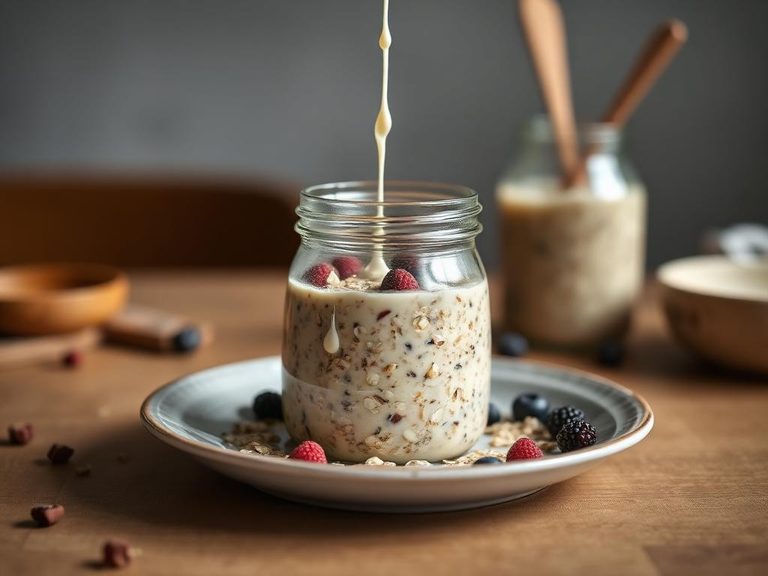
🌍 Where it's eaten
💡 Did you know?
Fortified soymilk is one of the few plant-based beverages that nutritionally matches cow's milk for calcium and vitamin D content per serving, making it a direct nutritional counterpart in many dietary guidelines.
Full nutrition (USDA data · scales with serving)
| Water | 92.7 g |
| Energy | 30.0 kcal |
| Energy | 126 kj |
| Protein | 2.4 g |
| Total lipid (fat) | 0.77 g |
| Ash | 0.64 g |
| Carbohydrate, by difference | 3.5 g |
| Fiber, total dietary | 0.30 g |
| Total Sugars | 2.6 g |
| Calcium, Ca | 123 mg |
| Iron, Fe | 0.43 mg |
| Magnesium, Mg | 15.0 mg |
| Phosphorus, P | 87.0 mg |
| Potassium, K | 117 mg |
| Sodium, Na | 48.0 mg |
| Zinc, Zn | 0.23 mg |
| Copper, Cu | 0.09 mg |
| Selenium, Se | 2.3 ug |
| Vitamin C, total ascorbic acid | 0.00 mg |
| Thiamin | 0.04 mg |
| Riboflavin | 0.20 mg |
| Niacin | 0.22 mg |
| Vitamin B-6 | 0.02 mg |
| Folate, total | 9.0 ug |
| Folic acid | 0.00 ug |
| Folate, food | 9.0 ug |
| Folate, DFE | 9.0 ug |
| Choline, total | 12.3 mg |
| Vitamin B-12 | 1.0 ug |
| Vitamin B-12, added | 1.0 ug |
| Vitamin A, RAE | 61.0 ug |
| Retinol | 61.0 ug |
| Carotene, beta | 1.0 ug |
| Carotene, alpha | 0.00 ug |
| Cryptoxanthin, beta | 0.00 ug |
| Vitamin A, IU | 204 iu |
| Lycopene | 0.00 ug |
| Lutein + zeaxanthin | 0.00 ug |
| Vitamin E (alpha-tocopherol) | 0.06 mg |
| Vitamin E, added | 0.00 mg |
| Vitamin D (D2 + D3), International Units | 47.0 iu |
| Vitamin D (D2 + D3) | 1.2 ug |
| Vitamin D2 (ergocalciferol) | 1.2 ug |
| Vitamin K (phylloquinone) | 1.6 ug |
| Alcohol, ethyl | 0.00 g |
| Caffeine | 0.00 mg |
| Theobromine | 0.00 mg |
Fat & fatty acid profile (per 100g)
| Fatty acids, total saturated | 0.01 g |
| SFA 4:0 | 0.00 g |
| SFA 6:0 | 0.00 g |
| SFA 8:0 | 0.00 g |
| SFA 10:0 | 0.00 g |
| SFA 12:0 | 0.00 g |
| SFA 14:0 | 0.00 g |
| SFA 16:0 | 0.00 g |
| SFA 18:0 | 0.00 g |
| Fatty acids, total monounsaturated | 0.20 g |
| MUFA 16:1 | 0.00 g |
| MUFA 18:1 | 0.20 g |
| MUFA 20:1 | 0.01 g |
| MUFA 22:1 | 0.00 g |
| Fatty acids, total polyunsaturated | 0.43 g |
| PUFA 18:2 | 0.38 g |
| PUFA 18:3 | 0.05 g |
| PUFA 18:4 | 0.00 g |
| PUFA 20:4 | 0.00 g |
| PUFA 20:5 n-3 (EPA) | 0.00 g |
| PUFA 22:5 n-3 (DPA) | 0.00 g |
| PUFA 22:6 n-3 (DHA) | 0.00 g |
| Fatty acids, total trans | 0.00 g |
| Cholesterol | 0.00 mg |
Amino acid profile (per 100g)
Estimated from Soymilk, chocolate, unfortified — USDA does not publish this profile for Soymilk.
| Tryptophan | 0.04 g |
| Threonine | 0.11 g |
| Isoleucine | 0.11 g |
| Leucine | 0.19 g |
| Lysine | 0.13 g |
| Methionine | 0.03 g |
| Cystine | 0.00 g |
| Phenylalanine | 0.11 g |
| Tyrosine | 0.09 g |
| Valine | 0.12 g |
| Arginine | 0.19 g |
| Histidine | 0.06 g |
| Alanine | 0.10 g |
| Aspartic acid | 0.29 g |
| Glutamic acid | 0.49 g |
| Glycine | 0.10 g |
| Proline | 0.15 g |
| Serine | 0.14 g |
FAQ
Is light soymilk less nutritious than regular?
Not necessarily. 'Light' typically refers to reduced calories and often sugar, but this product is fortified with calcium and vitamins A & D, making it nutritionally robust. The protein content is slightly lower than some regular versions, but it remains a good source.
Can I use this for cooking and baking?
Yes, it's excellent for baking cakes, muffins, and pancakes, or for making sauces and soups. Its light flavor won't overpower dishes, and the vanilla version adds a subtle sweetness to sweet recipes.
Why does it have added sugar?
The added sugar (2.61g per 100g) is primarily to balance the natural beany flavor of soy and enhance palatability, especially in the vanilla variety. It's a common practice to make plant-based milks more appealing to a wider audience.
Nutrient density (calculated · NRF9.3)
Nutrient Rich Foods index: beneficial nutrients (protein, fiber, vitamins, minerals) minus saturated fat, added sugar & sodium, per 100 kcal.
NRF9.3 index — Fulgoni, Keast & Drewnowski, 2009. Computed from USDA nutrients.
Weight-loss friendliness (composite index)
Energy density 0.30 kcal/g · 32% calories from protein · 0.3 g fiber · 2.6 g sugar per 100 g.
Composite of energy density (Rolls et al., 1999), protein & fiber satiety, minus sugar. A calculated heuristic — ranks satiety-per-calorie, not a clinical measure.
Dietary load (calculated from USDA values)
Potential renal acid load. Positive = acid-forming, negative = alkaline-forming.
Sodium-to-potassium ratio: 0.41 (lower is better — aim for ≤ 1)
Sodium:potassium per WHO potassium guidance. Computed from USDA nutrients.