

Soymilk, chocolate, nonfat, with added calcium, vitamins A and D
Whole food · Legumes and Legume Products

Photo: Wikipedia
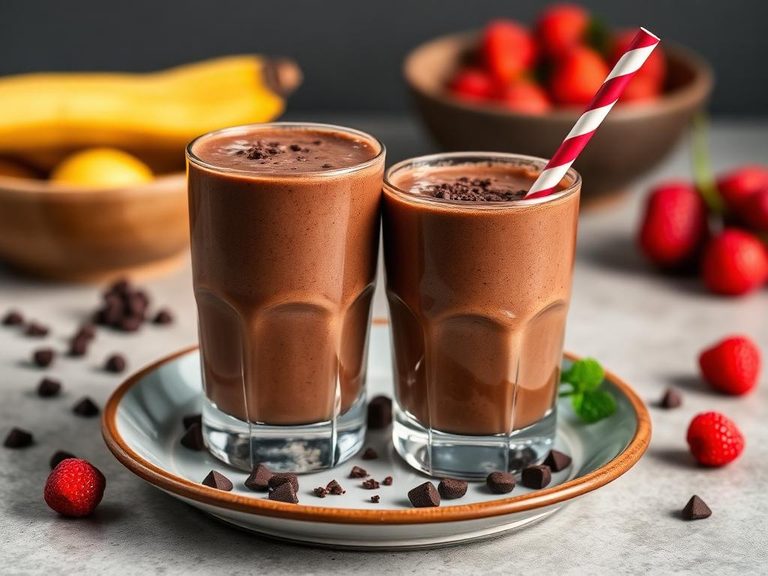
This is a light, chocolate-flavored plant-based milk made from soybeans, fortified with calcium and vitamins A and D. It has a smooth, creamy texture and a mild, sweet chocolate taste without any of the fat of traditional dairy milk. Nutritionally, it's a low-calorie source of plant protein and is often enriched to match the vitamin profile of cow's milk.
Calorie split: 22% protein · 77% carbs · 1% fat
↓ Full nutrition💚 Why it's loved
People love it as a convenient, tasty way to boost protein and calcium intake without the saturated fat of chocolate milk. It's a staple in smoothies, cereal, and coffee, and is a go-to for those following vegan or lactose-free diets.
⚠️ Watch-outs & how to enjoy it better
The added sugar (3.65g per 100g) can contribute to blood sugar spikes if consumed in large quantities, and soy is a common allergen. To mitigate sugar impact, pair it with a source of protein or healthy fat (like nuts or oats) and practice portion control. For those with soy allergies, this product must be avoided entirely.
Key benefits
- Low in calories (44 kcal per 100g)
- Good source of plant-based protein (2.47g per 100g)
- Fortified with calcium, vitamins A and D
- Very low in fat (0.04g per 100g)
- Dairy-free and lactose-free alternative
🍽️ Popular dishes


🌍 Where it's eaten
💡 Did you know?
Chocolate soy milk was first commercially produced in the United States in the 1980s, capitalizing on the growing popularity of both soy-based products and low-fat diets.
Full nutrition (USDA data · scales with serving)
| Water | 88.4 g |
| Energy | 44.0 kcal |
| Energy | 184 kj |
| Protein | 2.5 g |
| Total lipid (fat) | 0.04 g |
| Ash | 0.64 g |
| Carbohydrate, by difference | 8.5 g |
| Fiber, total dietary | 0.20 g |
| Total Sugars | 3.6 g |
| Calcium, Ca | 116 mg |
| Iron, Fe | 0.35 mg |
| Magnesium, Mg | 10.0 mg |
| Phosphorus, P | 87.0 mg |
| Potassium, K | 105 mg |
| Sodium, Na | 57.0 mg |
| Zinc, Zn | 0.10 mg |
| Copper, Cu | 0.20 mg |
| Selenium, Se | 1.7 ug |
| Vitamin C, total ascorbic acid | 0.00 mg |
| Thiamin | 0.04 mg |
| Riboflavin | 0.17 mg |
| Niacin | 0.51 mg |
| Vitamin B-6 | 0.04 mg |
| Folate, total | 7.0 ug |
| Folic acid | 0.00 ug |
| Folate, food | 7.0 ug |
| Folate, DFE | 7.0 ug |
| Choline, total | 28.4 mg |
| Vitamin B-12 | 0.23 ug |
| Vitamin B-12, added | 0.23 ug |
| Vitamin A, RAE | 61.0 ug |
| Retinol | 61.0 ug |
| Carotene, beta | 2.0 ug |
| Carotene, alpha | 0.00 ug |
| Cryptoxanthin, beta | 0.00 ug |
| Vitamin A, IU | 206 iu |
| Lycopene | 0.00 ug |
| Lutein + zeaxanthin | 0.00 ug |
| Vitamin E (alpha-tocopherol) | 0.13 mg |
| Vitamin E, added | 0.00 mg |
| Vitamin D (D2 + D3), International Units | 41.0 iu |
| Vitamin D (D2 + D3) | 1.0 ug |
| Vitamin D2 (ergocalciferol) | 1.0 ug |
| Vitamin K (phylloquinone) | 3.6 ug |
| Alcohol, ethyl | 0.00 g |
| Caffeine | 2.0 mg |
| Theobromine | 19.0 mg |
Fat & fatty acid profile (per 100g)
| Fatty acids, total saturated | 0.00 g |
| SFA 4:0 | 0.00 g |
| SFA 6:0 | 0.00 g |
| SFA 8:0 | 0.00 g |
| SFA 10:0 | 0.00 g |
| SFA 12:0 | 0.00 g |
| SFA 14:0 | 0.00 g |
| SFA 16:0 | 0.00 g |
| SFA 18:0 | 0.00 g |
| Fatty acids, total monounsaturated | 0.00 g |
| MUFA 16:1 | 0.00 g |
| MUFA 18:1 | 0.00 g |
| MUFA 20:1 | 0.00 g |
| MUFA 22:1 | 0.00 g |
| Fatty acids, total polyunsaturated | 0.04 g |
| PUFA 18:2 | 0.03 g |
| PUFA 18:3 | 0.00 g |
| PUFA 18:4 | 0.00 g |
| PUFA 20:4 | 0.00 g |
| PUFA 20:5 n-3 (EPA) | 0.00 g |
| PUFA 22:5 n-3 (DPA) | 0.00 g |
| PUFA 22:6 n-3 (DHA) | 0.00 g |
| Fatty acids, total trans | 0.00 g |
| Cholesterol | 0.00 mg |
Amino acid profile (per 100g)
Estimated from Soymilk, chocolate, with added calcium, vitamins A and D — USDA does not publish this profile for Soymilk.
| Tryptophan | 0.03 g |
| Threonine | 0.07 g |
| Isoleucine | 0.08 g |
| Leucine | 0.13 g |
| Lysine | 0.09 g |
| Methionine | 0.02 g |
| Cystine | 0.00 g |
| Phenylalanine | 0.08 g |
| Tyrosine | 0.06 g |
| Valine | 0.08 g |
| Arginine | 0.13 g |
| Histidine | 0.04 g |
| Alanine | 0.07 g |
| Aspartic acid | 0.20 g |
| Glutamic acid | 0.34 g |
| Glycine | 0.07 g |
| Proline | 0.10 g |
| Serine | 0.10 g |
FAQ
Is chocolate soy milk a good source of protein?
Yes, it provides a decent amount of plant-based protein (about 6g per cup), making it a good option for vegetarians and vegans, though not as high as some protein-fortified versions.
How does it compare to regular chocolate milk nutritionally?
It is significantly lower in fat and calories but also has less protein. The added vitamins and minerals often make it nutritionally comparable to low-fat dairy milk in terms of calcium and vitamins.
Can I use it in cooking and baking?
Absolutely. It works well in pancakes, muffins, and sauces, adding moisture and a mild chocolate flavor. It can be a direct 1:1 substitute for dairy milk in most recipes.
Nutrient density (calculated · NRF9.3)
Nutrient Rich Foods index: beneficial nutrients (protein, fiber, vitamins, minerals) minus saturated fat, added sugar & sodium, per 100 kcal.
NRF9.3 index — Fulgoni, Keast & Drewnowski, 2009. Computed from USDA nutrients.
Weight-loss friendliness (composite index)
Energy density 0.44 kcal/g · 22% calories from protein · 0.2 g fiber · 3.6 g sugar per 100 g.
Composite of energy density (Rolls et al., 1999), protein & fiber satiety, minus sugar. A calculated heuristic — ranks satiety-per-calorie, not a clinical measure.
Dietary load (calculated from USDA values)
Potential renal acid load. Positive = acid-forming, negative = alkaline-forming.
Sodium-to-potassium ratio: 0.54 (lower is better — aim for ≤ 1)
Sodium:potassium per WHO potassium guidance. Computed from USDA nutrients.