

Soup, chicken noodle, dry, mix, prepared with water
Whole food · Soups, Sauces, and Gravies
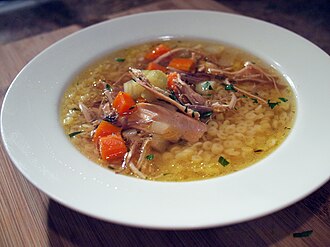
Photo: Wikipedia
This is the humble, shelf-stable foundation of a classic comfort food: a dehydrated mix of fine egg noodles, powdered chicken broth, and savory seasonings. When prepared with water, it yields a light, salty broth with tender, small pasta pieces. Nutritionally, it's a very low-calorie, primarily carbohydrate-based food, offering quick energy with minimal protein or fat.
Calorie split: 15% protein · 64% carbs · 22% fat
↓ Full nutrition💚 Why it's loved
People love it for its unmatched convenience and nostalgic, comforting flavor—a warm, salty chicken broth with soft noodles that can be ready in minutes. It's a versatile pantry staple that can be eaten alone or used as a base for more elaborate soups.
⚠️ Watch-outs & how to enjoy it better
It is often very high in sodium, which can contribute to water retention and is a concern for those monitoring blood pressure. The refined carbohydrates can cause a rapid blood sugar spike, and it lacks substantial protein or fiber for satiety. To counteract this, pair it with a source of protein (like a boiled egg or shredded chicken) and fiber (like a handful of frozen vegetables) to balance the meal and slow digestion.
Key benefits
- Extremely low calorie density (23 kcal/100g)
- Provides quick-release carbohydrates for immediate energy
- Highly shelf-stable and requires no refrigeration
- Extremely fast and convenient to prepare
- A familiar, comforting base for quick meals
🍽️ Popular dishes


🌍 Where it's eaten
💡 Did you know?
The fine, short noodles in these mixes are specifically designed to rehydrate quickly in hot water, a technology perfected for military rations and camping food before becoming a household staple.
Full nutrition (USDA data · scales with serving)
| Water | 94.2 g |
| Energy | 23.0 kcal |
| Energy | 96.0 kj |
| Protein | 0.84 g |
| Total lipid (fat) | 0.55 g |
| Ash | 0.78 g |
| Carbohydrate, by difference | 3.7 g |
| Fiber, total dietary | 0.10 g |
| Total Sugars | 0.31 g |
| Calcium, Ca | 2.0 mg |
| Iron, Fe | 0.20 mg |
| Magnesium, Mg | 3.0 mg |
| Phosphorus, P | 12.0 mg |
| Potassium, K | 13.0 mg |
| Sodium, Na | 229 mg |
| Zinc, Zn | 0.08 mg |
| Copper, Cu | 0.01 mg |
| Manganese, Mn | 0.03 mg |
| Selenium, Se | 3.8 ug |
| Vitamin C, total ascorbic acid | 0.00 mg |
| Thiamin | 0.08 mg |
| Riboflavin | 0.03 mg |
| Niacin | 0.43 mg |
| Pantothenic acid | 0.04 mg |
| Vitamin B-6 | 0.01 mg |
| Folate, total | 7.0 ug |
| Folic acid | 6.0 ug |
| Folate, food | 1.0 ug |
| Folate, DFE | 11.0 ug |
| Choline, total | 4.9 mg |
| Vitamin B-12 | 0.02 ug |
| Vitamin B-12, added | 0.00 ug |
| Vitamin A, RAE | 1.0 ug |
| Retinol | 0.00 ug |
| Carotene, beta | 5.0 ug |
| Carotene, alpha | 1.0 ug |
| Cryptoxanthin, beta | 0.00 ug |
| Vitamin A, IU | 11.0 iu |
| Lycopene | 0.00 ug |
| Lutein + zeaxanthin | 8.0 ug |
| Vitamin E (alpha-tocopherol) | 0.05 mg |
| Vitamin E, added | 0.00 mg |
| Vitamin D (D2 + D3), International Units | 0.00 iu |
| Vitamin D (D2 + D3) | 0.00 ug |
| Vitamin K (phylloquinone) | 1.4 ug |
| Alcohol, ethyl | 0.00 g |
| Caffeine | 0.00 mg |
| Theobromine | 0.00 mg |
Fat & fatty acid profile (per 100g)
| Fatty acids, total saturated | 0.12 g |
| SFA 4:0 | 0.00 g |
| SFA 6:0 | 0.00 g |
| SFA 8:0 | 0.00 g |
| SFA 10:0 | 0.00 g |
| SFA 12:0 | 0.00 g |
| SFA 14:0 | 0.00 g |
| SFA 16:0 | 0.09 g |
| SFA 18:0 | 0.03 g |
| Fatty acids, total monounsaturated | 0.20 g |
| MUFA 16:1 | 0.02 g |
| MUFA 18:1 | 0.19 g |
| MUFA 20:1 | 0.00 g |
| MUFA 22:1 | 0.00 g |
| Fatty acids, total polyunsaturated | 0.15 g |
| PUFA 18:2 | 0.14 g |
| PUFA 18:3 | 0.01 g |
| PUFA 18:4 | 0.00 g |
| PUFA 20:4 | 0.00 g |
| PUFA 20:5 n-3 (EPA) | 0.00 g |
| PUFA 22:5 n-3 (DPA) | 0.00 g |
| PUFA 22:6 n-3 (DHA) | 0.00 g |
| Cholesterol | 4.0 mg |
Amino acid profile (per 100g)
Estimated from Soup, bean with pork, canned, condensed — USDA does not publish this profile for Soup.
| Tryptophan | 0.06 g |
| Threonine | 0.24 g |
| Isoleucine | 0.29 g |
| Leucine | 0.48 g |
| Lysine | 0.40 g |
| Methionine | 0.07 g |
| Cystine | 0.07 g |
| Phenylalanine | 0.33 g |
| Tyrosine | 0.18 g |
| Valine | 0.32 g |
| Arginine | 0.31 g |
| Histidine | 0.15 g |
| Alanine | 0.29 g |
| Aspartic acid | 0.66 g |
| Glutamic acid | 1.1 g |
| Glycine | 0.28 g |
| Proline | 0.27 g |
| Serine | 0.29 g |
FAQ
How does the nutrition change when prepared with water vs. milk?
Preparing with water maintains the very low calorie count. Using milk would significantly increase the calories, protein, fat, and calcium, making it a more substantial but different product.
Is this the same as instant ramen?
No. While both are dehydrated noodle soups, chicken noodle mix typically uses egg noodles and a chicken-flavored broth powder, whereas instant ramen often uses wheat noodles and a separate seasoning packet with a different flavor profile and texture.
Can I reduce the sodium content?
You can try using only half of the provided seasoning packet, or prepare it with less water and then add plain hot water to taste. Rinsing the rehydrated noodles briefly before adding the broth can also remove some surface salt.
Nutrient density (calculated · NRF9.3)
Nutrient Rich Foods index: beneficial nutrients (protein, fiber, vitamins, minerals) minus saturated fat, added sugar & sodium, per 100 kcal.
NRF9.3 index — Fulgoni, Keast & Drewnowski, 2009. Computed from USDA nutrients.
Weight-loss friendliness (composite index)
Energy density 0.23 kcal/g · 15% calories from protein · 0.1 g fiber · 0.3 g sugar per 100 g.
Composite of energy density (Rolls et al., 1999), protein & fiber satiety, minus sugar. A calculated heuristic — ranks satiety-per-calorie, not a clinical measure.
Dietary load (calculated from USDA values)
Potential renal acid load. Positive = acid-forming, negative = alkaline-forming.
Sodium-to-potassium ratio: 17.62 (lower is better — aim for ≤ 1)
Sodium:potassium per WHO potassium guidance. Computed from USDA nutrients.