

Pie, mince, prepared from recipe
Whole food · Baked Products

Photo: Wikipedia
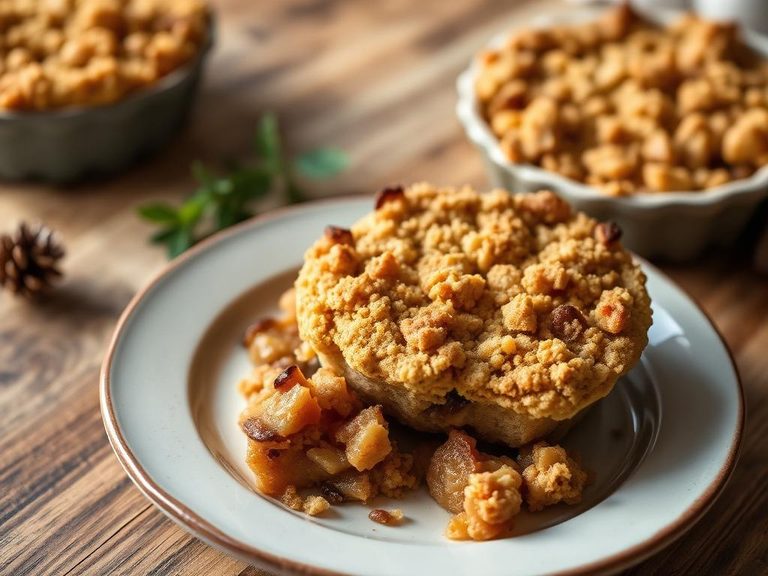
Mince pie is a rich, sweet pastry filled with a spiced mixture of dried fruits, suet, and sugar, offering a dense, chewy texture with a buttery, flaky crust. Its nutrition profile is high in carbohydrates and sugar, providing a quick energy boost, but it is also calorie-dense with moderate fat content. The combination of warm spices and sweet, fruity filling makes it a beloved festive treat, especially during the holiday season.
Calorie split: 3% protein · 64% carbs · 32% fat
↓ Full nutrition💚 Why it's loved
People love mince pie for its nostalgic, festive flavor, combining sweet, spiced dried fruits with a buttery pastry crust, often evoking holiday traditions and family gatherings. Its versatility allows it to be enjoyed warm or cold, with or without accompaniments like cream or custard.
⚠️ Watch-outs & how to enjoy it better
Mince pie is high in sugar and carbohydrates, which can cause blood-sugar spikes, and its calorie density may not suit those watching their intake. To counteract this, pair it with a source of protein or fat (like nuts or yogurt) to slow sugar absorption, and practice portion control by enjoying a small slice rather than multiple servings.
Key benefits
- Provides quick energy from carbohydrates
- Contains dietary fiber from dried fruits
- Offers small amounts of protein and fat
- Rich in antioxidants from spices and dried fruits
- Traditional comfort food with cultural significance
🍽️ Popular dishes





🌍 Where it's eaten
💡 Did you know?
Mince pies were originally filled with minced meat (like mutton or beef) mixed with fruits and spices, and the tradition of eating them at Christmas dates back to the 13th century in England.
Full nutrition (USDA data · scales with serving)
| Water | 37.4 g |
| Energy | 289 kcal |
| Energy | 1209 kj |
| Protein | 2.6 g |
| Total lipid (fat) | 10.8 g |
| Ash | 1.2 g |
| Carbohydrate, by difference | 48.0 g |
| Fiber, total dietary | 2.6 g |
| Total Sugars | 28.3 g |
| Calcium, Ca | 22.0 mg |
| Iron, Fe | 1.5 mg |
| Magnesium, Mg | 14.0 mg |
| Phosphorus, P | 42.0 mg |
| Potassium, K | 203 mg |
| Sodium, Na | 254 mg |
| Zinc, Zn | 0.22 mg |
| Copper, Cu | 0.11 mg |
| Manganese, Mn | 0.26 mg |
| Selenium, Se | 6.6 ug |
| Vitamin C, total ascorbic acid | 5.9 mg |
| Thiamin | 0.15 mg |
| Riboflavin | 0.10 mg |
| Niacin | 1.2 mg |
| Pantothenic acid | 0.10 mg |
| Vitamin B-6 | 0.07 mg |
| Folate, total | 23.0 ug |
| Folic acid | 18.0 ug |
| Folate, food | 5.0 ug |
| Folate, DFE | 36.0 ug |
| Choline, total | 7.2 mg |
| Vitamin B-12 | 0.00 ug |
| Vitamin B-12, added | 0.00 ug |
| Vitamin A, RAE | 1.0 ug |
| Retinol | 0.00 ug |
| Carotene, beta | 5.0 ug |
| Carotene, alpha | 0.00 ug |
| Cryptoxanthin, beta | 12.0 ug |
| Vitamin A, IU | 22.0 iu |
| Lycopene | 0.00 ug |
| Lutein + zeaxanthin | 13.0 ug |
| Vitamin E (alpha-tocopherol) | 0.15 mg |
| Vitamin E, added | 0.00 mg |
| Vitamin D (D2 + D3), International Units | 0.00 iu |
| Vitamin D (D2 + D3) | 0.00 ug |
| Vitamin K (phylloquinone) | 5.4 ug |
| Alcohol, ethyl | 0.00 g |
| Caffeine | 0.00 mg |
| Theobromine | 0.00 mg |
Fat & fatty acid profile (per 100g)
| Fatty acids, total saturated | 2.7 g |
| SFA 4:0 | 0.00 g |
| SFA 6:0 | 0.00 g |
| SFA 8:0 | 0.00 g |
| SFA 10:0 | 0.00 g |
| SFA 12:0 | 0.00 g |
| SFA 14:0 | 0.04 g |
| SFA 16:0 | 1.5 g |
| SFA 18:0 | 1.1 g |
| Fatty acids, total monounsaturated | 4.7 g |
| MUFA 16:1 | 0.00 g |
| MUFA 18:1 | 4.7 g |
| MUFA 20:1 | 0.00 g |
| MUFA 22:1 | 0.00 g |
| Fatty acids, total polyunsaturated | 2.8 g |
| PUFA 18:2 | 2.7 g |
| PUFA 18:3 | 0.18 g |
| PUFA 18:4 | 0.00 g |
| PUFA 20:4 | 0.00 g |
| PUFA 20:5 n-3 (EPA) | 0.00 g |
| PUFA 22:5 n-3 (DPA) | 0.00 g |
| PUFA 22:6 n-3 (DHA) | 0.00 g |
| Cholesterol | 0.00 mg |
Amino acid profile (per 100g)
| Tryptophan | 0.03 g |
| Threonine | 0.07 g |
| Isoleucine | 0.07 g |
| Leucine | 0.15 g |
| Lysine | 0.06 g |
| Methionine | 0.05 g |
| Cystine | 0.05 g |
| Phenylalanine | 0.11 g |
| Tyrosine | 0.07 g |
| Valine | 0.10 g |
| Arginine | 0.12 g |
| Histidine | 0.06 g |
| Alanine | 0.09 g |
| Aspartic acid | 0.16 g |
| Glutamic acid | 0.78 g |
| Glycine | 0.07 g |
| Proline | 0.23 g |
| Serine | 0.10 g |
FAQ
What is the main difference between mince pie and fruit pie?
Mince pie typically contains a mixture of dried fruits, spices, and suet or butter, while fruit pie usually features fresh or cooked fruit as the primary filling.
Can mince pie be eaten cold?
Yes, mince pie can be enjoyed cold, though it is often served warm with cream, custard, or ice cream for enhanced flavor and texture.
Is mince pie suitable for vegetarians?
Traditional mince pie contains suet (animal fat), but many modern recipes use vegetable suet or butter, making them suitable for vegetarians.
Nutrient density (calculated · NRF9.3)
Nutrient Rich Foods index: beneficial nutrients (protein, fiber, vitamins, minerals) minus saturated fat, added sugar & sodium, per 100 kcal.
NRF9.3 index — Fulgoni, Keast & Drewnowski, 2009. Computed from USDA nutrients.
Weight-loss friendliness (composite index)
Energy density 2.89 kcal/g · 4% calories from protein · 2.6 g fiber · 28.3 g sugar per 100 g.
Composite of energy density (Rolls et al., 1999), protein & fiber satiety, minus sugar. A calculated heuristic — ranks satiety-per-calorie, not a clinical measure.
Dietary load (calculated from USDA values)
Potential renal acid load. Positive = acid-forming, negative = alkaline-forming.
Sodium-to-potassium ratio: 1.25 (lower is better — aim for ≤ 1)
Sodium:potassium per WHO potassium guidance. Computed from USDA nutrients.