

Candies, sweet chocolate
Whole food · Sweets
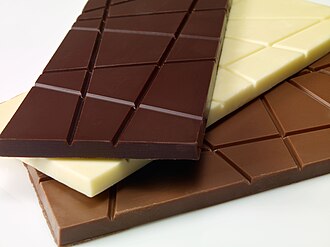
Photo: Wikipedia
Sweet chocolate candy is a rich, indulgent confection made from cocoa solids, sugar, and often milk, delivering a smooth, melt-in-your-mouth texture with deep cocoa notes balanced by sweetness. Its dense, creamy mouthfeel and glossy finish make it a classic treat, with a nutritional profile dominated by energy-dense fats and sugars.
Calorie split: 3% protein · 43% carbs · 54% fat
↓ Full nutrition💚 Why it's loved
People adore it for its luxurious, comforting flavor and the way it dissolves on the tongue, offering a moment of pure indulgence. It's deeply embedded in celebrations, gifting rituals, and personal rewards across cultures.
⚠️ Watch-outs & how to enjoy it better
Its high sugar and fat content can lead to blood-sugar spikes and contribute to excess calorie intake, making it unsuitable for those managing diabetes or weight. To enjoy mindfully, pair a small piece with protein-rich nuts or fiber to slow sugar absorption, and practice strict portion control.
Key benefits
- Quick source of energy from fats and carbs
- Contains antioxidants from cocoa solids
- Provides small amounts of minerals like iron and magnesium
- Can boost mood through sensory pleasure and endorphin release
- Versatile base for desserts and baking
🍽️ Popular dishes





🌍 Where it's eaten
💡 Did you know?
The smooth texture of modern sweet chocolate is achieved through a process called conching, invented in 1879, which involves continuously agitating and aerating the chocolate for hours or even days.
Full nutrition (USDA data · scales with serving)
| Water | 0.50 g |
| Energy | 507 kcal |
| Energy | 2120 kj |
| Protein | 3.9 g |
| Total lipid (fat) | 34.2 g |
| Ash | 1.0 g |
| Carbohydrate, by difference | 60.4 g |
| Fiber, total dietary | 5.5 g |
| Total Sugars | 51.5 g |
| Calcium, Ca | 24.0 mg |
| Iron, Fe | 2.8 mg |
| Magnesium, Mg | 113 mg |
| Phosphorus, P | 147 mg |
| Potassium, K | 290 mg |
| Sodium, Na | 16.0 mg |
| Zinc, Zn | 1.5 mg |
| Copper, Cu | 0.57 mg |
| Manganese, Mn | 0.49 mg |
| Selenium, Se | 2.8 ug |
| Vitamin C, total ascorbic acid | 0.00 mg |
| Thiamin | 0.02 mg |
| Riboflavin | 0.24 mg |
| Niacin | 0.67 mg |
| Pantothenic acid | 0.07 mg |
| Vitamin B-6 | 0.04 mg |
| Folate, total | 3.0 ug |
| Folic acid | 0.00 ug |
| Folate, food | 3.0 ug |
| Folate, DFE | 3.0 ug |
| Choline, total | 29.9 mg |
| Vitamin B-12 | 0.00 ug |
| Vitamin B-12, added | 0.00 ug |
| Vitamin A, RAE | 0.00 ug |
| Retinol | 0.00 ug |
| Carotene, beta | 0.00 ug |
| Carotene, alpha | 0.00 ug |
| Cryptoxanthin, beta | 0.00 ug |
| Vitamin A, IU | 0.00 iu |
| Lycopene | 0.00 ug |
| Lutein + zeaxanthin | 18.0 ug |
| Vitamin E (alpha-tocopherol) | 0.26 mg |
| Vitamin E, added | 0.00 mg |
| Vitamin D (D2 + D3), International Units | 0.00 iu |
| Vitamin D (D2 + D3) | 0.00 ug |
| Vitamin K (phylloquinone) | 6.3 ug |
| Alcohol, ethyl | 0.00 g |
| Caffeine | 66.0 mg |
| Theobromine | 426 mg |
Fat & fatty acid profile (per 100g)
| Fatty acids, total saturated | 20.1 g |
| SFA 4:0 | 0.00 g |
| SFA 6:0 | 0.00 g |
| SFA 8:0 | 0.00 g |
| SFA 10:0 | 0.00 g |
| SFA 12:0 | 0.00 g |
| SFA 14:0 | 0.03 g |
| SFA 16:0 | 8.7 g |
| SFA 18:0 | 11.3 g |
| Fatty acids, total monounsaturated | 11.2 g |
| MUFA 16:1 | 0.07 g |
| MUFA 18:1 | 11.2 g |
| MUFA 20:1 | 0.00 g |
| MUFA 22:1 | 0.00 g |
| Fatty acids, total polyunsaturated | 0.99 g |
| PUFA 18:2 | 0.96 g |
| PUFA 18:3 | 0.03 g |
| PUFA 18:4 | 0.00 g |
| PUFA 20:4 | 0.00 g |
| PUFA 20:5 n-3 (EPA) | 0.00 g |
| PUFA 22:5 n-3 (DPA) | 0.00 g |
| PUFA 22:6 n-3 (DHA) | 0.00 g |
| Cholesterol | 0.00 mg |
Amino acid profile (per 100g)
| Tryptophan | 0.06 g |
| Threonine | 0.15 g |
| Isoleucine | 0.15 g |
| Leucine | 0.24 g |
| Lysine | 0.20 g |
| Methionine | 0.04 g |
| Cystine | 0.05 g |
| Phenylalanine | 0.19 g |
| Tyrosine | 0.15 g |
| Valine | 0.23 g |
| Arginine | 0.22 g |
| Histidine | 0.07 g |
| Alanine | 0.18 g |
| Aspartic acid | 0.39 g |
| Glutamic acid | 0.59 g |
| Glycine | 0.17 g |
| Proline | 0.17 g |
| Serine | 0.17 g |
FAQ
Is sweet chocolate the same as milk chocolate?
Not exactly. 'Sweet chocolate' can refer to dark chocolate with added sugar, while milk chocolate contains milk solids. The nutrition profile here suggests a milk chocolate due to the sugar and fat levels.
Can I eat this as part of a balanced diet?
Yes, in moderation. Due to its high calorie density (507 kcal/100g), it should be treated as an occasional treat, not a staple. Pairing it with protein or fiber can help mitigate blood sugar impact.
Why is the sugar content so high?
Sugar is a primary ingredient in sweet chocolate, providing sweetness, texture, and preservation. At 51.48g per 100g, it constitutes over half the weight, which is typical for this category of confection.
Nutrient density (calculated · NRF9.3)
Nutrient Rich Foods index: beneficial nutrients (protein, fiber, vitamins, minerals) minus saturated fat, added sugar & sodium, per 100 kcal.
NRF9.3 index — Fulgoni, Keast & Drewnowski, 2009. Computed from USDA nutrients.
Weight-loss friendliness (composite index)
Energy density 5.07 kcal/g · 3% calories from protein · 5.5 g fiber · 51.5 g sugar per 100 g.
Composite of energy density (Rolls et al., 1999), protein & fiber satiety, minus sugar. A calculated heuristic — ranks satiety-per-calorie, not a clinical measure.
Dietary load (calculated from USDA values)
Potential renal acid load. Positive = acid-forming, negative = alkaline-forming.
Sodium-to-potassium ratio: 0.06 (lower is better — aim for ≤ 1)
Sodium:potassium per WHO potassium guidance. Computed from USDA nutrients.