

Bread, raisin, enriched, toasted
Whole food · Baked Products

Photo: Wikipedia
Toasted raisin bread transforms soft, sweet slices into a golden-brown treat with a crisp exterior and a warm, chewy interior, where plump raisins caramelize slightly under heat. Nutritionally, it's an energy-dense carbohydrate source, delivering a notable 297 kcal per 100g, primarily from its enriched flour and fruit sugars.
Calorie split: 11% protein · 75% carbs · 14% fat
↓ Full nutrition💚 Why it's loved
People adore the comforting contrast of the buttery, crisp toast against the sweet, jammy bursts of raisin, making it a nostalgic and versatile breakfast or snack base.
⚠️ Watch-outs & how to enjoy it better
Its high sugar and refined carbohydrate content can lead to rapid blood-sugar spikes, making it less ideal for diabetics or those managing insulin resistance. To mitigate this, pair a slice with protein (like Greek yogurt or nut butter) and healthy fat to slow digestion, or opt for a smaller portion as part of a balanced meal.
Key benefits
- Provides quick energy from its high carbohydrate content.
- Enriched flour adds B vitamins like thiamine and niacin.
- Contains small amounts of dietary fiber and protein.
- Raisins offer trace minerals like iron and potassium.
🍽️ Popular dishes
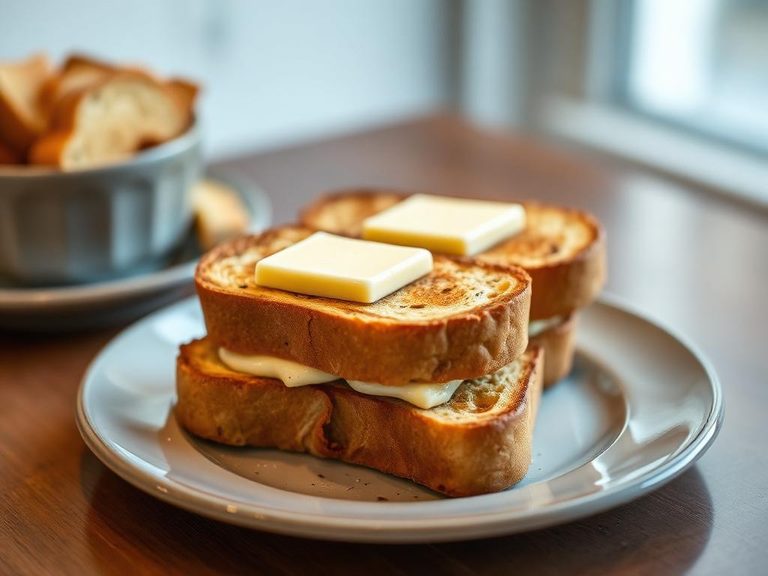
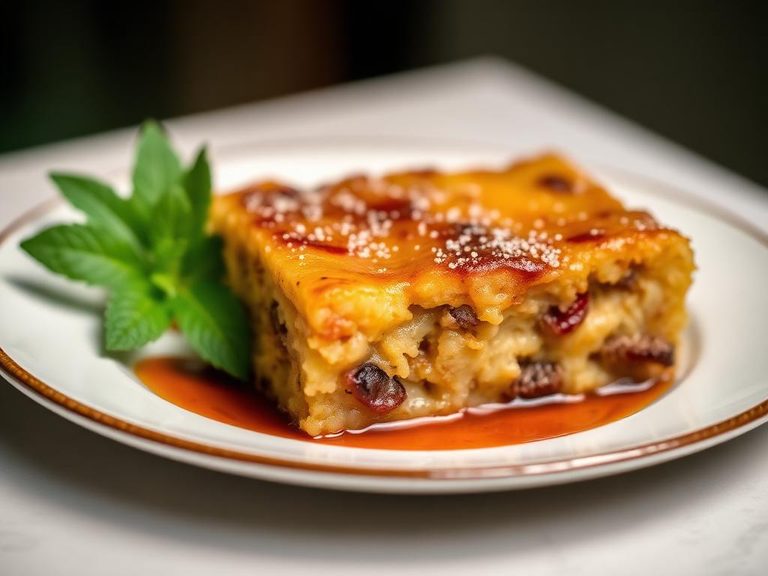
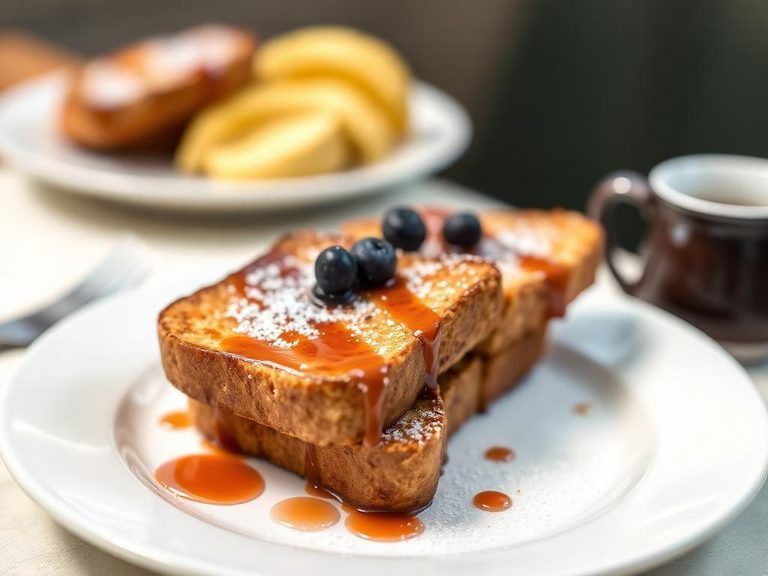
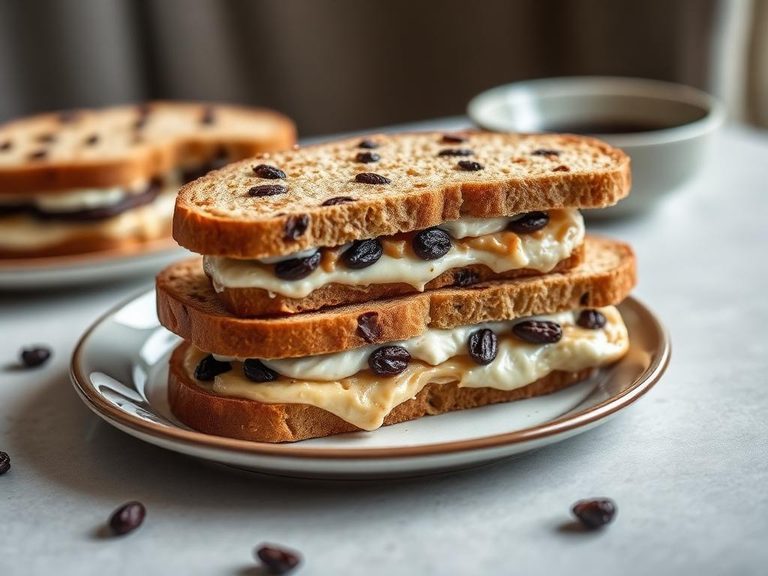

🌍 Where it's eaten
💡 Did you know?
The practice of adding raisins to bread dates back to ancient times, but modern enriched raisin bread with added vitamins became a staple in American diets during the early 20th century as a way to combat nutritional deficiencies.
Full nutrition (USDA data · scales with serving)
| Water | 27.8 g |
| Energy | 297 kcal |
| Energy | 1243 kj |
| Protein | 8.6 g |
| Total lipid (fat) | 4.8 g |
| Ash | 1.9 g |
| Carbohydrate, by difference | 56.9 g |
| Fiber, total dietary | 4.7 g |
| Total Sugars | 6.2 g |
| Calcium, Ca | 72.0 mg |
| Iron, Fe | 3.1 mg |
| Magnesium, Mg | 28.0 mg |
| Phosphorus, P | 118 mg |
| Potassium, K | 246 mg |
| Sodium, Na | 377 mg |
| Zinc, Zn | 0.78 mg |
| Copper, Cu | 0.21 mg |
| Manganese, Mn | 0.55 mg |
| Selenium, Se | 21.7 ug |
| Vitamin C, total ascorbic acid | 0.40 mg |
| Thiamin | 0.29 mg |
| Riboflavin | 0.39 mg |
| Niacin | 3.4 mg |
| Pantothenic acid | 0.27 mg |
| Vitamin B-6 | 0.07 mg |
| Folate, total | 98.0 ug |
| Folic acid | 72.0 ug |
| Folate, food | 26.0 ug |
| Folate, DFE | 148 ug |
| Choline, total | 15.9 mg |
| Vitamin B-12 | 0.00 ug |
| Vitamin B-12, added | 0.00 ug |
| Vitamin A, RAE | 0.00 ug |
| Retinol | 0.00 ug |
| Carotene, beta | 0.00 ug |
| Carotene, alpha | 0.00 ug |
| Cryptoxanthin, beta | 0.00 ug |
| Vitamin A, IU | 0.00 iu |
| Lycopene | 0.00 ug |
| Lutein + zeaxanthin | 46.0 ug |
| Vitamin E (alpha-tocopherol) | 0.31 mg |
| Vitamin E, added | 0.00 mg |
| Vitamin D (D2 + D3), International Units | 0.00 iu |
| Vitamin D (D2 + D3) | 0.00 ug |
| Vitamin K (phylloquinone) | 1.9 ug |
| Alcohol, ethyl | 0.00 g |
| Caffeine | 0.00 mg |
| Theobromine | 0.00 mg |
Fat & fatty acid profile (per 100g)
| Fatty acids, total saturated | 1.2 g |
| SFA 4:0 | 0.00 g |
| SFA 6:0 | 0.00 g |
| SFA 8:0 | 0.00 g |
| SFA 10:0 | 0.00 g |
| SFA 12:0 | 0.00 g |
| SFA 14:0 | 0.02 g |
| SFA 16:0 | 0.64 g |
| SFA 18:0 | 0.52 g |
| Fatty acids, total monounsaturated | 2.5 g |
| MUFA 16:1 | 0.01 g |
| MUFA 18:1 | 2.5 g |
| MUFA 20:1 | 0.00 g |
| MUFA 22:1 | 0.00 g |
| Fatty acids, total polyunsaturated | 0.74 g |
| PUFA 18:2 | 0.70 g |
| PUFA 18:3 | 0.04 g |
| PUFA 18:4 | 0.00 g |
| PUFA 20:4 | 0.00 g |
| PUFA 20:5 n-3 (EPA) | 0.00 g |
| PUFA 22:5 n-3 (DPA) | 0.00 g |
| PUFA 22:6 n-3 (DHA) | 0.00 g |
| Cholesterol | 0.00 mg |
Amino acid profile (per 100g)
| Tryptophan | 0.09 g |
| Threonine | 0.24 g |
| Isoleucine | 0.31 g |
| Leucine | 0.56 g |
| Lysine | 0.22 g |
| Methionine | 0.14 g |
| Cystine | 0.17 g |
| Phenylalanine | 0.39 g |
| Tyrosine | 0.22 g |
| Valine | 0.36 g |
| Arginine | 0.39 g |
| Histidine | 0.18 g |
| Alanine | 0.29 g |
| Aspartic acid | 0.38 g |
| Glutamic acid | 2.6 g |
| Glycine | 0.29 g |
| Proline | 0.90 g |
| Serine | 0.39 g |
FAQ
Is toasted raisin bread healthier than plain bread?
Toasting doesn't significantly change the nutritional profile but can make it more palatable and easier to digest for some. The added raisins increase sugar and calorie content compared to plain bread.
Can I use it for savory dishes?
While primarily sweet, its toasting makes it suitable for savory toppings like avocado or smoked salmon, though the sweetness will contrast with savory flavors.
Why does the bread sometimes burn quickly?
The high sugar content from raisins and added sugars caramelizes and can burn at lower temperatures than plain bread. Use a lower toaster setting or watch it closely.
Nutrient density (calculated · NRF9.3)
Nutrient Rich Foods index: beneficial nutrients (protein, fiber, vitamins, minerals) minus saturated fat, added sugar & sodium, per 100 kcal.
NRF9.3 index — Fulgoni, Keast & Drewnowski, 2009. Computed from USDA nutrients.
Weight-loss friendliness (composite index)
Energy density 2.97 kcal/g · 12% calories from protein · 4.7 g fiber · 6.2 g sugar per 100 g.
Composite of energy density (Rolls et al., 1999), protein & fiber satiety, minus sugar. A calculated heuristic — ranks satiety-per-calorie, not a clinical measure.
Dietary load (calculated from USDA values)
Potential renal acid load. Positive = acid-forming, negative = alkaline-forming.
Sodium-to-potassium ratio: 1.53 (lower is better — aim for ≤ 1)
Sodium:potassium per WHO potassium guidance. Computed from USDA nutrients.