

Beverages, cranberry-apple juice drink, low calorie, with vitamin C added
Whole food · Beverages

Photo: Wikipedia
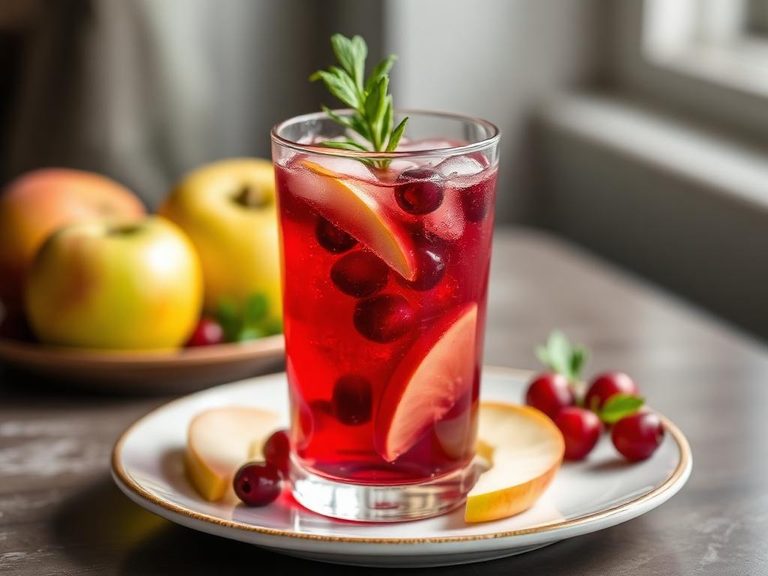
A light, tart-sweet fusion of cranberry and apple juices, this low-calorie drink is a refreshing, ruby-hued beverage with a crisp, fruity finish. It's fortified with Vitamin C, offering a bright, tangy flavor profile without the heaviness of full-sugar juices. At just 19 kcal per 100g, it's a guilt-free way to enjoy a fruity thirst-quencher.
Calorie split: 2% protein · 98% carbs · 0% fat
↓ Full nutrition💚 Why it's loved
People love it for its perfect balance of tart cranberry and sweet apple, offering a more complex and refreshing taste than plain apple juice. It's a versatile mixer for cocktails or a simple, flavorful base for homemade spritzers.
⚠️ Watch-outs & how to enjoy it better
The low calorie count often comes from added sweeteners like sucralose or aspartame, which some people prefer to avoid. Those monitoring blood sugar should note the 4.6g of sugar per 100g, though it's lower than many juices. To mitigate, pair it with a handful of nuts or a cheese stick to add protein and healthy fats, slowing sugar absorption.
Key benefits
- Excellent source of Vitamin C for immune support
- Very low in calories, suitable for weight management
- Provides quick hydration with natural fruit flavors
- Contains minimal sugar compared to standard fruit drinks
- Zero fat and cholesterol-free
🍽️ Popular dishes
🌍 Where it's eaten
💡 Did you know?
Cranberries are one of only a few commercially grown fruits native to North America, and they were historically used by Native Americans for food, dye, and medicine long before the Pilgrims arrived.
Full nutrition (USDA data · scales with serving)
| Water | 95.2 g |
| Energy | 19.0 kcal |
| Energy | 79.0 kj |
| Protein | 0.10 g |
| Total lipid (fat) | 0.00 g |
| Ash | 0.12 g |
| Carbohydrate, by difference | 4.7 g |
| Fiber, total dietary | 0.10 g |
| Total Sugars | 4.6 g |
| Calcium, Ca | 10.0 mg |
| Iron, Fe | 0.06 mg |
| Magnesium, Mg | 3.0 mg |
| Phosphorus, P | 1.0 mg |
| Potassium, K | 45.0 mg |
| Sodium, Na | 5.0 mg |
| Zinc, Zn | 0.02 mg |
| Copper, Cu | 0.01 mg |
| Manganese, Mn | 0.01 mg |
| Selenium, Se | 0.10 ug |
| Fluoride, F | 70.1 ug |
| Vitamin C, total ascorbic acid | 32.0 mg |
| Thiamin | 0.00 mg |
| Riboflavin | 0.01 mg |
| Niacin | 0.03 mg |
| Pantothenic acid | 0.01 mg |
| Vitamin B-6 | 0.02 mg |
| Folate, total | 0.00 ug |
| Folic acid | 0.00 ug |
| Folate, food | 0.00 ug |
| Folate, DFE | 0.00 ug |
| Choline, total | 0.40 mg |
| Vitamin B-12 | 0.00 ug |
| Vitamin B-12, added | 0.00 ug |
| Vitamin A, RAE | 0.00 ug |
| Retinol | 0.00 ug |
| Carotene, beta | 6.0 ug |
| Carotene, alpha | 0.00 ug |
| Cryptoxanthin, beta | 0.00 ug |
| Vitamin A, IU | 10.0 iu |
| Lycopene | 0.00 ug |
| Lutein + zeaxanthin | 19.0 ug |
| Vitamin E (alpha-tocopherol) | 0.27 mg |
| Vitamin E, added | 0.00 mg |
| Vitamin D (D2 + D3), International Units | 0.00 iu |
| Vitamin D (D2 + D3) | 0.00 ug |
| Vitamin K (phylloquinone) | 1.1 ug |
| Alcohol, ethyl | 0.00 g |
| Caffeine | 0.00 mg |
| Theobromine | 0.00 mg |
Fat & fatty acid profile (per 100g)
| Fatty acids, total saturated | 0.00 g |
| SFA 4:0 | 0.00 g |
| SFA 6:0 | 0.00 g |
| SFA 8:0 | 0.00 g |
| SFA 10:0 | 0.00 g |
| SFA 12:0 | 0.00 g |
| SFA 14:0 | 0.00 g |
| SFA 16:0 | 0.00 g |
| SFA 18:0 | 0.00 g |
| Fatty acids, total monounsaturated | 0.00 g |
| MUFA 16:1 | 0.00 g |
| MUFA 18:1 | 0.00 g |
| MUFA 20:1 | 0.00 g |
| MUFA 22:1 | 0.00 g |
| Fatty acids, total polyunsaturated | 0.00 g |
| PUFA 18:2 | 0.00 g |
| PUFA 18:3 | 0.00 g |
| PUFA 18:4 | 0.00 g |
| PUFA 20:4 | 0.00 g |
| PUFA 20:5 n-3 (EPA) | 0.00 g |
| PUFA 22:5 n-3 (DPA) | 0.00 g |
| PUFA 22:6 n-3 (DHA) | 0.00 g |
| Fatty acids, total trans | 0.00 g |
| Cholesterol | 0.00 mg |
Amino acid profile (per 100g)
Estimated from Beverages, carbonated, tonic water — USDA does not publish this profile for Beverages.
| Tryptophan | 0.00 g |
| Threonine | 0.00 g |
| Isoleucine | 0.00 g |
| Leucine | 0.00 g |
| Lysine | 0.00 g |
| Methionine | 0.00 g |
| Cystine | 0.00 g |
| Phenylalanine | 0.00 g |
| Tyrosine | 0.00 g |
| Valine | 0.00 g |
| Arginine | 0.00 g |
| Histidine | 0.00 g |
| Alanine | 0.00 g |
| Aspartic acid | 0.00 g |
| Glutamic acid | 0.00 g |
| Glycine | 0.00 g |
| Proline | 0.00 g |
| Serine | 0.00 g |
FAQ
Is this juice drink the same as 100% cranberry-apple juice?
No. A 'juice drink' typically contains a smaller percentage of actual fruit juice (often 25-50%) blended with water, sweeteners, and added vitamins. 100% juice is made solely from pressed fruit with no added water or sugars.
Why is Vitamin C added if cranberries and apples have some naturally?
Vitamin C (ascorbic acid) is added both as a nutrient boost and as a natural preservative to prevent oxidation, which helps maintain the drink's fresh flavor and bright color over a longer shelf life.
Can I use this as a substitute for cranberry juice in recipes?
You can, but be aware it will be sweeter and less tart than pure cranberry juice. For recipes like sauces or marinades where tartness is key, you may need to add a splash of lemon juice or vinegar to balance the flavor.
Nutrient density (calculated · NRF9.3)
Nutrient Rich Foods index: beneficial nutrients (protein, fiber, vitamins, minerals) minus saturated fat, added sugar & sodium, per 100 kcal.
NRF9.3 index — Fulgoni, Keast & Drewnowski, 2009. Computed from USDA nutrients.
Weight-loss friendliness (composite index)
Energy density 0.19 kcal/g · 2% calories from protein · 0.1 g fiber · 4.6 g sugar per 100 g.
Composite of energy density (Rolls et al., 1999), protein & fiber satiety, minus sugar. A calculated heuristic — ranks satiety-per-calorie, not a clinical measure.
Dietary load (calculated from USDA values)
Potential renal acid load. Positive = acid-forming, negative = alkaline-forming.
Sodium-to-potassium ratio: 0.11 (lower is better — aim for ≤ 1)
Sodium:potassium per WHO potassium guidance. Computed from USDA nutrients.