

Babyfood, dinner, beef noodle, junior
Whole food · Baby Foods

Photo: Wikipedia
This is a smooth, savory baby food purée designed for toddlers, blending tender beef and soft noodles into a mild, spoonable texture. It offers a gentle introduction to meaty flavors with a subtle beef broth base, while its nutrition profile is tailored for little appetites. At just 57 calories per 100g, it provides a balanced mix of protein and carbs for sustained energy without being overly rich.
Calorie split: 18% protein · 52% carbs · 30% fat
↓ Full nutrition💚 Why it's loved
Parents love it for its convenience and balanced nutrition, offering a complete, savory meal in a ready-to-serve format. Toddlers often enjoy the familiar, mild beef and noodle flavors, making mealtime less stressful.
⚠️ Watch-outs & how to enjoy it better
The sodium content, common in prepared baby foods, can be higher than ideal for very young kidneys. To counteract, ensure the rest of the day's meals are low-sodium and offer water alongside. It may also contain common allergens like wheat (from noodles) or soy; introduce these separately beforehand to monitor tolerance.
Key benefits
- Provides iron from beef to support toddler growth
- Offers a balanced mix of protein and carbs for energy
- Mild, familiar flavors help with food acceptance
- Smooth texture is easy for early chewers
- Convenient, complete meal for busy parents
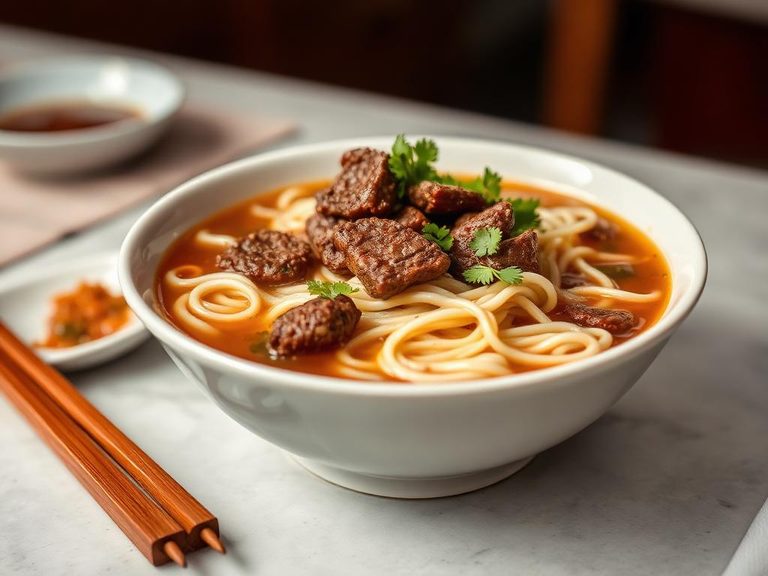
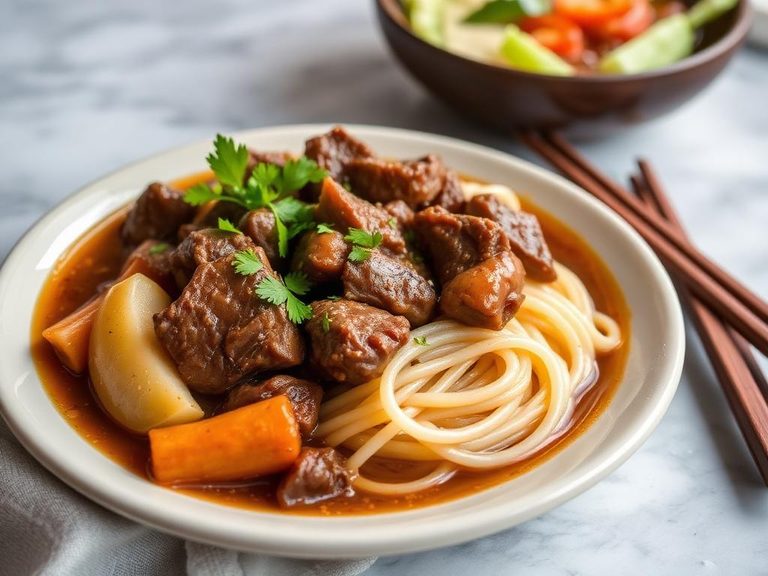
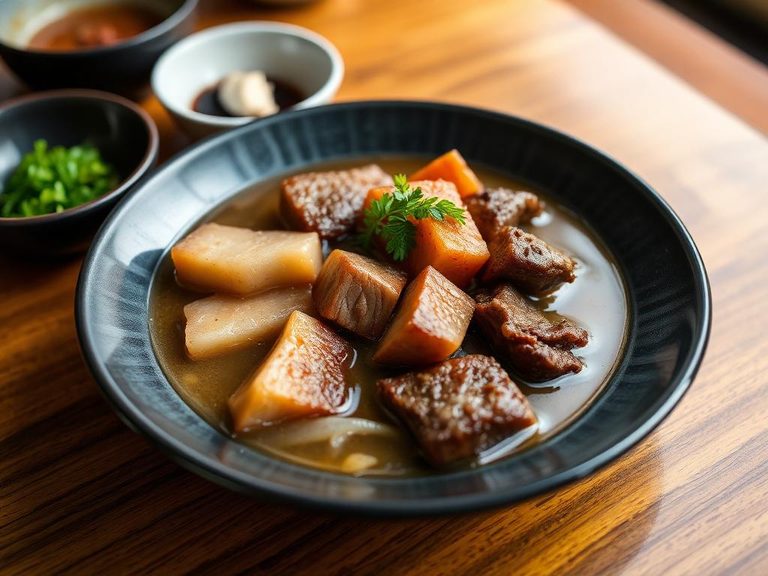
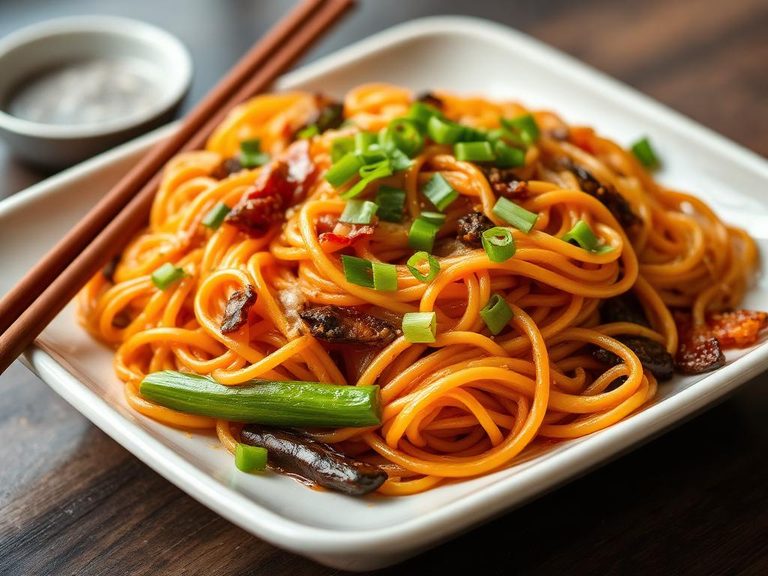
🍽️ Popular dishes
🌍 Where it's eaten
💡 Did you know?
The concept of 'beef noodle' as a comfort food is so universal that it appears in some form across dozens of cuisines, from Taiwanese beef noodle soup to Argentine locro.
Full nutrition (USDA data · scales with serving)
| Water | 87.8 g |
| Energy | 57.0 kcal |
| Energy | 239 kj |
| Protein | 2.5 g |
| Total lipid (fat) | 1.9 g |
| Ash | 0.50 g |
| Carbohydrate, by difference | 7.3 g |
| Fiber, total dietary | 1.1 g |
| Total Sugars | 1.4 g |
| Calcium, Ca | 8.0 mg |
| Iron, Fe | 0.43 mg |
| Magnesium, Mg | 7.0 mg |
| Phosphorus, P | 30.0 mg |
| Potassium, K | 46.0 mg |
| Sodium, Na | 26.0 mg |
| Zinc, Zn | 0.40 mg |
| Copper, Cu | 0.03 mg |
| Selenium, Se | 5.7 ug |
| Vitamin C, total ascorbic acid | 1.4 mg |
| Thiamin | 0.03 mg |
| Riboflavin | 0.04 mg |
| Niacin | 0.58 mg |
| Pantothenic acid | 0.23 mg |
| Vitamin B-6 | 0.03 mg |
| Folate, total | 12.0 ug |
| Folic acid | 7.0 ug |
| Folate, food | 6.0 ug |
| Folate, DFE | 17.0 ug |
| Choline, total | 12.1 mg |
| Vitamin B-12 | 0.10 ug |
| Vitamin B-12, added | 0.00 ug |
| Vitamin A, RAE | 33.0 ug |
| Retinol | 0.00 ug |
| Carotene, beta | 320 ug |
| Carotene, alpha | 146 ug |
| Cryptoxanthin, beta | 0.00 ug |
| Vitamin A, IU | 656 iu |
| Lycopene | 1030 ug |
| Lutein + zeaxanthin | 163 ug |
| Vitamin E (alpha-tocopherol) | 0.47 mg |
| Vitamin E, added | 0.00 mg |
| Vitamin D (D2 + D3), International Units | 1.0 iu |
| Vitamin D (D2 + D3) | 0.00 ug |
| Vitamin D3 (cholecalciferol) | 0.00 ug |
| Vitamin K (phylloquinone) | 4.6 ug |
| Alcohol, ethyl | 0.00 g |
| Caffeine | 0.00 mg |
| Theobromine | 0.00 mg |
Fat & fatty acid profile (per 100g)
| Fatty acids, total saturated | 0.77 g |
| SFA 4:0 | 0.00 g |
| SFA 6:0 | 0.00 g |
| SFA 8:0 | 0.00 g |
| SFA 10:0 | 0.01 g |
| SFA 12:0 | 0.01 g |
| SFA 14:0 | 0.06 g |
| SFA 16:0 | 0.46 g |
| SFA 18:0 | 0.21 g |
| Fatty acids, total monounsaturated | 0.84 g |
| MUFA 16:1 | 0.08 g |
| MUFA 18:1 | 0.72 g |
| MUFA 20:1 | 0.00 g |
| MUFA 22:1 | 0.00 g |
| Fatty acids, total polyunsaturated | 0.09 g |
| PUFA 18:2 | 0.07 g |
| PUFA 18:3 | 0.02 g |
| PUFA 18:4 | 0.00 g |
| PUFA 20:4 | 0.00 g |
| PUFA 20:5 n-3 (EPA) | 0.00 g |
| PUFA 22:5 n-3 (DPA) | 0.00 g |
| PUFA 22:6 n-3 (DHA) | 0.00 g |
| Cholesterol | 8.0 mg |
Amino acid profile (per 100g)
| Tryptophan | 0.03 g |
| Threonine | 0.10 g |
| Isoleucine | 0.14 g |
| Leucine | 0.21 g |
| Lysine | 0.18 g |
| Methionine | 0.05 g |
| Cystine | 0.03 g |
| Phenylalanine | 0.12 g |
| Tyrosine | 0.09 g |
| Valine | 0.13 g |
| Arginine | 0.16 g |
| Histidine | 0.07 g |
| Alanine | 0.15 g |
| Aspartic acid | 0.22 g |
| Glutamic acid | 0.52 g |
| Glycine | 0.15 g |
| Proline | 0.19 g |
| Serine | 0.10 g |
FAQ
Is this suitable for a 6-month-old?
This 'junior' stage product is typically for babies around 8-10 months who are comfortable with thicker textures and have already been introduced to meat and grains. Always consult your pediatrician.
Does it contain added sugar?
The 1.45g of sugar per 100g is likely naturally occurring from ingredients like carrots or tomatoes in the sauce, not added sugar. Check the ingredient list for specifics.
How does the protein content compare to homemade beef purée?
At 2.5g per 100g, it's a moderate amount. Homemade purées can vary widely based on the lean meat-to-liquid ratio, but this product provides a consistent, convenient source.
Nutrient density (calculated · NRF9.3)
Nutrient Rich Foods index: beneficial nutrients (protein, fiber, vitamins, minerals) minus saturated fat, added sugar & sodium, per 100 kcal.
NRF9.3 index — Fulgoni, Keast & Drewnowski, 2009. Computed from USDA nutrients.
Weight-loss friendliness (composite index)
Energy density 0.57 kcal/g · 18% calories from protein · 1.1 g fiber · 1.4 g sugar per 100 g.
Composite of energy density (Rolls et al., 1999), protein & fiber satiety, minus sugar. A calculated heuristic — ranks satiety-per-calorie, not a clinical measure.
Dietary load (calculated from USDA values)
Potential renal acid load. Positive = acid-forming, negative = alkaline-forming.
Sodium-to-potassium ratio: 0.57 (lower is better — aim for ≤ 1)
Sodium:potassium per WHO potassium guidance. Computed from USDA nutrients.