Turkey, fryer-roasters, meat and skin, cooked, roasted
Whole food · Poultry Products

Photo: Wikipedia
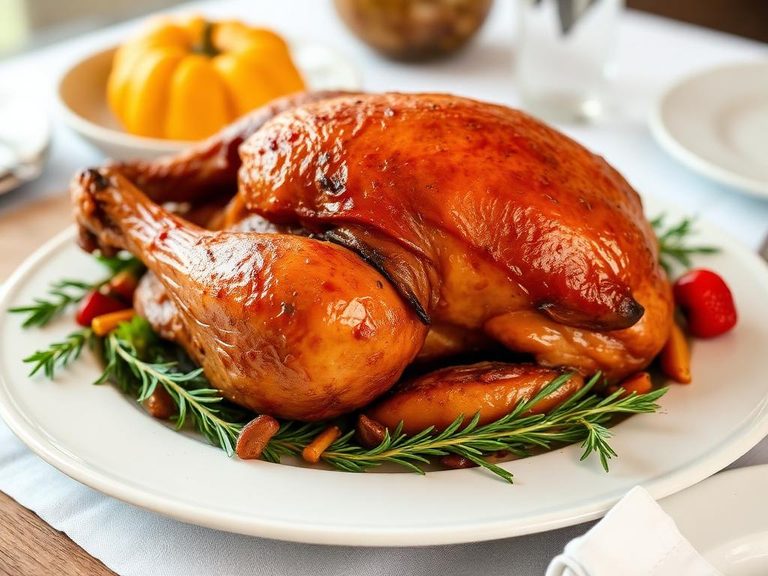
Fryer-roaster turkey is a young, tender bird, typically weighing 3-5 pounds, prized for its juicy, mild-flavored white meat and crisp, golden skin when roasted. This lean powerhouse delivers an exceptional amount of complete protein per calorie, making it a staple for muscle-building and weight management diets.
💚 Why it's loved
People adore its clean, savory flavor that acts as a perfect canvas for herbs, spices, and marinades. Its versatility shines from a simple weeknight roast to the centerpiece of holiday feasts, symbolizing comfort and celebration in many cultures.
⚠️ Watch-outs & how to enjoy it better
The lean meat can dry out easily if overcooked, leading to a tough, chewy texture. To counteract this, use a meat thermometer to pull it at 165°F (74°C) in the thickest part, and let it rest for 10-15 minutes before carving to retain juices. The skin, while flavorful, is high in saturated fat; those monitoring intake can opt for skinless portions.
Key benefits
- Excellent source of complete, high-quality protein
- Very low in carbohydrates and naturally sugar-free
- Rich in essential minerals like selenium and phosphorus
- Provides B vitamins, especially niacin (B3) and B6
- Low in fat compared to many other roasted meats
🍽️ Popular dishes

🌍 Where it's eaten
💡 Did you know?
The domestic turkey is the only domesticated bird native to the Americas, and Benjamin Franklin famously advocated for it as the national symbol of the United States over the bald eagle.
Full nutrition (scales with serving)
| Water | 65.8 g |
| Energy | 172 kcal |
| Energy | 720 kj |
| Protein | 28.3 g |
| Total lipid (fat) | 5.7 g |
| Ash | 0.99 g |
| Carbohydrate, by difference | 0.00 g |
| Fiber, total dietary | 0.00 g |
| Total Sugars | 0.00 g |
| Calcium, Ca | 22.0 mg |
| Iron, Fe | 1.9 mg |
| Magnesium, Mg | 25.0 mg |
| Phosphorus, P | 198 mg |
| Potassium, K | 250 mg |
| Sodium, Na | 66.0 mg |
| Zinc, Zn | 2.9 mg |
| Copper, Cu | 0.15 mg |
| Manganese, Mn | 0.02 mg |
| Selenium, Se | 33.8 ug |
| Fluoride, F | 20.9 ug |
| Vitamin C, total ascorbic acid | 0.00 mg |
| Thiamin | 0.04 mg |
| Riboflavin | 0.18 mg |
| Niacin | 4.9 mg |
| Pantothenic acid | 0.90 mg |
| Vitamin B-6 | 0.42 mg |
| Folate, total | 7.0 ug |
| Folic acid | 0.00 ug |
| Folate, food | 7.0 ug |
| Folate, DFE | 7.0 ug |
| Choline, total | 69.7 mg |
| Betaine | 5.9 mg |
| Vitamin B-12 | 0.37 ug |
| Vitamin B-12, added | 0.00 ug |
| Vitamin A, RAE | 0.00 ug |
| Retinol | 0.00 ug |
| Carotene, beta | 0.00 ug |
| Carotene, alpha | 0.00 ug |
| Cryptoxanthin, beta | 0.00 ug |
| Vitamin A, IU | 0.00 iu |
| Lycopene | 0.00 ug |
| Lutein + zeaxanthin | 0.00 ug |
| Vitamin E (alpha-tocopherol) | 0.35 mg |
| Vitamin E, added | 0.00 mg |
| Vitamin D (D2 + D3), International Units | 1.0 iu |
| Vitamin D (D2 + D3) | 0.00 ug |
| Vitamin D3 (cholecalciferol) | 0.00 ug |
| Vitamin K (phylloquinone) | 0.80 ug |
| Vitamin K (Dihydrophylloquinone) | 0.00 ug |
| Alcohol, ethyl | 0.00 g |
| Caffeine | 0.00 mg |
| Theobromine | 0.00 mg |
Fat & fatty acid profile (per 100g)
| Fatty acids, total saturated | 1.6 g |
| SFA 4:0 | 0.00 g |
| SFA 6:0 | 0.00 g |
| SFA 8:0 | 0.00 g |
| SFA 10:0 | 0.00 g |
| SFA 12:0 | 0.01 g |
| SFA 14:0 | 0.04 g |
| SFA 16:0 | 1.0 g |
| SFA 18:0 | 0.40 g |
| Fatty acids, total monounsaturated | 2.0 g |
| MUFA 16:1 | 0.33 g |
| MUFA 18:1 | 1.6 g |
| MUFA 20:1 | 0.01 g |
| MUFA 22:1 | 0.01 g |
| Fatty acids, total polyunsaturated | 1.4 g |
| PUFA 18:2 | 1.2 g |
| PUFA 18:3 | 0.07 g |
| PUFA 18:4 | 0.00 g |
| PUFA 20:4 | 0.10 g |
| PUFA 20:5 n-3 (EPA) | 0.00 g |
| PUFA 22:5 n-3 (DPA) | 0.01 g |
| PUFA 22:6 n-3 (DHA) | 0.02 g |
| Cholesterol | 105 mg |
Amino acid profile (per 100g)
| Tryptophan | 0.31 g |
| Threonine | 1.2 g |
| Isoleucine | 1.4 g |
| Leucine | 2.2 g |
| Lysine | 2.6 g |
| Methionine | 0.79 g |
| Cystine | 0.31 g |
| Phenylalanine | 1.1 g |
| Tyrosine | 1.1 g |
| Valine | 1.5 g |
| Arginine | 2.0 g |
| Histidine | 0.84 g |
| Alanine | 1.8 g |
| Aspartic acid | 2.7 g |
| Glutamic acid | 4.5 g |
| Glycine | 1.7 g |
| Proline | 1.3 g |
| Serine | 1.2 g |
FAQ
What's the difference between a fryer-roaster and a roaster turkey?
A fryer-roaster is a young, smaller bird (typically under 16 weeks old) with tender, milder meat. A roaster is older and larger, with firmer, more developed flavor but can be tougher if not cooked properly.
How do I keep turkey meat from drying out?
Brining (soaking in a salt-water solution) before cooking helps immensely. Also, roast at a moderate temperature (325-350°F / 165-175°C), use a meat thermometer, and always let the cooked turkey rest before carving to allow juices to redistribute.
Is turkey skin healthy to eat?
Turkey skin is high in saturated fat and calories. While it adds flavor and crispness, it's best enjoyed in moderation. Removing the skin before eating significantly reduces the fat content of the meal.